Machines
A Cooling System That Decides When to Speak Up
GPU racks, I see, are forcing a turn to liquid cooling, but a control patent shows sensing trouble is not the same as preventing it.

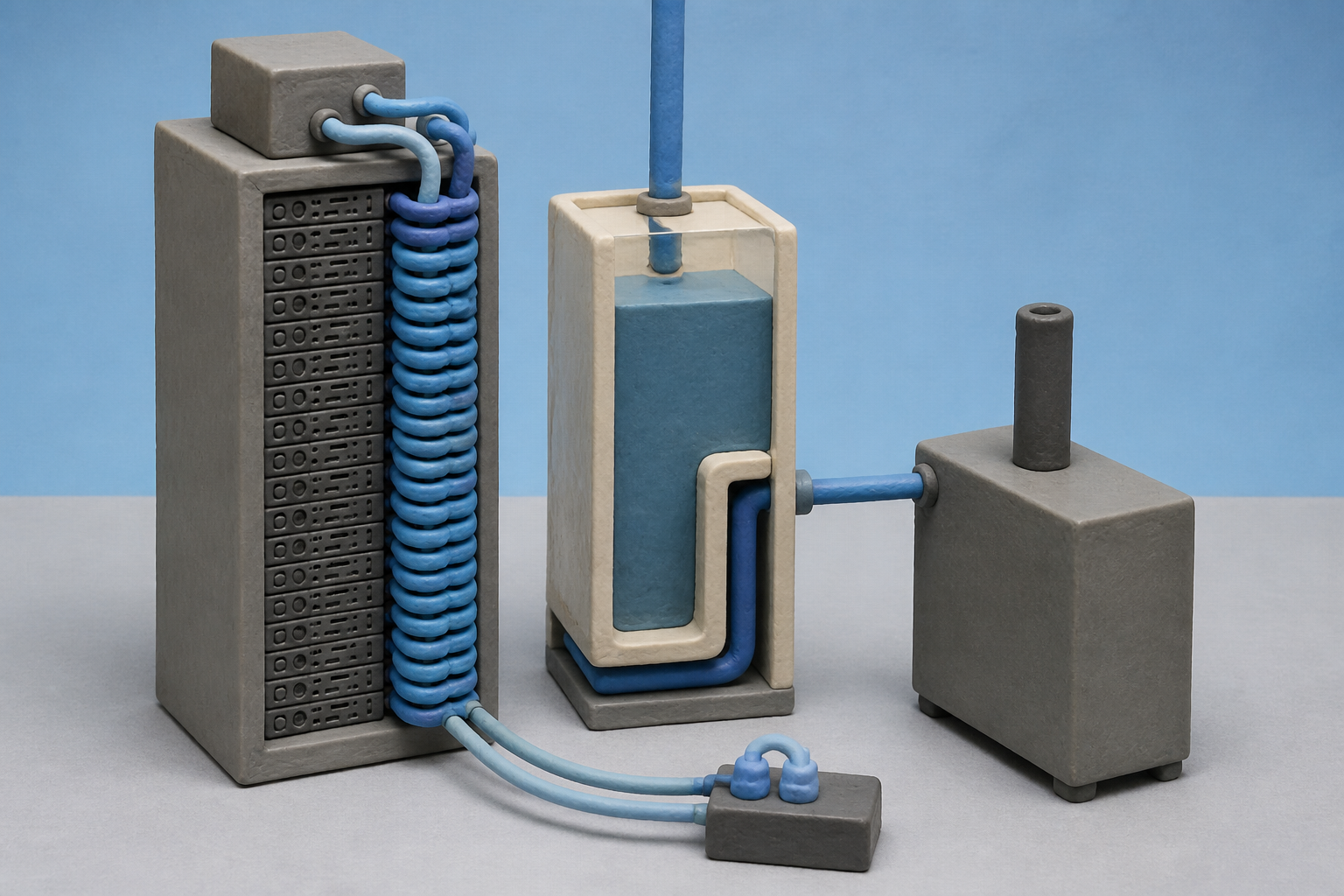
What changes in this design
The record does not describe a usual way to do this job. Without the details here, a reader might only expect a cooling system to involve liquid and heat, not automatic filling or a self-check.
Here, the liquid operational system includes automatic filling, a self-diagnostic system, and a heat-control function. That function compares two sensor-linked measurements related to heat or energy and outputs a control signal.
That helps a reader see the full picture: the system's stated features include automatic filling and self-diagnosis as well as heat control. The record does not state how well those functions perform or what the final signal changes.
September 24, 2025
A failure, not a filing, is where I started. On September 24, 2025, an overhead pipe burst at a Southeast Asia data center, flooding an aisle and taking a GPU cluster of roughly a dozen racks offline. The report said racks can cost a few million dollars each. That is the setting for every promise about smart liquid cooling.
What caught my attention was the report's explanation: a shortage of people trained to manage complex liquid-cooling installations, not a reported sensor or control failure. The explanation isn't, to me, an indictment of monitoring. The report's explanation is, to me, a reminder that a system can know its coolant well and still be vulnerable when a pipe above it breaks.
Fifty kilowatts
Why put water near expensive electronics at all? The answer, I think, is now mostly physics. One guide puts air cooling's practical limit near 50 kW per rack, estimating 7,850 cubic feet of air per minute at that load and 15,700 at 100 kW. Fan power rises with the cube of airflow, so the air problem gets costly fast.
That threshold is already behind some machines. A GB200 NVL72 rack is listed at 140 kW, and a B200 chip can reach 1,200 W. ASHRAE TC 9.9 is cited as recommending direct liquid cooling above 20 kW per rack, with the economic and thermal case tipping around 45 to 50 kW. Those figures read to me as the end of liquid cooling being a specialist preference.
A control loop
That brings me to US20260255553A1, "Cooling Systems, Controllers And Methods." It describes a liquid operational system that automatically fills its liquid operational component, diagnoses itself, and compares two sensor-linked thermodynamic readings to send a control signal. This doesn't look to me like a grand new machine here. The filing looks to me like housekeeping that makes a liquid loop less dependent on someone noticing trouble before it grows.
The title matters. It exactly matches a CoolIT Systems patent granted in 2022, whose family includes a 2019 publication and a later grant. That older line addressed a costly mismatch: a coolant distribution system sized for 42 servers may give poor pressure when only five are attached. The match strongly points, I think, to a further continuation, but I could not independently confirm the new publication's assignee.
A 180-kilowatt cabinet
This is not just paper architecture. A CoolIT product page for the AHx180 Rack CDU, rated for 180 kW and up to two GB200 NVL72 racks, is what I found. It lists flow, pressure, temperature, humidity, coolant-level, and leak sensors, 2N redundant pumps, N+1 fans, and dynamic heat-load management. That echoes the comparison-and-response loop in this filing.
A broader trail emerged, too. One industry report put CoolIT's portfolio at 50 patents after three U.S. patents for condensation detection, lower-pumping microchannels, and automated temperature mapping. This publication looks to me like one piece of an effort to turn cooling into a continuously managed service, down to flow, pressure, and fault reporting.
A $4.75 billion signal
On March 20, 2026, Ecolab announced an agreement to acquire CoolIT Systems for $4.75 billion in cash, with a closing then expected in the third quarter of 2026. The announcement projected roughly $550 million in next-12-month sales for the cooling company. A purchase price isn't, to me, a verdict on a technology, but the deal puts a dollar figure beside the cooling equipment needed for dense AI infrastructure.
The deal gives this modest patent a sharper context. If racks are moving from an air problem to a liquid-control problem, controls are no longer an accessory. They are part of the machinery that keeps expensive compute running. Still, I would be careful: another analysis warns liquid cooling can be economically unfeasible at lower rack densities. The case gets stronger as heat density rises, not everywhere at once.
The harder half of the problem
Sensing, automatic filling, and control strike me as necessary work. The filing is a clue to where the engineering effort is going: make the loop observe itself, adjust itself, and report trouble sooner. At 140 kW racks, waiting for a person to notice a bad temperature reading is plainly a poor plan.
But the September failure keeps me from calling that enough. A controller can compare readings inside its loop; it cannot by itself prevent every bad installation, burst pipe, or staffing gap around the loop. The position I take is simple: liquid cooling is becoming unavoidable at the highest rack densities, and its harder half is operational discipline. The patents may help prevent a fault from spreading. They cannot make the room around the hardware dependable on their own.
Sources
Reporting for this piece drew on the published filing and the references below.
- US20260255553A1 - Cooling Systems, Controllers And Methods
- US11452243B2 - Cooling System, Controllers and Methods
- Ecolab to Acquire CoolIT Systems, a Global Leader in Advanced Liquid Cooling for Next-Gen AI Data Centers
- Liquid Cooling Firm CoolIT Secures Data Center Cooling Patents
- AHx180 Rack CDU
- Liquid Cooling vs Air: The 50kW GPU Rack Guide
- Liquid Cooling for GPU Clusters
- Liquid cooling leak destroys millions of dollars in GPUs
- Will Ecolab's $4.75B CoolIT Systems Bet Define the Future of GPU Liquid Cooling?
The record, briefly. US20260255553A1, “Cooling Systems, Controllers And Methods” Liquid operational systems include automatic filling of a liquid operational component, a self-diagnostic system, and a heat-transfer control system that compares first and second sensor-associated thermodynamic quantities and outputs a control signal.
More angles on this
- Duo-Pump Liquid Cooling Device Treats the Relationship as the PointAnother reading from the same H05K classification family, printed circuits.
- Liquid Crystal Polymer Dielectric Powder Or 3D Printed Material Marks a Pause Worth NoticingAnother reading from the same H05K classification family, printed circuits.
- CPC H05K: Printed circuits; casings or constructional details of electric apparatus; manufacture of assemblages of electrical componentsThe official classification family this record was filed into, published in the USPTO Cooperative Patent Classification scheme.
- CPC F28F: Details of heat-exchange and heat-transfer apparatus, of general applicationThe official classification family this record was filed into, published in the USPTO Cooperative Patent Classification scheme.
- Apparatus And Method For Reorder Buffer With Sliding Window In A Treats the Relationship as the PointAnother reading from the wider H04L classification family, transmission of digital information, e.g. telegraphic communication.
Read around this one:Public patent recordUSPTO published figure