Field Notes
A Fibre’s Quiet Alignment Along a Buried Submarine Cable
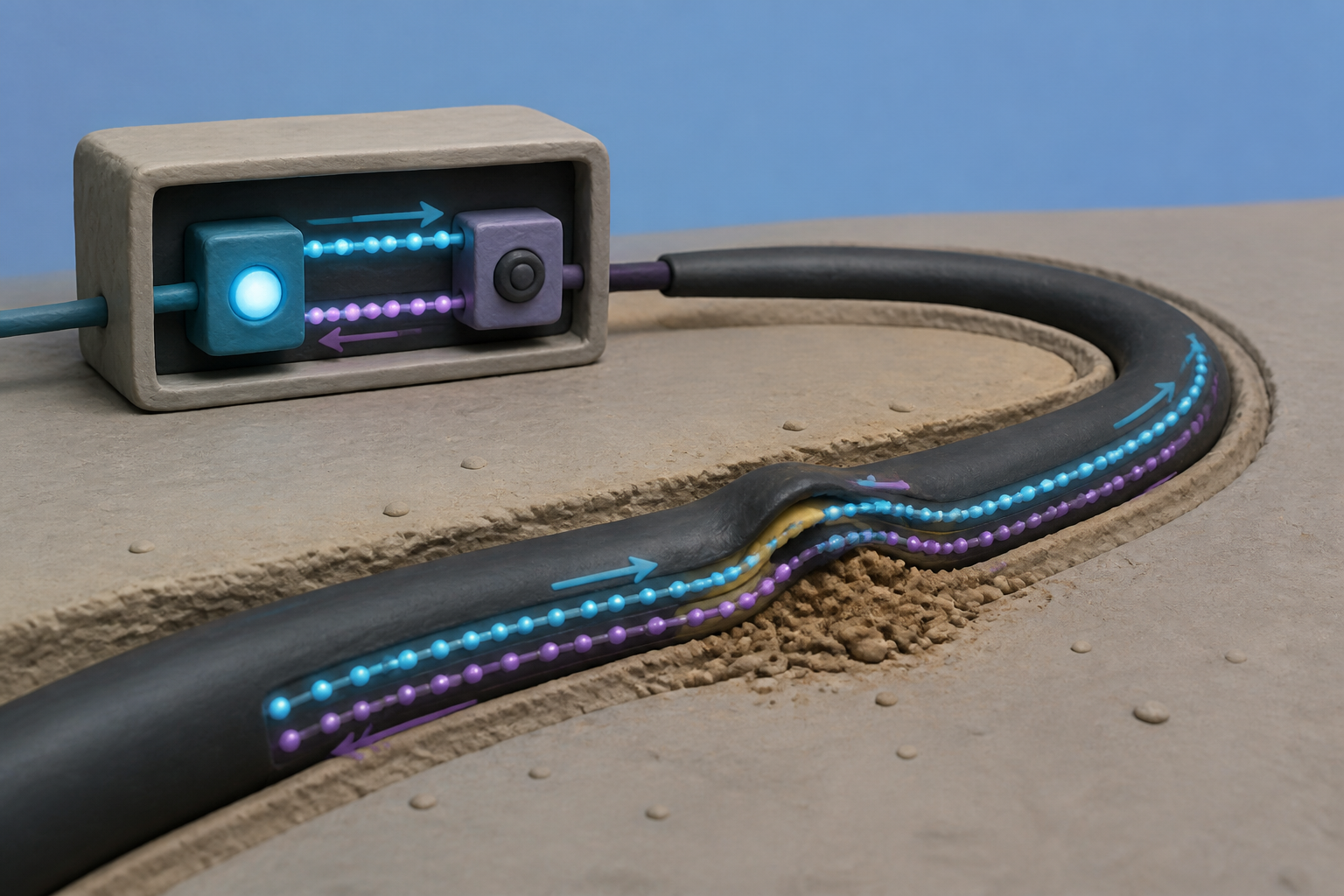
Interrogating Signals and Backscattered Response Signals: A method and system transmit interrogating signals into a sensing optical fibre in a buried submarine cable.

First, the setting
Much of the world’s phone and internet traffic travels through cables lying on the seabed. Near shore, shifting sand, strong currents, anchors, and fishing gear can leave sections less protected. Keeping track of those routes matters because people rely on steady connections for work, conversations, services, and contact with family.
A technician in a shore-side operations room watches a route displayed beside equipment connected to a cable landing station. Offshore, a vessel may pass over the cable’s route while waves shift the seabed. If crews are sent to inspect an area, nearby boat operators and coastal workers may see temporary activity around it.
What changes in this design
A buried cable is out of sight, so a reader might assume that locating a place where it is uncovered would require checking along the cable’s route.
Instead, the system sends test messages into a sensing optical fibre within the buried cable, receives returning messages, and processes changes in the fibre’s strain to identify and locate an exposure point.
The idea is not just to notice a change. It is to use strain variation to place the exposed point along the cable’s length.
Fibre Within the Buried Cable
A sensing optical fibre runs inside a buried submarine cable, and the condition that directs attention is an exposure point to be identified and located along the cable. That relationship is the physical detail that made me look twice: the fibre is not merely present inside the cable; it is the path through which the system asks for information. The published record is US20260261337A1, titled Monitoring Submarine Cable Exposure, published September 3, 2026. It describes interrogating signals, meaning signals transmitted into the sensing optical fibre to prompt a response. You can picture the starting arrangement before relying on specialist language: a cable lies buried, a fibre sits within it, and a signal enters because where something is along that cable will matter. The condition, then, is not detached from the picture; it is tied to that narrow route inside the cable.
That route matters because the next action turns the fibre from a physical detail into a returning path. The filing describes backscattered response signals, meaning response signals that come back after interrogating signals are transmitted into the sensing optical fibre. It also describes processing strain variation, meaning a change in how the fibre is strained, to identify an exposure point and its location along the cable. The sequence is direct: signals enter, responses return, and the system processes the strain variation for point identification and location. Within what the filing describes, that is narrower than treating a buried cable as one long, undifferentiated object; the response is connected to a point and to where that point lies. The buried cable and the sensing optical fibre are less like strangers sharing a trench and more like coworkers comparing notes.
Returned Signals Meet Strain
Because that place is the consequence, the mechanism reads as a quiet alignment rather than a dramatic event. An incoming signal, a returned response, and a position along the cable become meaningful in relation to one another. The returning signal has the air of a librarian marking the place where the cable's condition changes. One relationship becomes visible: a condition is held beside a place, instead of being left as a general concern about the cable. The location along the cable appears less like a dramatic reveal and more like a label-maker doing patient work. This is why the reference to a location along the cable matters in the reading. It connects the signal path to a named outcome without asking you to supply a larger story. I think that restraint is worth your attention: the filing is interesting here as a system of correspondence, not as a story of a cable suddenly announcing its whole life.
Exposure Points and Place
That correspondence opens an everyday design question beyond the cable: when a system must notice a condition, how can its evidence stay aligned with the place that matters? A note is useful when it stays with the right page, not when it turns up later as a scrap with no address. The first transferable observation is concrete. Keep the sensing element geographically tied to the thing being considered; here, the sensing optical fibre is in the buried submarine cable, and the outcome described is a location along that cable. The second is equally practical. Let the return carry forward the same relationship established by the outgoing signal, so a response can be considered in relation to a position rather than as a floating notification. Those are observations drawn from the arrangement, not claims that every system ought to work this way.
With those observations in view, the quiet work of alignment looks less abstract. The filing joins two named outcomes—an exposure point and its location—and it does so through interrogating signals sent into the sensing optical fibre, backscattered response signals received from it, and processed strain variation. That pairing widened the lens for me, because it makes location part of the task rather than a decorative afterthought. An ordinary alert can tell you that something deserves attention; the published system is described as processing strain variation to identify an exposure point and locate it along the cable. The difference is not a contest between grander and smaller systems. It is one relationship becoming visible: condition held beside place. Once that relationship is visible, the wording stops feeling technical for technical's sake and starts feeling like a careful arrangement of responsibilities.
From there, the fit becomes memorable precisely because it stays bounded. You do not have to imagine more than the published arrangement provides: a buried submarine cable, a sensing optical fibre, interrogating signals, backscattered response signals, strain variation, an exposure point, and a location along the cable. That restraint matters to the editorial interpretation; it keeps a clear sequence from becoming a bundle of promises the public description does not make. What I take from it is a modest reminder that systems become clearer when the path of inquiry and the place of consequence remain connected. This filing offers that reminder in one narrow, tangible arrangement. That is why I return to the opening picture, not to a flourish: a sensing optical fibre running inside a buried submarine cable, with signals sent in and responses returned, while strain variation is processed to identify an exposure point and its location along the cable.
The record, briefly. US20260261337A1, “Monitoring Submarine Cable Exposure” A method and system transmit interrogating signals into a sensing optical fibre in a buried submarine cable, receive backscattered response signals, and process strain variation to identify an exposure point and its location along the cable.
More angles on this
- Portable And Low-Cost Microscopic Imaging Device Makes a Small Case for Better TimingAnother reading from the same G02B classification family, optical elements, systems or apparatus.
- Optical Waveguide Component And Augmented Reality Display Device Makes a Small Case for Better TimingAnother reading from the same G02B classification family, optical elements, systems or apparatus.
- CPC H04B: TransmissionThe official classification family this record was filed into, published in the USPTO Cooperative Patent Classification scheme.
- CPC G01L: Measuring force, stress, torque, work, mechanical power, mechanical efficiency, or fluid pressureThe official classification family this record was filed into, published in the USPTO Cooperative Patent Classification scheme.
- A Port, Two Gloves, and the Quiet Work of AlignmentAnother reading from the neighbouring G01N classification family, investigating or analysing materials by determining their chemical or physical properties.
Read around this one:Public patent recordUSPTO published figure