Objects
Optical Waveguide Component And Augmented Reality Display Device Makes a Small Case for Better Timing
Meta's sold-out Display glasses use a different kind of waveguide from Goertek's U.S. filing, exposing an optical choice still unsettled.

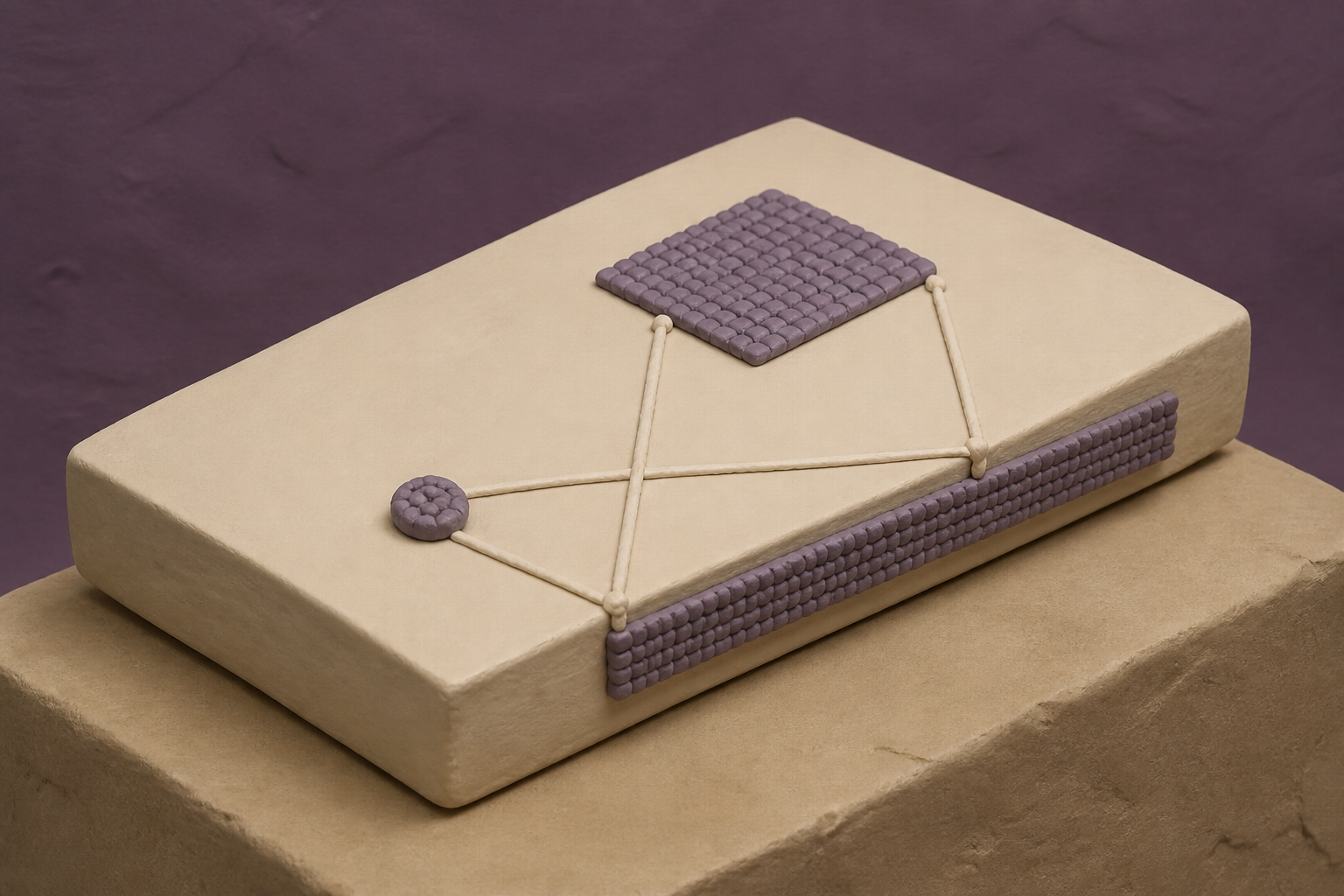
What changes in this design
Without further detail, a reader might imagine a display sends light straight from its image-making parts toward the viewer.
This record describes light entering a waveguide substrate through one grating, changing direction at another, and leaving through a third. The latter two grating stages provide first and second pupil expansion.
It gives a concrete picture of the optical path inside the component: light is brought in, turned, then sent out after two expansion stages. What it measures or how it performs is not stated.
Two days after launch
On October 1, 2025, Meta began selling its $800 Ray-Ban Display glasses. Within two days, almost every store carrying them had sold out and demonstration appointments were booked through November, according to Meta's chief technology officer. That is an unusually physical constraint for a category that often sounds like software: a small transparent optical part had become one of the things keeping a wanted product from reaching more faces.
The Display uses a geometric, reflective waveguide rather than a diffractive grating. A teardown identifies Lumus as its waveguide maker and describes a stack of partially reflective mirrors, with each layer reflecting about 5 percent of the light. It was selected, the teardown reports, to avoid the eye glow and rainbow artifacts associated with diffractive grating systems. That engineering fork, not the sales rush alone, sent me to a Goertek patent published this year.
Three gratings in a lens
US20260259411A1, Optical Waveguide Component And Augmented Reality Display Device, sets out a diffractive waveguide with a coupling-in grating, a turning grating, and a coupling-out grating. The arrangement is specific: the turning and coupling-out portions provide first and second pupil expansion. Grating periods of 200 to 600 nanometres are intended to save waveguide design space and improve see-through transmittance. It is an effort to give a compact optical layout two dedicated stages of pupil expansion.
Nothing in the publication I could verify shows a finished display, production yield, field of view, or measured reduction in color artifacts. The patent describes a design and its intended benefits, not a product test. That boundary matters because it is easy to mistake a clever optical arrangement for settled evidence that it is the arrangement people will prefer.
The rainbow tradeoff
Diffractive waveguides have a long commercial history in headsets and smartglasses, but their basic wavelength-dependent behavior can produce color distortion and rainbow effects. Geometric waveguides reflect light in a different way, with much less wavelength dependence. The contrast is not academic when a wearer is looking through the display at the world. It is the part of this technical choice I think deserves the most attention.
Goertek's own CES 2026 lineup made the unresolved choice visible: a full-color etched diffractive waveguide appeared beside a separate rainbow-free polymer optical module specified at 4 grams and more than 92 percent transmittance. The company is presenting multiple optical families, not a single declared winner. That is why I do not read this application as a verdict on which approach will prevail. It is evidence that compact diffractive designs are still being improved while a prominent consumer product has chosen another route.
Capacity hides in the frame
Goertek also occupies an awkwardly important place in this story. Reports describe only Goertek and one other Chinese supplier as able to mass-produce AR waveguides at scales of 10 to 20 million units a year. For Meta's Display, Goertek supplies the optical-engine assembly while Lumus supplies the waveguide itself. That distinction is essential to my reading: being central to the product's optical assembly does not mean controlling the glass component whose supply is limiting it.
A trade report says orders for Lumus geometric waveguides rose from roughly 80,000 to 150,000 units within six months of launch, with a target of 500,000 cumulative units over two years. Those are not figures that make a patent into a product plan. Our interest in individual filings can obscure the harder industrial fact: optical designs must be made repeatedly, at quality, in quantities that a fast-moving product launch can absorb.
The harder half of the problem
The chronology gives this filing a useful restraint. Goertek claimed Chinese priority on May 24, 2022, then filed internationally on June 28 that year. Its appearance as a U.S. publication arrives amid a much newer consumer rush. Separate analysis of the company's patent activity finds its U.S. filings were concentrated from 2016 through 2022, while priority has shifted toward China in 2025 and 2026. This is older optical work becoming visible in a new market moment.
No waveguide family now wins simultaneously on cost, field of view, and color fidelity. Diffractive designs still promise compactness and have their own manufacturing path. Geometric designs can avoid the grating artifacts that trouble them, yet their supply has become a visible constraint, and wider-field approaches can require materials too costly for consumer-scale production. That is why I think Goertek's patent earns attention, but not as a forecast of the next pair of glasses. It shows that the problem remains split between what the eye wants and what a factory can deliver.
Sources
Reporting for this piece drew on the published filing and the references below.
- US20260259411 - Optical Waveguide Component And Augmented Reality Display Device
- Goertek Patent: Optical Waveguide Component and AR Display Device
- There's Groundbreaking Waveguide Tech Inside Meta's $800 AR Glasses
- Meta Ray-Ban Display Sells Out As Early Adopters Struggle To Buy
- Goertek Unveils Next-Generation Technologies at CES 2026
- Why Meta's AR/VR Dreams Need China's Goertek
- Meta's Ray-Ban Display Glasses Turn Near-Eye From Experiment to Supply-Constrained Business
- Inside the patents behind Goertek's next-generation AR glasses
- Waveguides explained: How the display in smart glasses and AR glasses works
The record, briefly. US20260259411A1, “Optical Waveguide Component And Augmented Reality Display Device” An optical waveguide component and augmented reality display device comprise a waveguide substrate and at least one grating group having a coupling-in grating, turning grating, and coupling-out grating, with the turning grating and coupling-out grating providing first and second pupil expansion.
More angles on this
- Method For Tunable Chromatic Aberration Projection Makes the Next Move Easier to SeeAnother reading from the same G02B classification family, optical elements, systems or apparatus.
- Inside waveguide photodetectorsAnother reading from the same G02B classification family, optical elements, systems or apparatus.
- CPC G02B: Optical elements, systems or apparatusThe official classification family this record was filed into, published in the USPTO Cooperative Patent Classification scheme.
- Inside multi-tiered semiconductor waveguideAnother reading from the neighbouring G02F classification family, optical devices or arrangements for the control of light by modification of the optical properties of the media of the.
- Inside road safety system including multiple roadAnother reading from the wider G01W classification family, meteorology.
Read around this one:Public patent recordUSPTO published figure