Field Notes
Inside road safety system including multiple road
A patent proposes embedding weather sensors and alert lights directly into road markers, but asphalt is a brutal place to run a computer network.

What changes in this design
Drivers usually rely on regional weather forecasts, roadside digital signs, or their own immediate observations to notice fog and freezing pavement.
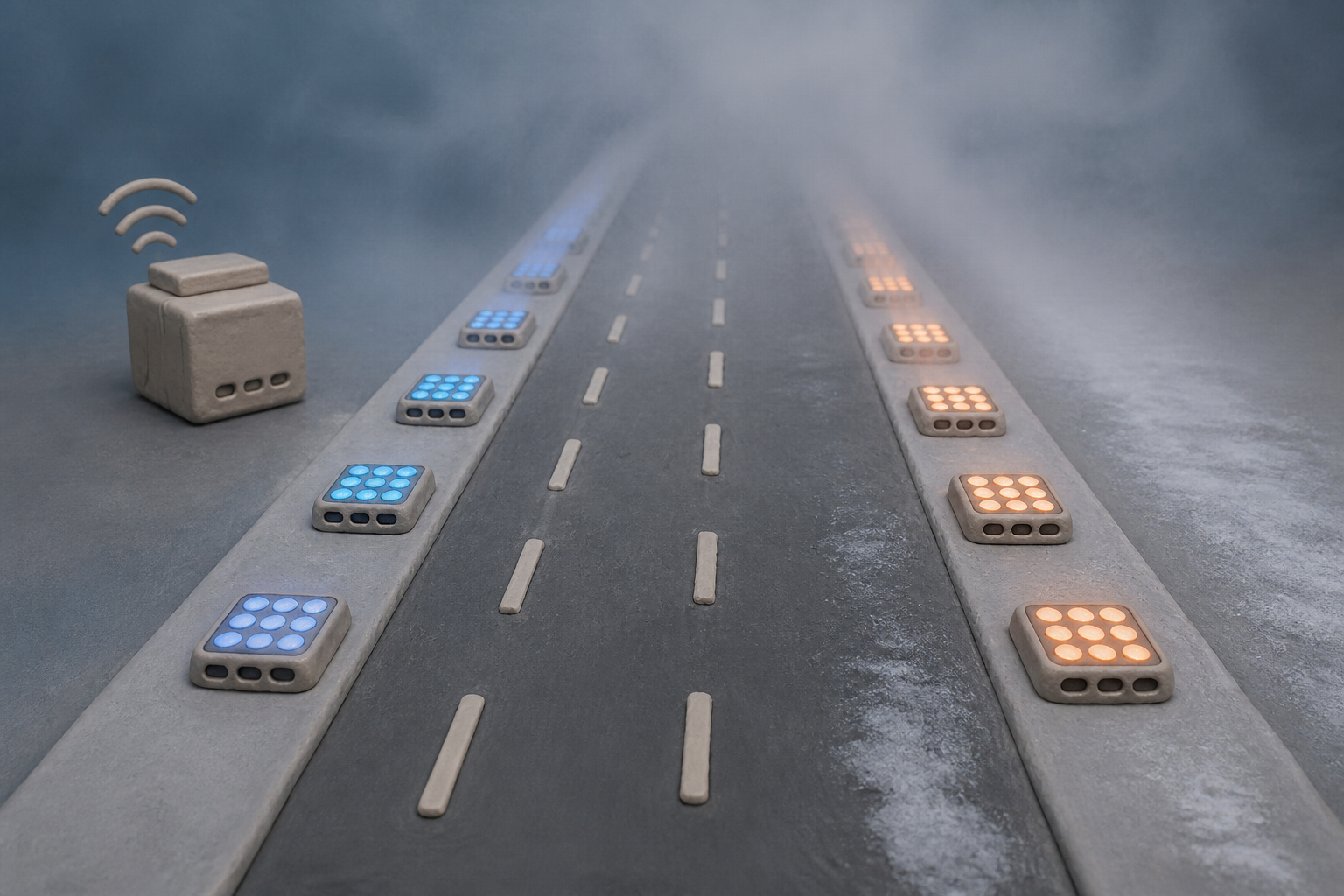
Street-level markers directly gather local temperature and moisture readings, relay them to a server, and switch on dedicated fog or icing warning lights right where cars travel.
Local road conditions can change rapidly over short distances, so having pavement markers that detect microclimate shifts and display instant visual warnings gives motorists immediate on-site cues.
The deadly math of freezing roads
Every winter, bad weather turns familiar stretches of highway into ice rinks. In the United States, an average of 744,911 weather-related vehicle crashes happen every year, making up twelve percent of all police-reported collisions. Freezing rain, sleet, and ice account for nearly 220,000 of those wrecks and claim 407 lives annually, while fog and blowing snow cause another 488 deaths. Across the Pacific, South Korea recorded 3,944 black ice accidents over a five-year stretch, with a fatality rate 1.8 times higher than crashes on dry asphalt.
When I looked through the crash statistics, the impulse behind smart infrastructure made immediate sense. State and local highway agencies spend more than $4.6 billion each year just plowing snow and salting roads. If highway departments could warn drivers the exact moment a bridge deck begins to glaze over, hundreds of pileups could be prevented.
Turning road studs into weather stations
That ambition sits at the center of a patent application published under US20260259348A1, titled "Road Safety System Including Multiple Road Markers Providing Road Hazard Information On Fog And Icing." The filing describes a network of raised road markers installed along the road surface, each outfitted with humidity and temperature sensors.
I find the patent's core appeal obvious: if the road detects freezing mist, warning drivers directly from the tarmac seems intuitive. In the system described, each marker measures local air temperature and moisture levels, then beams that data to a central server. When the server determines that fog or icing is setting in, it transmits commands back down to the markers. The studs then illuminate dedicated fog alert lights or icing alert lights, giving approaching motorists a visual warning embedded right into the lane line.
Radio waves, snowplows, and asphalt
Yet when we look at the physical reality of highway maintenance, the concept hits immediate friction. Road surfaces are punishing environments for electronics. In empirical radio frequency testing on pavement studs operating at 868 MHz and 2.4 GHz, researchers found that ground reflection, ground-level diffraction, and road surface attenuation severely degrade wireless signals. Because radio waves skim right along the asphalt, communicating reliably across even sixty meters requires elevated roadside base stations between half a meter and 1.5 meters high.
I doubt most drivers realize how violent the roadway environment is for raised hardware. Snowplowable raised pavement markers frequently shatter or tear free under steel plow blades, gouging asphalt and requiring inspection cycles every two to three years. Littering thousands of sensor-packed, battery-powered transmitters across open lanes creates an immense maintenance burden for road crews already struggling with basic pothole repair.
The view from the windshield
Highway management has largely moved toward a different architecture. Transportation agencies in the United States already monitor conditions through more than 2,400 state-owned Environmental Sensor Stations, which feed regional Road Weather Information Systems. Modern road weather management integrates these fixed stations with thermal mapping, vehicle probe data, and overhead dynamic message signs rather than scattering isolated hardware across travel lanes.
The economics of mobile sensing are proving hard to beat. In South Korea, researchers demonstrated that combining centralized atmospheric data with mobile vehicle infrared sensors could forecast black ice across 12,000 kilometers of national highways with a 0.99 F1-score. Gathering accurate temperature readings with an uncertainty of just 0.3 degrees Celsius from moving vehicles undercuts the operational need to drill thousands of physical sensors into pavement.
Federal traffic standards also pose a formidable barrier. Under Chapter 4N of the Manual on Uniform Traffic Control Devices, in-roadway warning lights are strictly restricted to pedestrian crosswalks and roundabout approaches. They must flash at 50 to 60 pulses per minute and cannot extend more than three-quarters of an inch above the pavement. Open-highway weather warning lights are simply not permitted under current federal rules. Even if they were allowed, lane-marking research highlights a behavioral phenomenon called risk compensation: when illuminated markers improve preview distance in fog, drivers often respond by driving faster, canceling out the safety benefit.
What would have to be true
To my eye, turning highway centerlines into a distributed sensor network faces nearly insurmountable practical hurdles. For a system like this to succeed, regulators would have to rewrite federal traffic control standards to allow in-pavement warning lights on high-speed roads, and safety studies would have to prove that illuminated studs do not encourage motorists to speed through freezing fog. Hardware engineers would need to overcome severe ground-level radio attenuation without building thousands of roadside antenna towers.
Most importantly, highway authorities would have to decide that maintaining millions of delicate, plow-vulnerable road studs is worth the budget, even while vehicle-mounted thermal sensors and connected car networks deliver the same hazard warnings without touching the pavement. Until those hurdles clear, our smartest weather sensors are far more likely to ride inside vehicles than under their tires.
Sources
Reporting for this piece drew on the published filing and the references below.
- US Patent Application US20260259348A1: Road Safety System Including Multiple Road Markers Providing Road Hazard Information On Fog And Icing
- How Do Weather Events Affect Roads? - FHWA Road Weather Management
- Preventing Black Ice Caused by Freezing Rain and Frost on Sensorless Rural Highways: Winter Maintenance in South Korea
- Chapter 4N. In-Roadway Lights - MUTCD 2009 Edition - FHWA
- Synthesis of benefits and costs of alternative lane marking strategies
- Surveillance, Monitoring, and Prediction - FHWA Road Weather Management
- What Technologies are Available to Help Mitigate Weather Impacts on Roads? - FHWA Road Weather Management
- Buried RF Sensors for Smart Road Infrastructure: Empirical Communication Range Testing, Propagation by Line of Sight, Diffraction and Reflection Model and Technology Comparison for
The record, briefly. US20260259348A1, “Road Safety System Including Multiple Road Markers Providing Road Hazard Information On Fog And Icing” A road safety system includes multiple road markers installed on a road to measure air humidity and temperature, and a server configured to receive this data to determine fog and icing conditions. Each road marker outputs fog alert light or icing alert light when corresponding condition information is received from the server.
More angles on this
- A Fixture's Setting Is Not Its PromiseAnother reading from the same E01F classification family, additional work.
- CPC G01W: MeteorologyThe official classification family this record was filed into, published in the USPTO Cooperative Patent Classification scheme.
- CPC E01F: Additional workThe official classification family this record was filed into, published in the USPTO Cooperative Patent Classification scheme.
- Inside methodAnother reading from the neighbouring G01V classification family, geophysics; gravitational measurements; detecting masses or objects; tags.
- Antireflective Glass Ceramic Articles And Methods Of Making The Same Makes a Small Case for Better TimingAnother reading from the wider G02B classification family, optical elements, systems or apparatus.
Read around this one:Public patent recordUSPTO published figure