Field Notes
A Fixture's Setting Is Not Its Promise
A small patent about holding parts still points to the growing strain of testing electronics that keep getting more demanding.

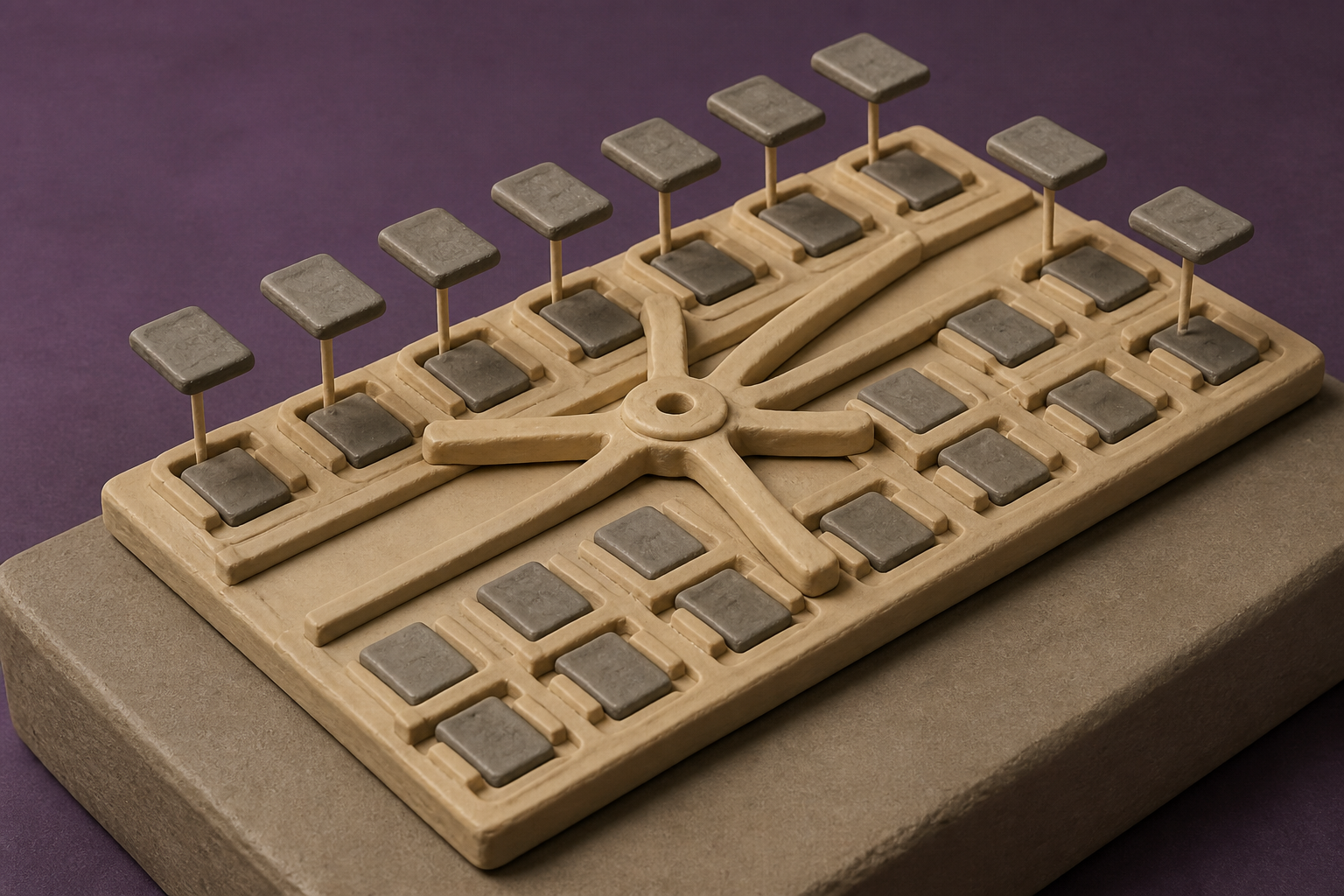
What changes in this design
Before seeing this setup, a reader might picture electronic parts resting in a tray or being held some other way. How positioning is ordinarily handled is not stated.
Here, the fixture uses a support tray, push unit, actuator unit, and barrier walls to move electronic parts against the walls. Each part is clamped between the push unit and those walls.
It helps a reader picture the fixture's job: each component is clamped between a push unit and barrier walls.
Six to eight hours
The number I kept returning to in a second-quarter 2026 earnings-call report was six to eight hours. Chroma ATE reported that system-level tests for AI chips such as MI300 had stretched from a four-hour target to that range as complexity rose. That is not a number about a tray or a spring. For me, it puts a basic fact in view: component position remains part of the job even as testing gets harder.
The same call reported NT$13.503 billion in quarterly consolidated revenue, up 110 percent year over year, and NT$4.4 billion in semiconductor-tester revenue. One quarter is not a verdict. Still, I think it explains why a modest-looking fixture belongs in this story: longer tests make repeatable handling part of the work, not a background detail.
A tray, a wall, a spring
That led me to US20260255523A1, published August 27, 2026, after a February 13, 2026 application. Chroma ATE is listed as the filer. Its electronic component positioning fixture places a component in a support tray, then uses a planar-motion push unit and cam-based actuator to move it against barrier walls. The result is a clamp between the pusher and those walls.
The specificity strikes me as more interesting than the scale. One version uses separate compression springs; another builds spring arms into the arrangement. The task is simple to describe: move a component into a fixed position against barriers. Standardized tray outlines do not settle that internal-support question. JEDEC conventions set external dimensions, pocket pitch, and pin-1 notches, while leaving inner component support unspecified.
Sixteen years earlier
Before calling this a new way of thinking, I checked the older art. A 2010 filing granted in 2012 described a fixture that aligned an electronic component inside a receptacle. Its spring-mounted wall applied two angled force components. The details differ, but the broad approach - a wall, spring force, and a part pressed into alignment - was documented 16 years before Chroma ATE's application.
That comparison does not decide whether any claim in the newer filing is valid. Patent claims turn on exact language and scope, not a quick family resemblance. Still, I think it matters because we can separate that legal question from the larger engineering story. This looks less like a fresh invention of alignment than another attempt to refine a stubborn physical problem.
Magnets and microns
A second route that I found in a 2018 filing granted in 2019 was a fixture for surface-mount parts that used switchable-polarity magnets during reflow soldering instead of a mechanical push unit. That is a different route to the same problem, not proof that springs have stopped working. It shows why I hesitate to call the newer fixture a final answer.
The limit gets sharper at 01005 scale. These passive components measure 0.4 mm by 0.2 mm, and one manufacturing guide says tolerances often need to be below plus or minus 10 micrometres; deviations of 20 to 50 micrometres can risk poor solder wetting. Solving that isn't something I'd claim for a barrier-wall fixture. The same guide warns that standard SMT assembly systems may not consistently reach the needed accuracy.
Seventy-fourth in Taiwan
Context changes the read. Chroma ATE's own 2024 disclosure puts it 74th among Taiwanese companies for patent applications and 70th for patents granted. A patent-analytics profile counts 1,337 patents across several electronics fields. Those figures read to me as substantial engineering reach, but not the country's leading volume of patent filings.
Elsewhere, Cohu sells semiconductor test handlers on its claimed 50-plus years of expertise, including configurable equipment for fragile wafer-level packages. One industry report estimates the 2026 handler market at $1.4 billion to $2.4 billion and names five leading suppliers without Chroma ATE. That ranking, I would treat as a snapshot, not a final scoreboard, but it keeps this patent in proportion.
Where this leaves things
The fixture, to me, is a sensible piece of precise machinery, not a declaration that mechanical alignment has won. Its spring-and-wall arrangement may be useful inside a controlled tray. Yet older spring-based fixtures, magnetic alternatives, standardized trays with unspecified interiors, and sub-10-micrometre placement demands make the larger lesson clear: no single setup settles component positioning.
For me, the filing's value is what it reveals about the work around it. While Chroma ATE reports higher tester revenue and longer system-level test cycles for AI chips, it is also still working on the basic act of holding a component exactly where it belongs. That tension feels honest. Advanced electronics keep making the small motions matter more, not less.
Sources
Reporting for this piece drew on the published filing and the references below.
- Chroma Ate Inc (TPE:2360) Q2 2026 Earnings Call Highlights
- Electronic Component Positioning Fixture
- What is JEDEC?
- Fixture for aligning an electronic component - US8281483B2
- Fixture to enable positioning of SMT components - US10225968B1
- The Impact of 01005 Component Placement on SMT Line Accuracy
- Corporate Governance / Patents
- Chroma ATE Inc. Company Profile & Patent Analytics
- Global Semiconductor Test Handler Market Projected to Hit $2.4 Billion by 2026
The record, briefly. US20260255523A1, “Electronic Component Positioning Fixture” An electronic component positioning fixture uses a support tray, push unit, and actuator unit to move electronic components against barrier walls, clamping each component between the push unit and the barrier walls.
Identity details. The saved title-page transcription needs review, so names are not repeated here. Check the official published title page.
More angles on this
- Inside the haptic deviceAnother reading from the same G06F classification family, electric digital data processing.
- Duo-Pump Liquid Cooling Device Treats the Relationship as the PointAnother reading from the same H05K classification family, printed circuits.
- CPC H05K: Printed circuits; casings or constructional details of electric apparatus; manufacture of assemblages of electrical componentsThe official classification family this record was filed into, published in the USPTO Cooperative Patent Classification scheme.
- CPC E01F: Additional workThe official classification family this record was filed into, published in the USPTO Cooperative Patent Classification scheme.
- Apparatus And Method For Vehicle External Communication Questions the Default ArrangementAnother reading from the neighbouring G06T classification family, image data processing or generation, in general.
Read around this one:Public patent recordUSPTO published figure