Field Notes
Method For Tunable Chromatic Aberration Projection Makes the Next Move Easier to See
Rochester researchers are patenting a way to dial chromatic blur up or down, even as their own work warns that eyes may rely on it.

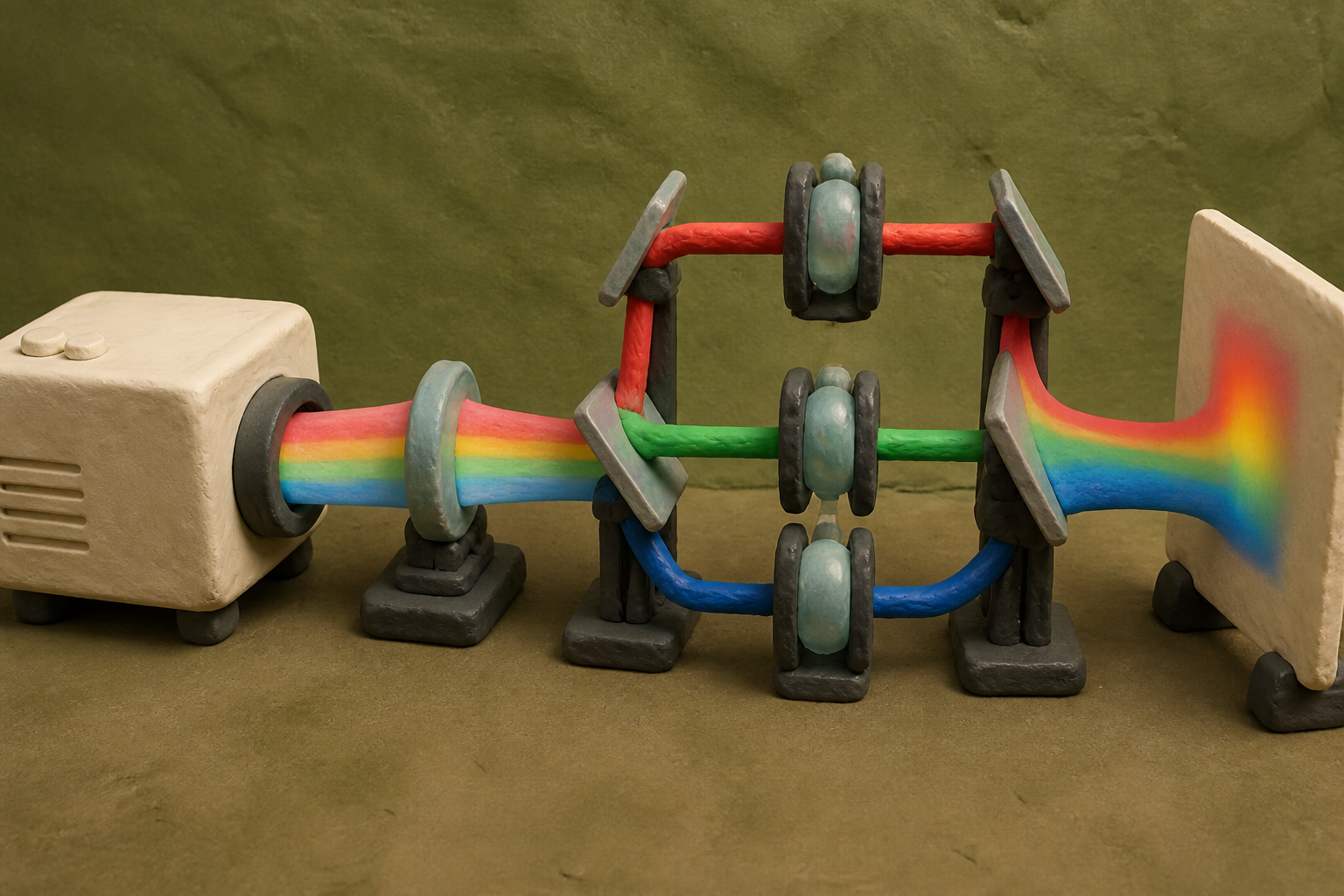
What changes in this design
A reader may picture a projector treating its colors as one bundle, aiming for a shared focus rather than handling each color separately.
Here, one or more adjustable lenses focus at least two separate visible wavelengths independently, whether the colors are separated in time or in space, before combining them into a multicolor image.
That makes the focus of different colors something the method can deliberately control, including correction, overcorrection, or reversal of chromatic aberration.
Nine eyes, two colors
In a nine-person vision experiment, six people with myopia and three without it looked through an adaptive-optics simulator at red and green images. The people without myopia showed a clear difference in the defocus they perceived: 0.58 diopters for green, 0.22 for red. The myopic group did not show the same pattern, reporting 0.61 and 0.73 diopters. The study's authors say the eye's underlying longitudinal chromatic aberration does not itself change with refractive error.
In other words, the blur caused by different colors focusing at different depths may be an optical fact but not a universal cue that brains use in the same way. That result made me pause before treating color-by-color correction as an uncomplicated improvement. It puts the human observer, not just the lens, at the center of this story.
A lens that chooses colors
The University of Rochester filed US20260259406A1 on February 27, 2026, and it was published on September 3. It proposes one or more optotunable lenses that focus separated visible wavelengths independently, then reunite them as a polychromatic image. The system is meant not simply to correct chromatic aberration, but to control it, overcorrect it, or reverse it.
The claims sketch several ways to do that: split colors spatially with dichroic mirrors, work with RGB channels, use narrowband light of 15 nanometers or less, and cycle colors in time using a supercontinuum laser or LEDs. The question I keep returning to is why a vision lab would patent the ability to make a familiar defect worse on purpose. The answer looks less like a new pair of glasses than a programmable test bench for perception.
Rochester's long experiment
That test bench has roots. A 1997 Rochester study used adaptive optics to correct a living human eye, increasing contrast sensitivity for fine patterns and allowing imaging of individual retinal cells. The later visual-simulation tradition moved from deformable mirrors for monochromatic correction toward optotunable or liquid lenses that can alter defocus without changing magnification. Its clinical questions include myopia, presbyopia and testing intraocular lenses.
Marcos's current lab describes a polychromatic adaptive-optics simulator with a deformable mirror, spatial light modulator and optotunable lenses, each able to steer monochromatic and chromatic aberration independently. That work is supported by a federal eye-research grant about multifocal optics, accommodation and myopia progression, and by Meta Reality Labs. There is, I think, a real connection here: the same university recruited Meta's former optics and display research leader in 2025 to direct a new extended-reality center. Still, funding and staff movement do not prove a headset product is on the way.
Correction is not the prize
Yet the lab's research supplies the strongest reason to resist a simple correction story. In a 2021 adaptive-optics study co-authored by Marcos, removing the eye's monochromatic aberrations improved perceived quality of green images by only 1.07 times on average, while it reduced the optical quality of blue images. The researchers concluded that a normal eye's aberrations already protect vision against about 1.5 diopters of chromatic defocus.
That finding does not contradict the patent. It makes its broader menu of settings more credible: if vision is adapted to a particular amount and pattern of chromatic blur, a good simulator needs to add, subtract and rearrange it, not just erase it. But it also means I would not accept a claim of better everyday sight without perceptual evidence across viewers, colors and time. Altering the optics could require neural readaptation before it feels helpful, or may help only particular users.
What would have to be true
For this to matter outside a lab, the system would need to show that it can create stable, accurately separated color focus in a device people can actually use. It would also need to demonstrate, rather than assume, that people can benefit from controlled chromatic error after their visual systems adapt. The myopia result raises a particularly awkward version of that test: a cue absent in one group may be useful in another.
Population scale makes the question more than academic. A 2021 review projected myopia in 52% of the world population, about 4.9 billion people, by 2050, with high myopia at 10%, about 925 million. Those are projections, not a promise of a market. My view is that this patent is most compelling as a way to ask better questions about sight, and most premature if presented as an automatic route to sharper color vision. The ability to reverse a blur is scientifically valuable. Whether our eyes want it reversed remains open.
Sources
Reporting for this piece drew on the published filing and the references below.
- US20260259406A1 - Method For Tunable Chromatic Aberration Projection
- Marcos Lab Projects
- Differences in perceived chromatic aberration between emmetropic and myopic eyes
- Adaptive optics visual simulators: a review of recent optical designs and applications
- Vision is protected against blue defocus
- More Than Fifty Percent of the World Population Will Be Myopic by 2050
- Barry Silverstein '84 to help lead the future of AR/VR at URochester
- Supernormal vision and high-resolution retinal imaging through adaptive optics
The record, briefly. US20260259406A1, “Method For Tunable Chromatic Aberration Projection” The method uses one or more optotunable lenses to independently focus two or more temporally or spatially separated visible wavelengths, combining them into a polychromatic image to control, correct, overcorrect, or reverse chromatic aberration.
More angles on this
- Inside waveguide photodetectorsAnother reading from the same G02B classification family, optical elements, systems or apparatus.
- Ritchey-Chrétien Telescope System With A Multi-Lens Corrector Questions the Default ArrangementAnother reading from the same G02B classification family, optical elements, systems or apparatus.
- CPC G02B: Optical elements, systems or apparatusThe official classification family this record was filed into, published in the USPTO Cooperative Patent Classification scheme.
- Inside multi-tiered semiconductor waveguideAnother reading from the neighbouring G02F classification family, optical devices or arrangements for the control of light by modification of the optical properties of the media of the.
- Inside road safety system including multiple roadAnother reading from the wider G01W classification family, meteorology.
Read around this one:Public patent recordUSPTO published figure