Wearables
A Glove Makes Its Case for Being Looked At
American design patents are cheap, booming, and suddenly on much shakier legal ground. One glove filing from Montclair shows why.

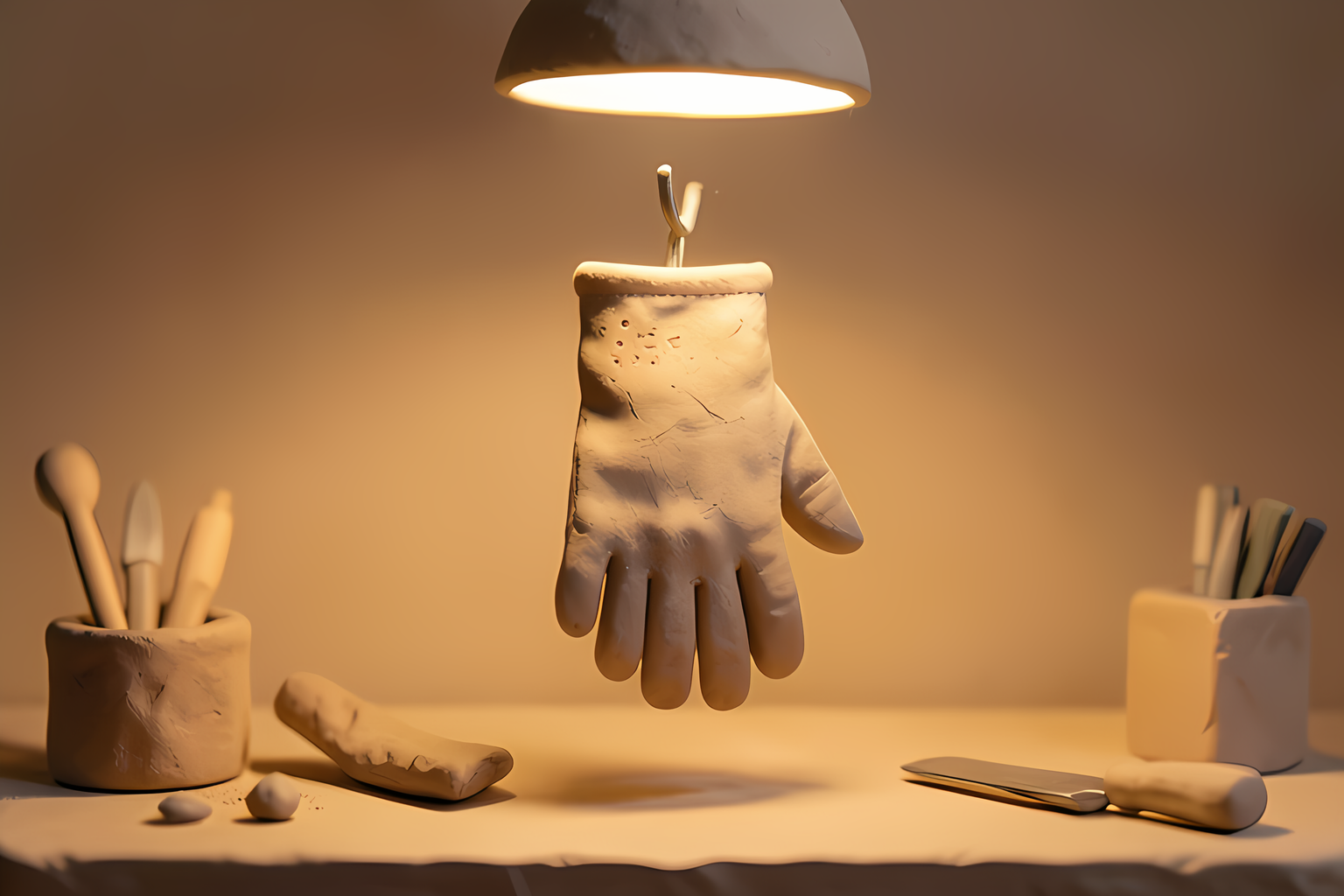
What changes in this design
A reader might ordinarily expect a glove description to say what it is made from or how it is used. This record does not provide those kinds of details.
Instead, it records visible form: a tubular upper section, a broader rounded center, one short left projection, four narrow lower projections, and curved and dashed lines.
That matters because the image is the main evidence here. It helps the reader separate what is visible from assumptions about materials, operation, or results.
The lobster mitt at $199.95
There is a piece of cold-weather gear that looks like a mistake until you have worn one. A thumb, then two wide pockets with two fingers in each. Climbers and skiers call it a lobster mitt. Fingers warm each other, so I see why a mitten beats a glove when it is properly cold, but a mitten cannot work a zipper or a buckle. Split the difference and you keep most of the warmth and get some of the hand back.
Black Diamond Equipment sells one at $199.95, goatskin palm, removable wool liner, rated to about minus 26 Celsius. The shape has been on shelves for years, and reviewers keep naming the same weakness: the finger you freed up is the one that gets cold first. A settled compromise, with a known flaw and a going price.
Three Noels in Montclair, one drawing set
On August 4, 2026, the patent office granted design patent D1,137,987. The title is one word: Glove. The applicants are three people sharing a surname and a Montclair, New Jersey address - Huguens Noel, Andrew Noel and Ashley V. Noel. They filed in February 2025 and had their grant in under eighteen months, on a single claim: the ornamental design for a glove, as shown and described.
The drawings are the interesting part, to my eye. This is not a five-fingered glove. Figures 3, 4 and 7 show a thumb and two broad pockets with scalloped, two-lobed tips, and the top view shows the cuff split into two chambers. The Noels patented the look of a lobster mitt.
A registered patent agent handled it, Kevin Prince, whose firm QuickPatents has served independent inventors since 2005. Four prior-art references appear on the face, from 1995, 1997, 2008 and 2019, every one found by the examiner. The applicants offered none. Nothing from the commercial split-mitt market is listed at all.
$520 and nothing to pay after that
Here is why a family can do this. For a micro entity the fees are $60 to file, $60 for search, $140 for examination and $260 to issue. That is $520, and a design patent carries no maintenance fees for its whole fifteen-year term. Add drawings and an agent and a clean case lands around $2,300 to $3,400. A utility patent runs $6,000 to $15,000, plus three renewal payments.
That price is, I think, producing a boom. About 52,000 design patents issued in 2025, a 10 percent jump and the highest annual total on record, while utility grants barely moved. Globally, 1.22 million design applications were filed in 2024, and the most crowded sector of all is textiles and accessories, at 16.7 percent.
The broken lines are part of the claim
One line in the specification is, to my mind, worth stopping on. Broken lines in a design patent normally mark what is not claimed, and the text usually says so. There is a narrow exception for stitching and fold lines, and this filing uses it: the broken lines depict stitching, and they do form part of the claimed design.
That is a trade. Pulling the seam layout into the claim makes the patent more specific, and it hands a competitor an escape route: reroute the stitching and you are outside it. What the Noels own is this look, not the three-pocket idea, which was on sale long before they filed.
What the Federal Circuit did in May 2024
Until recently a granted design patent was, I would have said, close to bulletproof. Two law professors coded nearly 1,200 case documents and found district courts upholding validity 88.4 percent of the time from 2008 to 2020, and enforceability 99.5 percent. Another dataset put restraining orders at 63 percent granted, against 35 percent for patents generally.
Then, on May 21, 2024, the Federal Circuit sitting en banc threw out the rigid obviousness test design patents had lived under for decades and replaced it with the flexible standard used for utility patents. The reading at the time was that this would make design patents harder to sustain. D1,137,987 issued fifteen months later, examined against four glove drawings. Enforcement was never cheap either: a fight between two outdoor clothing companies over a wavy heat-reflective pattern on gloves has been to the Federal Circuit twice and still is not resolved.
The open question
I could not confirm how the three Noels are related, or tie any of them to a glove company or a product on sale. That may not matter. Most design patents are never asserted, and this one costs nothing further to hold for fifteen years. The question I keep coming back to is the volume. Tens of thousands of these grants a year were priced, drafted and examined for a legal regime that stopped existing in May 2024, and nobody finds out what one is worth until somebody spends more enforcing it than it cost to get.
Sources
Reporting for this piece drew on the published filing and the references below.
- US D1,137,987 S - Glove (USPTO grant document)
- MPEP 1503.02 - Description (design patent drawing conventions)
- Federal Circuit Overrules Rosen-Durling Test for Design Patent Obviousness - Patently-O
- The Surprising Headline of 2025: USPTO Stability? - Patently-O
- World Intellectual Property Indicators 2025 - Industrial Designs Highlights (WIPO)
- How much does a design patent cost in 2026?
- About Us - QuickPatents.com
- Guide Finger Gloves - Black Diamond Equipment
- Gloves vs. Mittens: Which Is Best for Skiing?
- Defending Design Patents - Patently-O
- Design Patents Prove Successful On Enforcement, Defense - Sterne Kessler
- Federal Circuit Lowers Bar for Proving Design Patent Infringement - Morgan Lewis
The record, briefly. USD1137987S1, “Glove” The checked public record identifies a U.S. design patent titled 'Glove'. The reading treats the published title and figure as a visual starting point and does not infer a material, mechanism, or performance claim not established there.
More angles on this
- A Glove With a PortfolioAnother reading from the same A41D classification family, outerwear; protective garments; accessories.
- The Pants Have a Particular Part To PlayAnother reading from the same A41D classification family, outerwear; protective garments; accessories.
- CPC A41D: Outerwear; protective garments; accessoriesThe official classification family this record was filed into, published in the USPTO Cooperative Patent Classification scheme.
- The Suspender Belt Is Holding the Plot TogetherAnother reading from the neighbouring A41F classification family, garment fastenings; suspenders.
- The Leveling Bar Has a Very Firm Opinion About LevelAnother reading from the wider A01B classification family, soil working in agriculture or forestry.
Read around this one:Public patent recordUSPTO published figurePatent issue-date index