Machines
A Light Check Before Heating
An optical sensor in a tobacco-heating filing opens onto a crowded race to recognize loaded sticks, while heated tobacco's health premise remains unsettled.

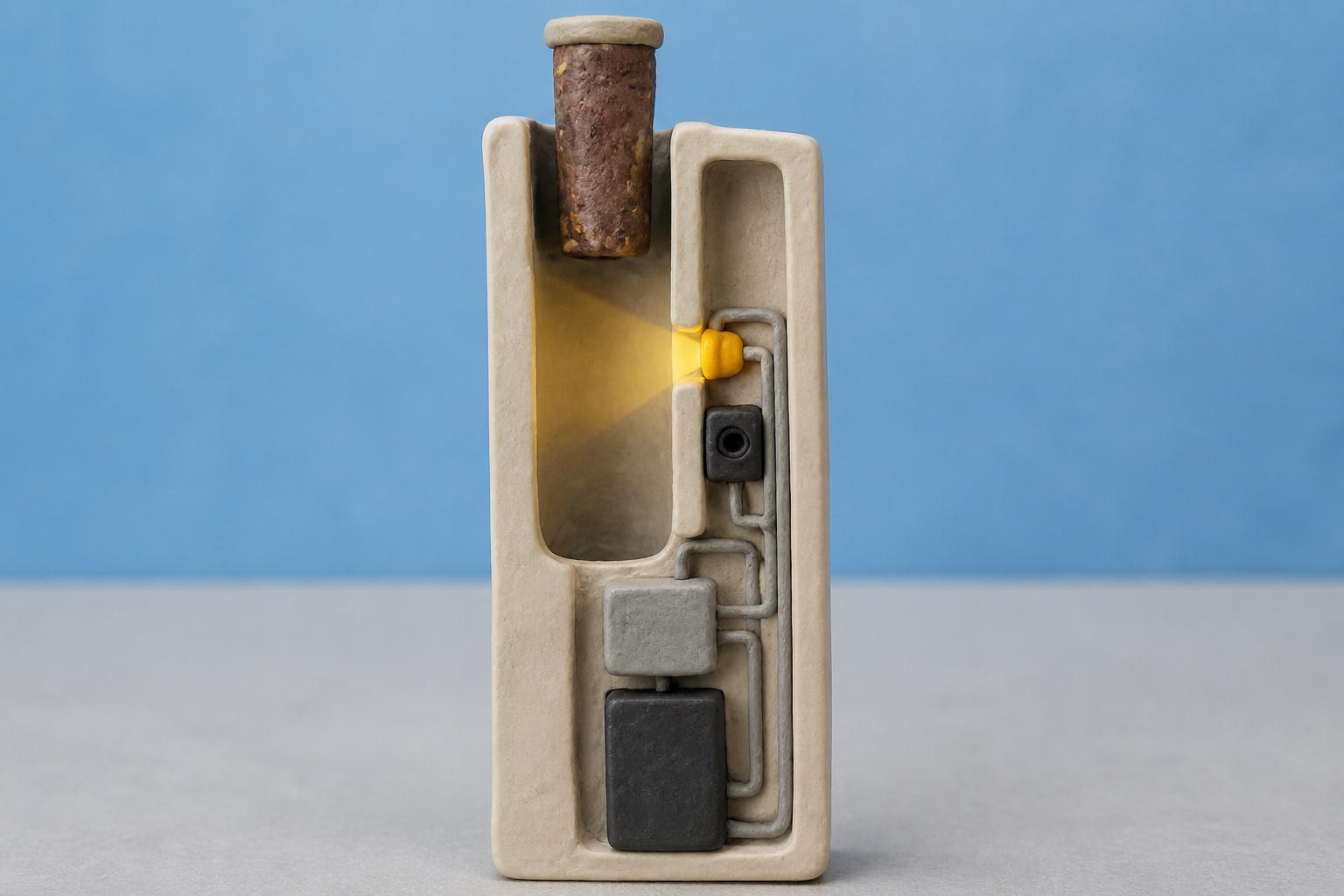
What changes in this design
Without a light-based check, a reader might assume heating begins without a stated way to confirm whether a tobacco unit is inside the chamber.
Here, a light source shines on the tobacco unit in the chamber. An optical sensor detects the resulting change in light, and the controller uses that detection to enable and control heating.
This is worth knowing because the light check is linked to the decision to enable and control heating.
Premier, 1988
In 1988, Premier went on sale as a cigarette that heated tobacco instead of burning it. The product had consumed an estimated $300 million to $325 million in development. Within months it was gone: fewer than 5 percent of U.S. test smokers liked the taste, and its maker's total losses were estimated at $800 million to $1 billion. A 1994 follow-up, Eclipse, also failed commercially. Its reduced-risk marketing was publicly disputed on the grounds that it still produced high carcinogen levels and more carbon monoxide than ordinary cigarettes.
That is a useful place to begin with a fresh device filing, because the industry is not trying out a quirky new idea. It is still refining an old bargain: give a smoker a heated tobacco unit, control the heat, and make the experience reliable enough to become routine. The stakes are no longer small. IQOS's manufacturer reported shipments of 155.1 billion heated-tobacco units in 2025, serving an estimated 43 million-plus adult users. One market-research estimate places the global category at $58.53 billion in 2026, with Asia-Pacific representing 45.6 percent and stick-format products 72.3 percent of revenue. That is an estimate, not a settled fact, but it gives a sense of why detection systems keep attracting patents.
A chamber and a beam
US20260256209A1 puts a modest component at the centre of that reliability. It describes a chamber, a light source, an optical sensor and a controller. Light is directed at a tobacco unit in the chamber; the sensor detects the resulting light change; then the controller can enable and control heating.
That is a presence check, not a health claim. A machine that knows whether a tobacco unit is there can decide when heating is appropriate. It can also turn a disposable stick into a recognized input rather than a passive object. That may sound fussy, but I do not think the distinction is semantic. In a regulated nicotine product, deciding what the device will accept is part of the product.
Magnets and court papers
The technology around that decision is already varied. A U.S. patent granted in 2024 to KT&G describes a different route: an inductive sensor detects a magnetic-field change when a stick is inserted, can identify the metal type, and may check the stick's genuineness or type. The newer publication describes the former task, detecting a tobacco unit through a light change, rather than that latter authentication task. Different sensing method, different stated scope.
The race is visible in paperwork as well as hardware. PointDaily reported that KT&G's overseas heated-tobacco patent filings rose from 9 in 2017 to 974 in 2024, after more than 4,700 domestic and international filings over the preceding three years. Ownership has reached court too. KT&G sued contractor iMTEK in Seoul in March 2022, seeking the transfer of six patents involving heaters and aerosol generation. In this category, sensing may become a line around compatibility, safety controls and ownership.
What precise heating cannot prove
Precision, though, is not proof of reduced harm. A 2022 review of 40 published clinical trials found that 29 were affiliated with or funded by the tobacco industry, and judged the overall evidence at high risk of bias. The reviewers cited short study durations, restrictive test conditions and missing comparators among the reasons more independent research is needed. That leaves a wide gap between controlling a heating cycle and showing a meaningful long-term health outcome.
The FDA's April 2026 decision illustrates both the possible regulatory path and its limits. It renewed modified-risk marketing authorization for five specific IQOS systems and HeatStick products, required postmarket surveillance, and retained the power to withdraw the orders. The authorization is product-specific. It does not let anyone turn a better sensor into a general claim that heated tobacco is safe; the agency says there is no safe tobacco product.
Where this leaves things
I read US20260256209A1 as a small but revealing filing: a proposal to use light to establish that a tobacco unit is in place before the device controls heat. Its value, if it has one, is practical. A device that recognizes what is loaded may behave more predictably, and the patent competition suggests that predictability is commercially important.
The number I keep returning to is 29 out of 40. Better control can be an engineering achievement without being a public-health result. Until the independent evidence catches up, a beam of light inside a tobacco chamber deserves scrutiny - not a health halo.
Sources
Reporting for this piece drew on the published filing and the references below.
- Premier (cigarette)
- Eclipse (cigarette)
- Tobacco Heating Device And Method For Detecting Presence Of Tobacco Unit By Using Optical Sensing Operation
- Philip Morris International Reports 2025 Fourth-Quarter & Full-Year Results
- Heated Tobacco Products Market Size & Growth Report
- US12075838B2 - Aerosol-generating device automatically performing heating operation
- PointDaily report on KT&G heated-tobacco patent growth
- KT&G and iMTEK Engage in Lengthy Patent Dispute
- Jury out on whether heated tobacco products are less harmful for health
- FDA Renews Authorization for Five IQOS Products to be Marketed with Exposure Modification Claims
The record, briefly. US20260256209A1, “Tobacco Heating Device And Method For Detecting Presence Of Tobacco Unit By Using Optical Sensing Operation” A tobacco heating device has a chamber, light source, optical sensor, and controller. The light source illuminates a tobacco unit in the chamber, and the sensor detects a resulting light change so the controller can enable and control heating.
More angles on this
- CPC A24F: Smokers' requisites; match boxes; simulated smoking devicesThe official classification family this record was filed into, published in the USPTO Cooperative Patent Classification scheme.
- CPC A24D: CigarsThe official classification family this record was filed into, published in the USPTO Cooperative Patent Classification scheme.
- A Baseplate's Signal: From Guess to Defined ResponseAnother reading from the neighbouring A24B classification family, manufacture or preparation of tobacco for smoking or chewing; tobacco; snuff.
- Degassing a bottle: a chamber, a pump, and the judgment left to whoever holds itAnother reading from the wider A23L classification family, foods, foodstuffs or non-alcoholic beverages, not otherwise provided for; preparation or treatment thereof.
- A cooling plate broader than it is deep, and the quiet difference between a setting and a promiseAnother reading in the same Machines category on this site.
Read around this one:Public patent recordUSPTO published figure