Objects
A New Timing Cue at the Device Boundary
An overlooked 5G timing patent shows why XR devices are being asked to teach the network when their data will arrive.

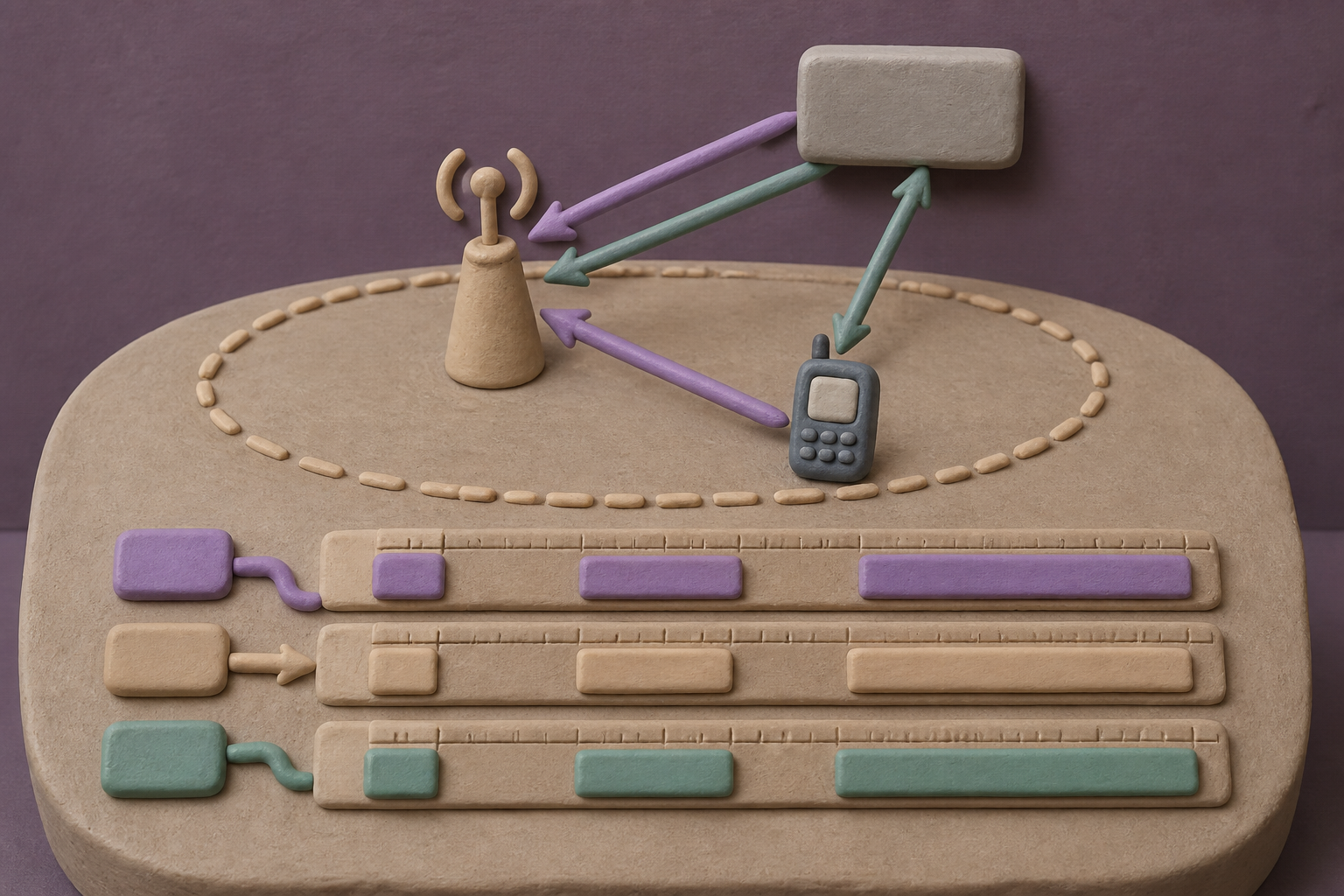
What changes in this design
Without this approach, someone might expect the application to keep following the timing pattern first chosen for its outgoing data.
Here, timing information is sent from one piece of equipment to a second piece, then revised timing comes from a third piece. The first piece causes the application to adjust the pattern in which it generates uplink traffic.
For a reader, this shows where a later timing update has an effect. It leads to a change in how the application generates its outgoing data.
Twenty milliseconds
The number that stopped me was 20 milliseconds. Above that, a technical review says motion-to-photon latency in virtual reality can cause nausea. Augmented reality has a looser but still demanding target: end-to-end latency below 50 ms. The visible video gets most of the attention, yet the early work begins with small upstream reports. Six-degree-of-freedom pose data travels up; the much heavier video stream travels down.
That asymmetry matters because XR traffic does not arrive with the clean rhythm of voice or industrial control. It comes in bursts, roughly periodic but jittery; the review describes the timing variation as an order of magnitude larger. A radio network can prepare capacity only if it has a credible idea of when the next burst will appear. This is where a relatively obscure patent becomes a useful clue.
The missing uplink schedule
At the network edge, a 5G scheduler does not get that idea for free. When several uplink flows are multiplexed, a base station cannot simply observe the characteristics of each one. A 3GPP 5G-Advanced paper by Nokia engineers says Release 18 extended UE Assistance Information to carry jitter, burst-arrival time and periodicity for each QoS flow. The device is asked to describe its own traffic timing.
The concrete scale keeps me from dismissing it as fussy scheduling work. The paper discusses PDU Set Delay Budgets of 10 to 30 ms, and a 60-frames-per-second video rhythm of 16.67 ms between frames. It also reports 11% to 95% capacity gains from related Configured Grant enhancements. Those gains do not establish what this filing achieves, and we should not borrow them as evidence for it.
A 2022 timing instruction
That standards work helps explain the U.S. filing Optimized Uplink Transmission With UE Assisted Information. Nokia Technologies Oy filed it on August 5, 2022; it published on August 27, 2026 as US20260254763A1. Its proposed loop is straightforward: a device sends its preferred burst timing to the device serving it, receives updated timing from a third device, and causes its application to change the pattern that generates uplink traffic.
The background frames the 5G radio access network as a latency and capacity bottleneck for periodic, delay-sensitive applications including industrial automation and XR. It describes applications with roughly 2 ms end-to-end burst requirements and time-division-duplex uplink/downlink cycles that cannot be resized dynamically for every traffic stream. The proposal is to move some adaptation into the application itself.
My confidence stops at the line between a published application and a proven standard-essential patent. This filing aligns with the Release 18 work, but I cannot establish from the public material that it has been declared essential, put into a product, or found valid by a court. That is not a small qualification. It changes the question from whether the idea is clever to what, if anything, it actually controls.
Eight thousand declarations
Behind the filing is a number to handle carefully. One analysis reported that Nokia had declared more than 7,000 5G-essential patent families by January 2025. Another estimates roughly 8,190 declared families, about 7.5% of all declared 5G SEPs. Those are declarations, not rulings. The total may matter commercially, but it tells me less than a technical mapping from a patent claim to a standard requirement.
That limit is not merely a rival's talking point. Qualcomm has argued that ETSI does not filter or confirm essentiality in its declaration database and outlined ways a company can inflate a tally, such as splitting one invention among family members or declaring a patent against many specifications. Its argument has an interest behind it, so I would not turn it into a verdict on Nokia. Still, a self-declared total cannot tell us whether this particular timing method is indispensable.
Nokia and Amazon signed a confidential global patent license on March 31, 2025, after litigation begun in October 2023 that included a January ITC infringement finding and a German injunction against Prime Video. I don't read that settlement as evidence about this particular application. It does show why the difference between a technical contribution, a declaration and an enforceable right deserves care.
The part worth watching
The useful question is not whether a device can report a preferred time. The filing proposes exactly that. The harder question is whether the report lets real networks reserve the right resources without wasting radio capacity, and whether applications respond well when asked to shift their timing. The evidence I want is interoperability testing and deployed XR services, not an enlarged tally of declarations.
This small filing deserves attention without becoming a proxy for Nokia's entire portfolio. It documents a real engineering direction: give the device timing information the network lacks, then let the application adapt. A claim of standard importance should need the same kind of evidence - an adopted requirement, a measured implementation or a tested service - rather than the size of a database entry.
Sources
Reporting for this piece drew on the published filing and the references below.
- Optimized Uplink Transmission With UE Assisted Information
- Optimized Uplink Transmission With UE Assisted Information - patent detail
- Overview of NR Enhancements for Extended Reality (XR) in 3GPP 5G-Advanced
- XR and 5G: Extended reality at scale with time-critical communication
- Nokia reaches 7,000 patent families declared as essential to 5G
- Nokia's 5G SEP Patent Portfolio: Declaration Trends and Licensing Strength
- Nokia and Amazon settle patent dispute with license agreement
- How companies game the ETSI SEP database to manipulate perceptions of leadership in 5G
The record, briefly. US20260254763A1, “Optimized Uplink Transmission With Ue Assisted Information” A first device determines first preferred burst timing information for an application and transmits it in a message to a second device serving it, then receives updated burst timing information for the application from a third device and causes the application to adjust the generation pattern of a UL traffic flow accordingly.
More angles on this
- When a Queue Waits for Its CueAnother reading from the same H04L classification family, transmission of digital information, e.g. telegraphic communication.
- The Reply Arrow's Quiet HandoffAnother reading from the same H04L classification family, transmission of digital information, e.g. telegraphic communication.
- CPC H04L: Transmission of digital information, e.g. telegraphic communicationThe official classification family this record was filed into, published in the USPTO Cooperative Patent Classification scheme.
- Tracking Wireless Monitoring With Reduced Data Loss Questions the Default ArrangementAnother reading from the neighbouring H04W classification family, wireless communication networks.
- A Segment That Cools And A Segment That Carries FlavourAnother reading from the wider H05B classification family, electric heating.
Read around this one:Public patent recordUSPTO published figure