Machines
A Nuclear Battery Whose Output You Can Count: Modular Cells, Named Heat Paths, and a Plain Test
I trace Brazil's modular nuclear-battery filing into a global race whose engineering is moving faster than its economics.

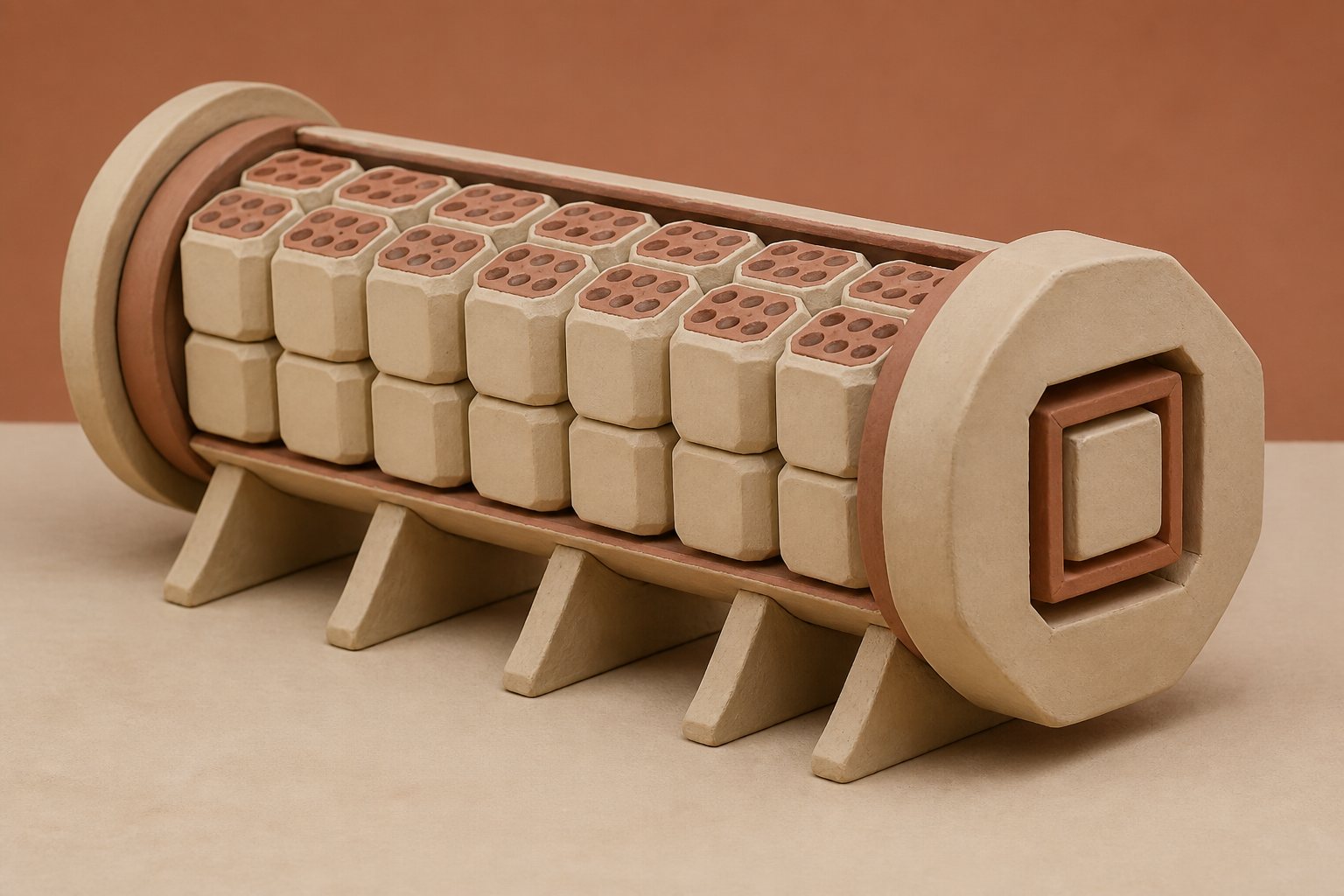
What changes in this design
A reader might first picture a nuclear battery as one self-contained power unit. The word battery can suggest one object rather than several smaller pieces joined together.
This record concerns multiple nuclear cells, each housing a nuclear microreactor. It says that assembling different numbers of cells produces 80 kW to 4.8 MW of thermal power and/or 32 kW to 1.92 MW of electrical power. Their heat is conducted to a heat-removal unit before power generation.
That is worth knowing because it makes the scale easy to follow: the number of joined cells is tied to the given heat and electricity ranges, and heat handling comes before power generation.
March 2018, KRUSTY
A 1 kWe reactor called KRUSTY completed its test in March 2018, a moment I keep returning to. By power-station standards, it was tiny. Yet it was the first nuclear-powered operation of a genuinely new U.S. reactor concept in more than 40 years. NASA's Kilopower work combined heat pipes with a Stirling engine and was intended to deliver one to ten kilowatts of electricity in space or on planetary surfaces. That test is, to me, the useful starting point for today's nuclear-battery claims. It established a physical recipe, not a business.
A container in Brazil
In Brazil, I see that recipe being translated into a much larger proposal. A national program is modelling a container-sized unit, 12 by 2.4 by 2.6 metres, between one and five megawatts, with sodium-core heat pipes at about 800 C and Stirling or Brayton conversion. The July 2025 account placed the program at technology-readiness level 3, with a three-year goal of level 6. It also reported that no microreactor was commercially operating anywhere at that point. Neither a modelled 8.7-year fuel cycle nor a first-unit estimate of about US$10 million is, to me, proof of a market. They tell me what its backers hope to make credible.
That gap is visible in the next planned step. After an October 2025 meeting, Brazil's nuclear safety authority described early licensing work for a reduced-scale critical unit inside an existing research-reactor building. In March 2026, the consortium's manager said it aimed to deliver a roughly 100 W critical unit so first tests could begin around mid-2027, pending licensing. That is, to me, a necessary experiment, not a miniature power station.
Cells in the filing
That is the context in which I read US20260253759A1, Modular Nuclear Battery And Nuclear Cell System. The application proposes repeatable nuclear cells, each housing a microreactor, that can be joined into a battery. Depending on the number assembled, it claims 80 kW to 4.8 MW thermal and/or 32 kW to 1.92 MW electrical. Fission heat is conducted to a heat-removal module and then to power generation. The U.S. filing has a European family member, so I can see this modular-cell architecture being pursued beyond one jurisdiction. But I do not mistake modular drawings for a factory line.
August 24, 2026
Brazil is not alone in moving from drawings toward tests. On August 24, 2026, Westinghouse's heat-pipe-cooled eVinci reactor completed zero-power criticality. Its commercial design is rated at 5 MWe and 13 MWth, and a scaled 3 MWth test reactor is headed to a federal test bed. That result matters, although I would not call zero-power criticality a commercial operation. Meanwhile, the U.S. Army selected five firms for a program offering up to $2.2 billion in milestone payments across fiscal years 2027 through 2031, with a first Army-regulated reactor targeted for September 2028. Those dates strike me as a measure of urgency, not a guarantee.
The open question
The hardest part, I think, is not arranging heat pipes in a sensible pattern. The sharper challenge, I found, lies in the economics and regulation around them. One critic argues that containment, security, labor and other fixed safety costs do not shrink with reactor output, while site-specific licensing changes the safety case whenever deployment moves. That is a direct threat to the promise of factory repetition. The same critique points to a thin Western supply of HALEU, the 20 to 50 percent enriched fuel many designs need. This filing doesn't tell me whether its cells require HALEU, so I will not assign that constraint to this design without evidence.
The qualified view, from where I stand, is simple. This filing is evidence that the nuclear-battery race is real, and that Brazil has entered it with a modular technical claim. It is not evidence that cheap, deployable nuclear power is solved. Before I believe in a battery for a remote town, I want to see licensing, fuel, operations and cost hold together at an actual site.
Sources
Reporting for this piece drew on the published filing and the references below.
- US20260253759A1 - Modular Nuclear Battery And Nuclear Cell System
- KRUSTY Reactor Design
- Brasil inicia o desenvolvimento de microrreatores nucleares
- ANSN participa de reunião na AMAZUL sobre projeto de microrreator nuclear brasileiro
- Projeto brasileiro de microrreator está perto de entrar em nova etapa
- Westinghouse eVinci Reaches Criticality Milestone at Nevada Test Site
- Army Selects Five Firms for $2.2 Billion Microreactor Program
- Why A Billion Dollars Won't Save The Microreactor Hype
- Modular nuclear battery system and nuclear cell - EP-4481760-A1
The record, briefly. US20260253759A1, “Modular Nuclear Battery And Nuclear Cell System” A nuclear battery has multiple nuclear cells housing nuclear microreactors. Depending on the number assembled, the cells generate 80 kW to 4.8 MW thermal and/or 32 kW to 1.92 MW electrical power; fission heat is conducted to a heat-removal module and then to power generation.
More angles on this
- CPC G21H: Obtaining energy from radioactive sourcesThe official classification family this record was filed into, published in the USPTO Cooperative Patent Classification scheme.
- CPC G21F: Protection against x-radiation, gamma radiation, corpuscular radiation or particle bombardmentThe official classification family this record was filed into, published in the USPTO Cooperative Patent Classification scheme.
- Shift Register Unit, Driving Method Thereof, Display Substrate And Display Marks a Pause Worth NoticingAnother reading from the wider G11C classification family, static stores.
- When a Signal Stops Reporting and Starts Shaping the Next DecisionAnother reading in the same Machines category on this site.
Read around this one:Public patent recordUSPTO published figure