Machines
When a Signal Stops Reporting and Starts Shaping the Next Decision
A diabetes patent asks whether the next advance in automated insulin delivery is not a new pump, but a better partnership.

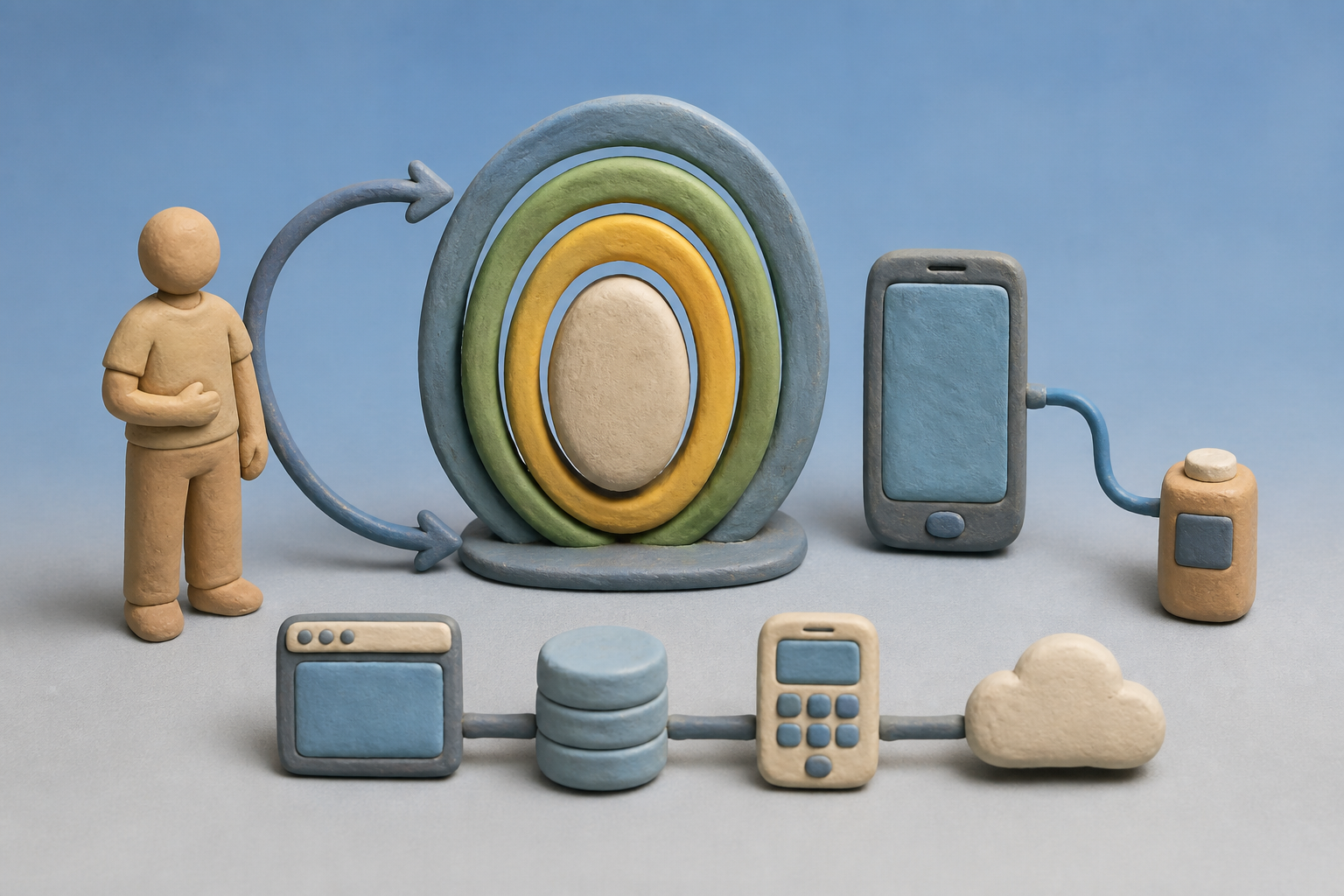
What changes in this design
A reader might otherwise picture diabetes management as a person making choices alone, or a computer system operating separately from the person.
Instead, the record presents a two-way partnership between a person and a machine. It names adaptation to bodily changes, adaptation to behavior changes, and a replay module, without explaining their detailed operation.
That framing matters because it asks the reader to see diabetes-related management as an ongoing shared process, not simply a person or a machine acting alone. What is measured, changed, or replayed is not stated.
2.6 hours a day
The number I keep returning to is 2.6 hours. Control-IQ received regulatory clearance in 2019 as the first interoperable automated glycemic controller. In a 168-person trial, participants spent that much more time each day, on average, in the 70-180 mg/dL target range than the comparison group. The clearance mattered because it made a practical promise: a sensor, software, and pump could share the work of dosing insulin.
But the loop cannot notice a pattern at midnight, decide whether a recurring high needs a clinician, or live with the settings when a day goes sideways. Those choices stay with the person wearing it. The gap between a machine that reacts and a person who must manage the consequences is, I think, where this story begins.
A biweekly digital twin
That is where US20260253737A1 enters, published on August 27, 2026. The University of Virginia Patent Foundation is the applicant. It was filed on February 22, 2024, with priority to two provisional applications from 2023. Its proposal is bidirectional: physiological adaptation uses a personalized glucose-metabolism model and insulin-dosing suggestions, while behavioral adaptation turns glucose records into actionable information and risk assessments.
A Replay module lets people simulate possible treatment or behavior changes. The Replay module isn't, to me, a claim that software should take over. It reads to me as an effort to make settings less opaque, so a person can rehearse a choice before making it. That ambition had already been tested. In a 72-person, six-month randomized trial published in May 2025, researchers mapped automated-delivery data to each participant's digital twin, optimized parameters every two weeks, and let users explore what-if scenarios.
The 70-140 range
The larger trial gives the idea a real signal, not a verdict. Time in range rose from 72% to 77%, with HbA1c falling from 6.8% to 6.6%. But its most revealing result was less flattering to the screen-based part of the program: information feedback alone added no benefit beyond automated insulin delivery. That result deserves more attention, I think, than the headline gain.
An earlier eight-week pilot I found adds needed restraint. Thirty adults used Control-IQ and the physiological module; half also received Behavioral Adaptation. The difference in the usual 70-180 mg/dL range was not statistically significant, although the behavioral group spent more time in the tighter 70-140 mg/dL range without more time below range. No severe hypoglycemia, diabetic ketoacidosis, or serious adverse events were reported.
Tidepool Loop
This adaptation layer isn't, to me, a matter for one device alone. Tidepool Loop received regulatory clearance in 2023 as a fully interoperable automated dosing app built from community open-source work. That doesn't validate this filing. It establishes a separate fact: an interoperable system rooted in community work can reach clearance.
The scale is plain: more than 40 million Americans live with diabetes, and diagnosed diabetes cost the United States $412.9 billion in 2022. Still, neither number will turn a patent into a conclusion for me. The answers to who benefits, what training people need, or how much discretion they want to keep aren't yet known. Future studies should, I think, also separate the effect of improved dosing from the effect of improved explanations. Those questions should, I think, be treated as design questions from the start.
Where this leaves things
Whether ABC can make automated insulin delivery sound more personal interested me less than whether it earns trust through measurable help. The 72-person trial gives it a reason to be taken seriously. The smaller pilot and the feedback-only result set a firm limit. That standard should apply as much to the user experience as to the glucose numbers. They suggest co-adaptation may matter, but explanations alone are not a magic feature.
US20260253737A1 looks to me, for now, like a map of a research direction, not a verdict on care. The next useful evidence should show whose glucose control improves, whether gains last, and whether people feel they retain meaningful control. That is the contest I will watch: not only whether a system can learn a person's body, but whether it can learn with the person.
Sources
Reporting for this piece drew on the published filing and the references below.
The record, briefly. US20260253737A1, “System, Method, And Computer Readable Medium For Adaptive Bio-Behavioral Control (Abc) In Diabetes” A method, system, and computer-readable medium implement Adaptive Bio-Behavioral Control for bidirectional human-machine co-regulation of metabolic disorders through physiological adaptation, behavioral adaptation, and replay modules.
Identity details. The saved title-page transcription needs review, so names are not repeated here. Check the official published title page.
More angles on this
- A Reading Taken in the Ear, and the File It Has to ReachAnother reading from the same G16H classification family, healthcare informatics.
- A Setting Is Not a Promise: Inspecting the HingeAnother reading from the same G16H classification family, healthcare informatics.
- CPC G16H: Healthcare informaticsThe official classification family this record was filed into, published in the USPTO Cooperative Patent Classification scheme.
- A Handoff Worth Watching: Fragment-Based Drug Design With an Assistant at the BenchAnother reading from the neighbouring G16B classification family, bioinformatics.
- Measurement And Analysis Method For Detecting And Quantifying Makes a Small Case for Better TimingAnother reading from the wider G01N classification family, investigating or analysing materials by determining their chemical or physical properties.
Read around this one:Public patent recordUSPTO published figure