Field Notes
A Nursing Cover With Named Openings, and the Moment Coverage Changes Hands
A new nursing-cover patent arrives after public breastfeeding became legal nationwide, exposing an old conflict between choice and expectation.

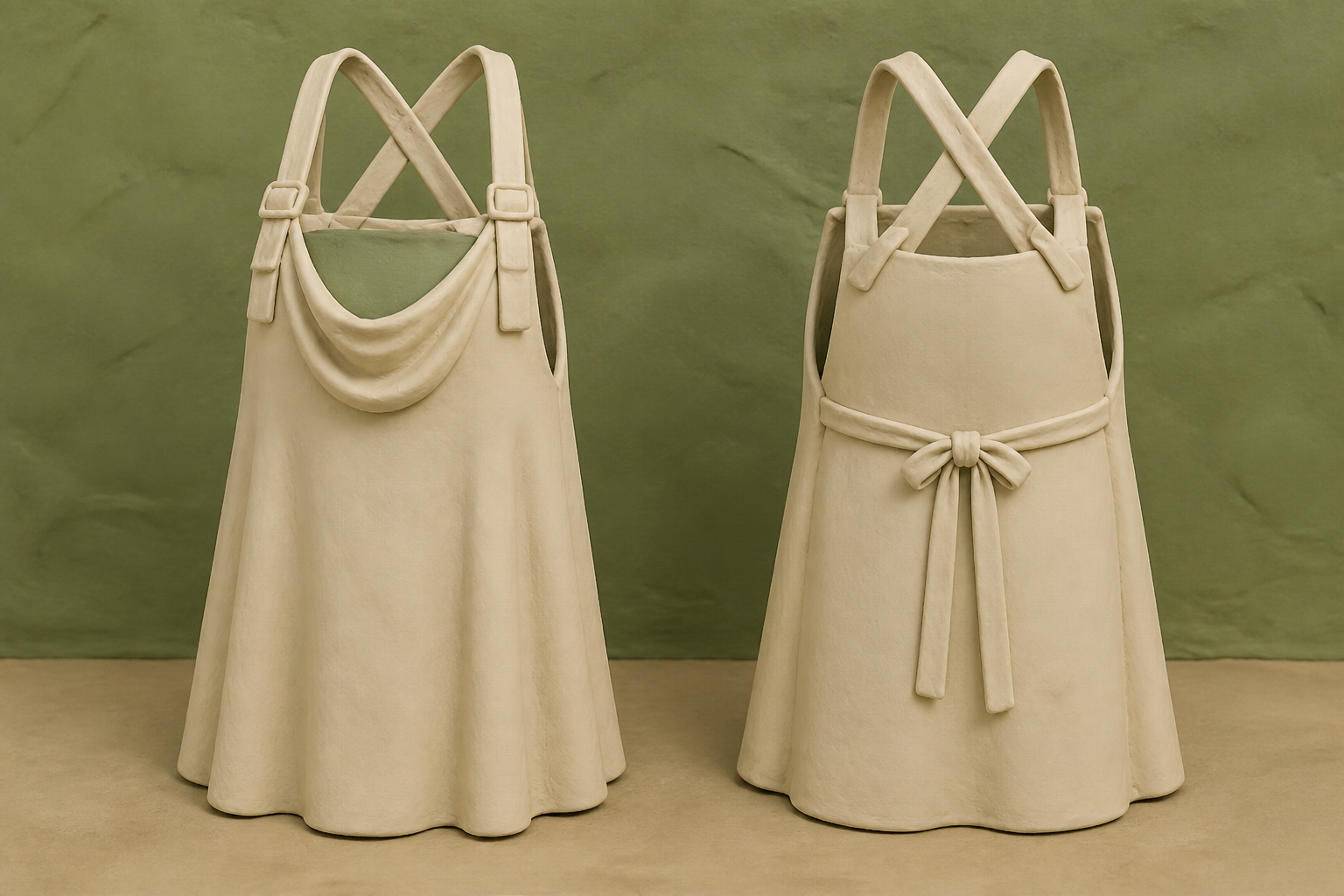
What changes in this design
A person may picture a nursing cover as one layer of fabric moved aside during feeding or when adjusting clothing.
This cover uses two layers, plus a chest opening beneath one layer, side openings with hidden zippers, a neck strap that can be adjusted, and a tie that wraps around.
For someone deciding whether the layout suits their needs, it helps to know that feeding access and clothing adjustment are paired with coverage. Its dimensions and how it feels to wear are not stated.
Utah, 2018
Utah and Idaho became the last states to legalize public breastfeeding in 2018, making it legal in all 50 states. Utah's bill had a narrow passage: its House committee voted 6-5 before the full House approved it 66-5 after language about whether a mother needed to be covered was removed. Legally, the question was settled. Socially, it wasn't.
Eight years later, US20260256222A1 treats that unresolved question as a garment-design problem. An adjustable neck strap and an under-layer chest opening put the filing in this history. Here, access sits beneath the fabric and coverage above it. Practically, the aim is access for feeding and adjusting clothing while maintaining coverage. Choice matters. Anyone who wants a cover deserves one that works. But the filing also preserves, I think, the premise that public feeding needs to be managed out of sight.
The bowed neckline
Such designs go back years. This premise was already being engineered into covers long before this filing. US7406718B2 came from a 2006 filing by Ronnie and Claire Ekelund and was assigned to Bebe au Lait. At the neckline, a bowed stiffener sat, held in place by a D-ring-adjustable neck strap. Wearers could see the baby while the cover stayed away from the body.
It isn't presented as a repeat, and I don't read it that way. Yet the work belongs to a long-running design line. Its adjustable neck strap belongs to the same familiar line of thought: hold fabric in a predictable place, then make feeding possible behind it. Bebe au Lait's follow-on patent, US8196222B2, is recorded as expired for nonpayment of maintenance fees as of June 12, 2024. That expiry does not make every nursing-cover idea free to use, but it does show how much of this product category has already moved from protected invention into ordinary design vocabulary.
Two layers, old idea
Two layers may matter most. The outer layer supplies discretion; an opening beneath it supplies access. Yet that basic division was already visible in Yoko Shimada's 2015 filing, published in 2016 as US20160073703A1. Shimada's filing described two zippers near the breasts beneath a repositionable inner lining held by an elastic band.
Details differ, and a patent publication alone cannot by itself settle what claims may survive examination. But the resemblance matters. Making that opening work in ordinary life is the hard part. Can it be reached without fumbling? Does it stay put after use? Will the garment come through the wash and still feel comfortable, without standing out or turning a nursing parent into the operator of a small piece of equipment? What I cannot tell from the information available is whether its particular combination clears the legal bar. What the earlier filing makes clear is that dual-layer access is not a newly discovered need.
Zippers in everyday clothes
Money around feeding products is real. Nursing-adjacent apparel has even drawn private-equity capital, though one public announcement disclosed neither a deal size nor revenue. One market report values the global breastfeeding-accessories category at $1.4 billion in 2024 and projects $3.3 billion by 2034. Bottles alone accounted for $314.1 million in 2024, while hospital-grade products held 84.6 percent of the reported market. Covers aren't central. Equipment such as pumps and bottles sits at its center instead.
Built into everyday clothes. That is the rival design instinct: remove the separate cover. Nursing Queen, founded in 2017, builds concealed horizontal or diagonal zippers into ordinary tops and dresses. By its count, the company has designed more than 250 styles and served more than 175,000 customers. Its approach shifts the task from carrying an extra object to choosing clothes that already open where needed. For me, the question is whether the better cover is a more elaborate cover, or no cover garment at all.
Where the risk actually sits
One breastfeeding-advocacy group objects. Babies may pull covers off. Enclosed fabric can raise heat and breathing concerns. According to the group, covers can also interrupt eye contact that research links to developmental benefit. Why carry another item, the group asks, when nursing commonly exposes less than observers assume? Those arguments do not mean every parent dislikes a cover. They mean a cover should remain a choice, not a condition of taking up space.
Neither the neck strap nor the layered opening is inherently wrong. Instead, the risk lies in treating public comfort as a problem mothers must solve with better hardware. I came away thinking the filing is most humane when read as an option for someone who wants privacy, and least convincing when read as a cure for public unease. Two decades have passed. Incremental cover designs have improved access behind fabric. Harder still is a public culture that does not demand the fabric first.
Sources
Reporting for this piece drew on the published filing and the references below.
- It Only Became Legal To Breastfeed In Public In All 50 States In 2018
- US7406718B2 - Nursing cover
- US8196222B2 - Nursing cover
- US20160073703A1 - Nursing Garments
- Breastfeeding Accessories Market Size & Share Report, 2032
- Montage Partners Invests In Solly Baby
- How Nursing Queen Breastfeeding Clothes Work (For Nursing & Pumping Moms)
- 7 Reasons Breastfeeding Mothers Can't Just Cover Up--and Shouldn't Have To
The record, briefly. US20260256222A1, “Dual-Layer Lightweight Nursing Cover” A nursing cover has a cowl neckline, adjustable neck strap, under-layer chest opening, side openings with invisible zippers, and a wrap-around tie. Its dual-layer construction provides breastfeeding access and clothing adjustment while maintaining coverage.
More angles on this
- Four numbered layers, one decided order: a garment record that spends its precision on sequenceAnother reading from the same A41D classification family, outerwear; protective garments; accessories.
- A Glove With a PortfolioAnother reading from the same A41D classification family, outerwear; protective garments; accessories.
- CPC A41D: Outerwear; protective garments; accessoriesThe official classification family this record was filed into, published in the USPTO Cooperative Patent Classification scheme.
- The Pants Have a Particular Part To PlayAnother reading from the neighbouring A41B classification family, shirts; underwear; baby linen; handkerchiefs.
- A Light Check Before HeatingAnother reading from the wider A24F classification family, smokers' requisites; match boxes; simulated smoking devices.
Read around this one:Public patent recordUSPTO published figure