Machines
A Robot That Turns an Orange Into a Reason to Talk
A proposed household robot turns spoken requests and familiar objects into collectible characters, with upgrades and timed rewards to keep interaction going.

First, the setting
Talking with a household device can involve both conversation and direct requests. A spoken reply answers in words, while a visible change gives someone another way to understand what happened. Combining these forms requires the device to connect what it hears with what it shows.
In a shared room, a voice request and an object do not automatically identify the same task. Someone needs to know what to say, what the device should look at and what its response means. Clear feedback helps connect those steps without making every exchange feel like setup.
What changes in this design
The proposal includes a conversation branch: when recognized speech matches neither of its two command types, the processor can generate a response sentence and play it through the robot’s speaker.
The object-collection branch gives speech a different consequence. A matching command triggers image capture, object recognition and selection of a stored character, which is added to the collection and displayed.
This lets the reader distinguish a spoken answer from a persistent visual reward. The engineering question becomes how well the command, recognized object and selected character connect into an understandable activity.
An orange becomes something to collect
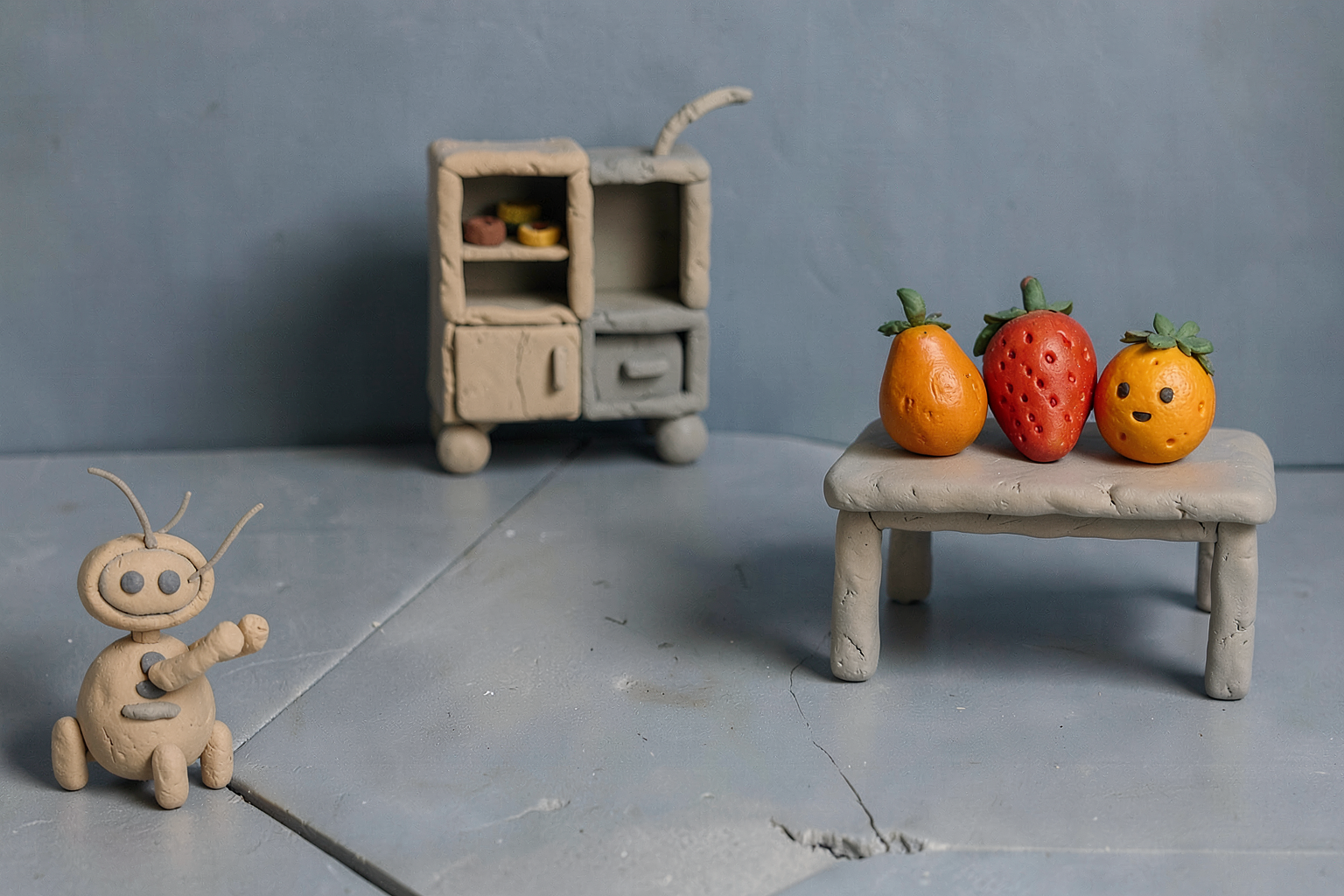
An orange can give this robot something to talk about without becoming the subject of a conversation. Say the configured command, let the camera recognize the fruit, and the proposed system adds a corresponding virtual character to a collection. The orange supplies the occasion; the robot supplies the souvenir. I’m interested in that conversion because it gives a household interaction a specific task and a visible result.
The application frames its problem around household robots with limited social functions and the wish to support people experiencing loneliness, including older people. Its concrete answer is a sequence of small activities: recognize an object, obtain a character, choose an upgrade, or chat. Those activities give the user things to request and see. Whether they become meaningful companionship is a separate question.
Published September 10, 2026, the application names National Chengchi University as applicant. The mechanism deserves attention on its own terms: it connects speech, household objects and a persistent collection rather than leaving every exchange to open-ended conversation. Primary application, paragraphs 0003 and 0038-0039.
Speech tells the camera when to look
The main sequence starts when the sound-receiving circuit detects sound in the robot’s activity area and converts it into a signal. Speech recognition turns that signal into text. The processor then checks whether the text matches a configured command keyword. In the described example, the phrase "I want to detect fruits" contains "detect fruits", which is enough to trigger the next step.
That match prompts the camera to capture an image. Image recognition checks for an object belonging to the relevant candidate types, such as an orange, guava or strawberry. Recognizing an orange selects its corresponding character from models already stored in the robot. Here, "model" means a virtual two-dimensional or three-dimensional character image, not a newly trained intelligence.
The system stores the selected character in its collection database and displays it. That is the part I find refreshingly concrete: the user can see what the request obtained. If the image contains no matching object, the described branch returns to checking speech when a new sound signal arrives. It does not describe conjuring a consolation character from an unsuccessful photograph. Primary application, paragraphs 0019-0020 and 0027-0039.
A character upgrade is a stored change of appearance
A second command takes the interaction from acquiring characters to upgrading them. The processor reads the collected characters and their levels, assigns each a number, and can display them sequentially with those numbers. The user then speaks the number of the character to upgrade. The robot has turned a collection into something the user can address by voice.
The upgrade itself follows a defined relationship between stored characters. In the example, characters belong to groups with level-one and level-two versions. Increasing a character’s level selects the corresponding higher-level model from its group and displays that version. The character grows up by becoming another stored picture. That makes the promised transformation easier to understand: the system chooses an appearance associated with the new level.
There is also a stated stopping point. If the group has no model for the increased level, the robot plays a prompt saying the character cannot be upgraded. I like seeing that boundary acknowledged. A visible collection needs understandable limits as well as attractive changes. Speech that matches neither the acquisition command nor the upgrade command can instead lead to a spoken response generated through language-model processing. Primary application, paragraphs 0040-0051.
The reward timer can run without a conversation
Other embodiments add timed rewards. The processor periodically draws a common character at random, stores it and displays it. A longer interval can produce a rare character. A shorter interval can supply an upgrade card, which a further embodiment checks for before allowing an upgrade. These schedules add another route into the collection alongside recognizing objects.
The detail that gives me pause is how the timer can start. In one embodiment, "interaction time" means elapsed time after power-on. The clock can be sociable even when nobody says a word. That distinction matters because receiving a reward after time passes does not, by itself, establish that an exchange took place.
My reading is that the proposal offers two different reasons to return: something the user deliberately obtains by showing an object, and something the robot awards on a schedule. Both can change the screen, but only the first route requires the particular speech-and-image sequence that makes the orange example distinctive. Primary application, paragraphs 0052-0058.
Collecting characters and making company
The application describes improved psychological state as an intended outcome. The passages describing these mechanisms do not establish that outcome with measured user benefits, nor do they provide recognition success rates or evidence that people sustain interest in the collection. I would keep those questions together: successful object detection, understandable upgrades and lasting social value are different things to demonstrate.
What holds my attention is the object-linked invitation. A person can ask the robot to notice something nearby and receive a lasting visual result. The remaining question is whether that collection gives the next conversation a reason to happen. A timer can add another character; I’d want to know whether the person wants to come back and talk about it.
The record, briefly. US20260263956A1, “Processing Method And Apparatus For Social Interactions With A Robot” A method for an interactive robot detects sound in an activity area, recognizes speech, checks for a first command keyword, captures an image, selects a new candidate character model, and updates storage to display that model.
More angles on this
- The Small Rearrangement Behind a Skin-Tone ScanAnother reading from the same G06V classification family, image or video recognition or understanding.
- When a Marker Gives Depth a ReferenceAnother reading from the same G06V classification family, image or video recognition or understanding.
- CPC G06V: Image or video recognition or understandingThe official classification family this record was filed into, published in the USPTO Cooperative Patent Classification scheme.
- CPC G10L: Speech analysis techniques or speech synthesisThe official classification family this record was filed into, published in the USPTO Cooperative Patent Classification scheme.
- Two Controller Grips, One Cord, and the Question of a Secure FitAnother reading from the neighbouring A63F classification family, card, board, or roulette games.
Read around this one:Public patent recordUSPTO published figure