Objects
Two Controller Grips, One Cord, and the Question of a Secure Fit
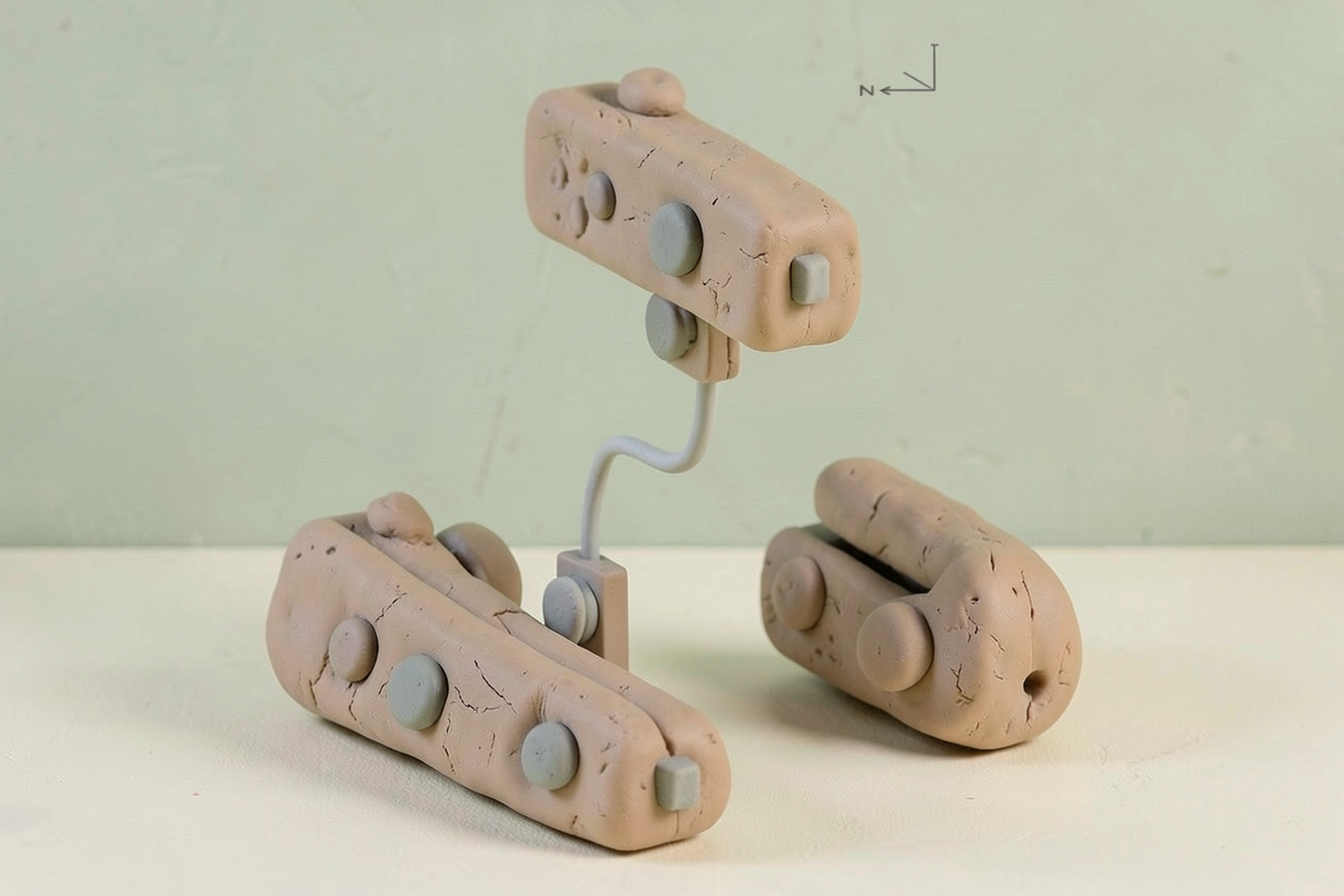
Sony's application proposes controller grips pulled against a phone by a flexible cord, with grooves and soft supports doing the delicate work of keeping it steady.

First, the setting
Handheld gaming combines two physical tasks: keeping a display visible and operating controls. Touchscreens put both tasks on the same object. Separate controls change where the fingers work, but also require a workable arrangement for supporting the screen.
Fit matters whenever an accessory attaches to a handheld device. Width, thickness and contact position affect how the pieces sit together. Controls must remain reachable while the assembly is held, and attaching or removing an accessory is itself part of using it.
What changes in this design
The application identifies the difficulty of holding a mobile screen while also using a separate operation device. Both tasks require the user's hands, making their physical arrangement part of the control problem.
The proposal attaches the right- and left-hand units to opposite device edges and connects them with a flexible cord. In the elastic implementation, the cord also supplies the pull intended to secure the assembly.
Bringing the controls onto the screen's edges addresses the holding problem directly. Its practical value depends on the combined behavior of the cord, edge contacts and rear supports, rather than on the availability of buttons alone.
The phone occupies the hands that need the controls
A phone and a separate game controller make an awkward demand: hold the screen where you can see it while keeping both hands available for the controls. I like that Sony's application starts with this physical problem. Before buttons can help, somebody has to decide what is holding what.
The proposal divides the controller into right- and left-hand units that engage opposite sides of a mobile device. A flexible cord joins them behind the screen. In the elastic version, stretching that cord produces the inward pull intended to hold the grips against the device. Here, the cord behaves more like a stretched waistband than a data cable.
Naoki Ogishita's application, naming Sony Interactive Entertainment Inc. as applicant, was published on September 10, 2026. Its title, Operation Device, undersells the interesting question: how can two separate grips form a secure handheld assembly around a screen that has no dedicated attachment mechanism? The described answer combines tension, shaped contact surfaces and deformable supports. Application, paragraphs 0004–0006 and 0050
The cord pulls; the grooves decide where
The distinction between a flexible cord and an elastic one matters. Flexibility lets a cord bend; elasticity lets it stretch and pull back. The application describes an elastic material such as rubber, but also allows a fixed-length cord for a predetermined device size and a version wound into a grip by a reel. Those are different ways of arranging the connection, not interchangeable descriptions of one component.
In the elastic implementation, each grip has an inward-facing groove that receives an edge of the phone. The described U-shaped groove reaches around that edge, including a surface facing the front of the device. The application explains that the cord's pull presses contact surfaces against the front and corresponding side of the phone.
The cord supplies the pull, but the groove geometry determines how the grip meets the device. Calling the result a squeeze leaves out the surfaces that make the squeeze useful. Meanwhile, placing the cord behind the phone keeps this connecting member away from the display. Application, paragraphs 0030–0036 and 0062
A generous groove needs a plan for wobble
The application recommends grooves wider than the device's thickness so the grips can accommodate different thicknesses. That sounds accommodating until clearance becomes movement. A groove that welcomes different thicknesses can also become a parking space for wobble.
The proposed response sits behind the phone. Projections extending from the grips carry deformable upper surfaces, with rubber or sponge given as examples, that contact the device's back. The description assigns these supports the job of stabilizing the assembly despite the wider grooves. It also proposes higher-friction material at contact areas. I find this combination more persuasive as an engineering explanation than elasticity alone: pull, support and resistance to sliding address different parts of the fit.
The unresolved issue is how those elements behave together. The described mechanism does not establish a measured range of holding forces, supported device dimensions, resistance to twisting or durability through repeated stretching. I'd want those quantities considered together: accommodating more sizes changes the fit, while the supports must take up clearance. The application presents stabilization as an intended result, not demonstrated performance. Application, paragraphs 0036–0039
The grips can join, but the cord stays
The proposal also lets the two grips couple without a phone between them. One described attachment fits over the rear projections, using narrowed openings that catch their wider tips. That gives the supports another job: the features that contact the phone's back can also help connect the grips into a separate controller.
Other described arrangements include an attachment with a slide pad and mechanisms that directly join the units, including magnets or a projection fitted into a hole. What interests me is the attempt to reuse the two hand units after removing the screen that originally sat between them.
Without the phone between them, the cord becomes a belt with no waist to fit. The application explicitly anticipates slack. Cutouts at the cord connections direct it upward when the grips move together, with the stated aim of keeping it from hanging toward the user's front. That modest routing detail earns its place: changing the controller's shape also changes where its loose cord wants to go. Application, paragraphs 0040–0049
A wire inside the elastic changes the bargain
In the main described implementation, each grip sends its inputs wirelessly to the mobile device. The connecting cord's mechanical role therefore does not require it to carry those signals. A separate wired arrangement adds a plug on one grip and routes the other grip's signals through a line inside the cord.
That introduces a specific tension within the tensioning member: its outer body can stretch, while the signal line needs protection from the resulting load. The proposed answer is spare line length within one or both grips. The wired connection may also carry power. I appreciate that the description acknowledges the difference between stretching the connection and stretching its contents.
My interest finally rests on the fit. The application offers several ways to connect controls, but its central proposition depends on two edge engagements and a rearward pull becoming a stable whole. How broadly can that arrangement accommodate device sizes while keeping the supports firmly seated? That is the question that separates an adaptable grip from an elastic promise. Application, paragraphs 0054–0060
The record, briefly. US20260263920A1, “Operation Device” An operation device fixed to a mobile device with a display includes right- and left-hand units connected by a flexible cord. Each unit has an abutment portion configured to abut a side surface of the mobile device, on opposite sides.
More angles on this
- The Bank Game That Updates Its Opinion of YouAnother reading from the same A63F classification family, card, board, or roulette games.
- A Dartboard Where One Bad Letter Can Restart Your WordAnother reading from the same A63F classification family, card, board, or roulette games.
- CPC A63F: Card, board, or roulette games; indoor games using small moving playing bodies; video games; games not otherwise provided forThe official classification family this record was filed into, published in the USPTO Cooperative Patent Classification scheme.
- Golf Scoring Between Screen and FieldAnother reading from the neighbouring A63B classification family, apparatus for physical training, gymnastics, swimming, climbing, or fencing; ball games; training equipment.
- A Small Condition Inside the HostAnother reading of a record filed by the same applicant, Sony Interactive Entertainment Inc..
Read around this one:Public patent recordUSPTO published figure