Field Notes
A Dartboard Where One Bad Letter Can Restart Your Word
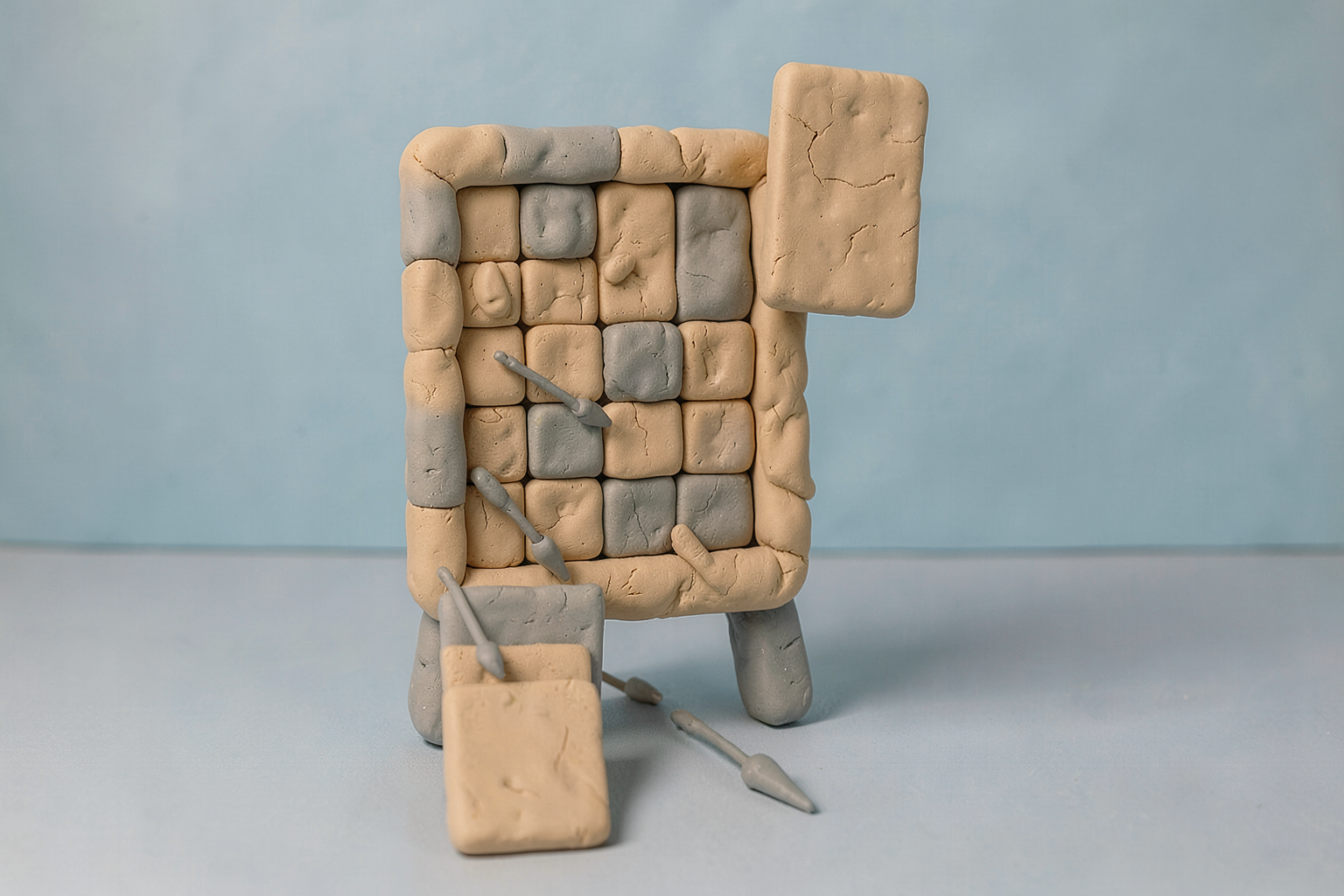
Cards set spelling and color challenges on this gridded dartboard, while tilted letters can restart a word, replace it, or send it to another player.

First, the setting
Dart games make a visible target into a shared physical challenge. Rules determine which hits count and what players pursue next. A board's markings therefore do two jobs: they give the thrower somewhere to aim and give everyone a way to interpret the landing.
During a turn, a player identifies the required target, aims, throws, and checks where the dart landed. Other players need to understand that result too. When a game uses sequences or special spaces, keeping track of progress becomes part of the activity alongside throwing.
What changes in this design
A simple target-selection game could give a player a card identifying a destination, then judge whether the dart reaches it.
Here, cards can establish a longer challenge, while special board squares change its progress or assignment. Other modes require alphabetic sequences or matching groups.
The game combines choosing targets with completing sequences under changing conditions. Selecting the correct square and successfully hitting it remain separate tasks.
Spelling with something that can miss
Knowing how to spell a word is one thing; landing its next letter with a dart is another. That gap is what interests me about Dart Throwing Game, published September 10, 2026. Its board carries letters, tilted letters, numbers, and symbols in a grid of squares. Players receive assigned darts, and cards drawn before throwing supply challenges. But the fuller idea goes well beyond having a card point at a square: some targets advance a word, while others change what you must do next.
The proposed game makes spelling depend on a sequence of physical hits. In its challenge word mode, you first strike an asterisk square, draw a category card, then attempt the letters spelling the object on that card in order. Knowing the answer doesn't complete the task. Your vocabulary can be impeccable while your elbow submits a different answer. I like that separation between choosing the right target and actually reaching it, especially because the board gives an errant throw consequences more specific than a disappointing score.
The tilted letters change the rules
The tilted letters aren't merely decorative versions of the alphabet. During the challenge word game, hitting a tilted R requires you to restart the spelling. A tilted X means drawing a new category card and starting over. A tilted S requires swapping category cards with another player; hit S more than once and you lose your remaining attempts for that turn. These are changes to the unfinished task, so the square you hit can matter well beyond that dart.
That S is the rule I'd most want to see played. A spelling challenge has an obvious private objective, but exchanging cards makes another player's unfinished business your own. The alphabet has acquired a surprisingly effective way to pass its problems around. I find this more distinctive than the simple fact that cards precede throws: the card establishes an objective, and the board can subsequently interfere with it. Whether those interruptions feel lively or exhausting would depend on play, not on how neatly the rules read.
Asterisks open the rounds
The board places asterisks in its four corners. In the challenge word game, the entry requirement increases across four rounds: one symbol hit to commence the first, then two, three, and four for the later rounds. Completing round four wins. I find that escalation easy to understand because it increases a requirement the player has already encountered. Before the spelling begins, there's a throwing task to clear.
Two numerical squares also alter spelling progress. One lets a player skip a letter; the other sends the player back to the previous letter. Each can be used only twice per round. There's a genuine clarity problem here: the published description prints both numerical labels as “−1,” despite assigning them opposite effects. I can't responsibly repair that into a presumed plus sign. As written, the rules need a clearer way to distinguish the helpful square from the punishing one.
That ambiguity matters because these squares offer a different kind of decision from simply pursuing the next letter. A permitted skip could shorten the route through a word, while the backward step lengthens it. I want those effects immediately recognizable from the throwing position. A shortcut loses some charm if identifying it requires a debate.
Color and column make another game
The battle cards use a different address system: a color and a numbered column. The column labels run from zero through eleven, and the board's marks have colors distributed across it. The supplied official Figure 7 shows cards labeled “Red 2,” “Yellow 9,” and “Orange 6.” A player must hit a square satisfying both parts of the instruction. A red mark elsewhere doesn't satisfy Red 2, and neither does a differently colored mark in column 2.
Here the player draws five battle cards, clears their targets, then draws another five. The battle game runs for four rounds, with completion of all four producing a win. I appreciate this alternative because it gives color a job beyond decoration. The word cards, meanwhile, carry words to spell, and category cards describe objects. These aren't interchangeable cards naming isolated destinations: they supply different kinds of challenges. The draw-before-throw sequence remains, but it doesn't mean drawing a fresh card for every dart.
One board, several kinds of progress
Other described modes use the markings without that card sequence. The alphabet challenge starts with a symbol hit, then requires letters in alphabetical order through Z. The match challenge progresses through a pair, two pairs, three of a kind, two sets of three, five consecutive letters, and six same-colored squares, before a tilted X finishes it. I can see the appeal of letting one grid support these different objectives, although remembering the current mode becomes part of playing.
The physical proposal is straightforward: a rectangular board mounted vertically, penetrable material such as compressed felt or cork, a surrounding rigid border, and pointed darts with grips and stabilizing wings. The published application describes these arrangements and rules; it supplies no playtest results establishing their pace or appeal. My strongest interest remains the spelling game, where a hit can advance, restart, replace, or exchange your assignment. I'd want to know whether players spend more time anticipating the next letter or recovering from the last interruption. That's the difference between a satisfying obstacle and a word that nobody gets to finish.
The record, briefly. US20260263913A1, “Dart Throwing Game” A vertically mounted dartboard uses a colored grid of letters, tilted letters, numerical squares, and corner asterisks. Assigned darts support alphabet, matching, spelling, and battle challenges. Word and category cards establish spelling assignments; tilted R, X, and S can restart spelling, replace the assignment, or exchange cards. Numerical squares change letter progress, although the published text labels both −1. Battle cards specify color-and-column targets and are drawn five at a time across four rounds.
More angles on this
- When a Game Character Crosses Servers, Who Supplies the Rest of the Scene?Another reading from the same A63F classification family, card, board, or roulette games.
- A Punching Bag Is Not Yet a PromiseAnother reading from the same A63F classification family, card, board, or roulette games.
- CPC A63F: Card, board, or roulette games; indoor games using small moving playing bodies; video games; games not otherwise provided forThe official classification family this record was filed into, published in the USPTO Cooperative Patent Classification scheme.
- When Golf Tape Hands Context to the ReaderAnother reading from the neighbouring A63B classification family, apparatus for physical training, gymnastics, swimming, climbing, or fencing; ball games; training equipment.
- The Signal Inside a Niraparib TabletAnother reading from the wider A61K classification family, preparations for medical, dental or toiletry purposes.
Read around this one:Public patent recordUSPTO published figure