Field Notes
Golf Scoring Between Screen and Field
Start with System and Method: A hybrid golf system senses a user's shots on a screen golf course. It keeps the central design choice visible.

First, the setting
Golf is often a social way to practice a sport, spend time outdoors, and compare how a round went. People keep track of each shot and the score for each hole, whether they are learning, playing with friends, or fitting practice into a busy day.
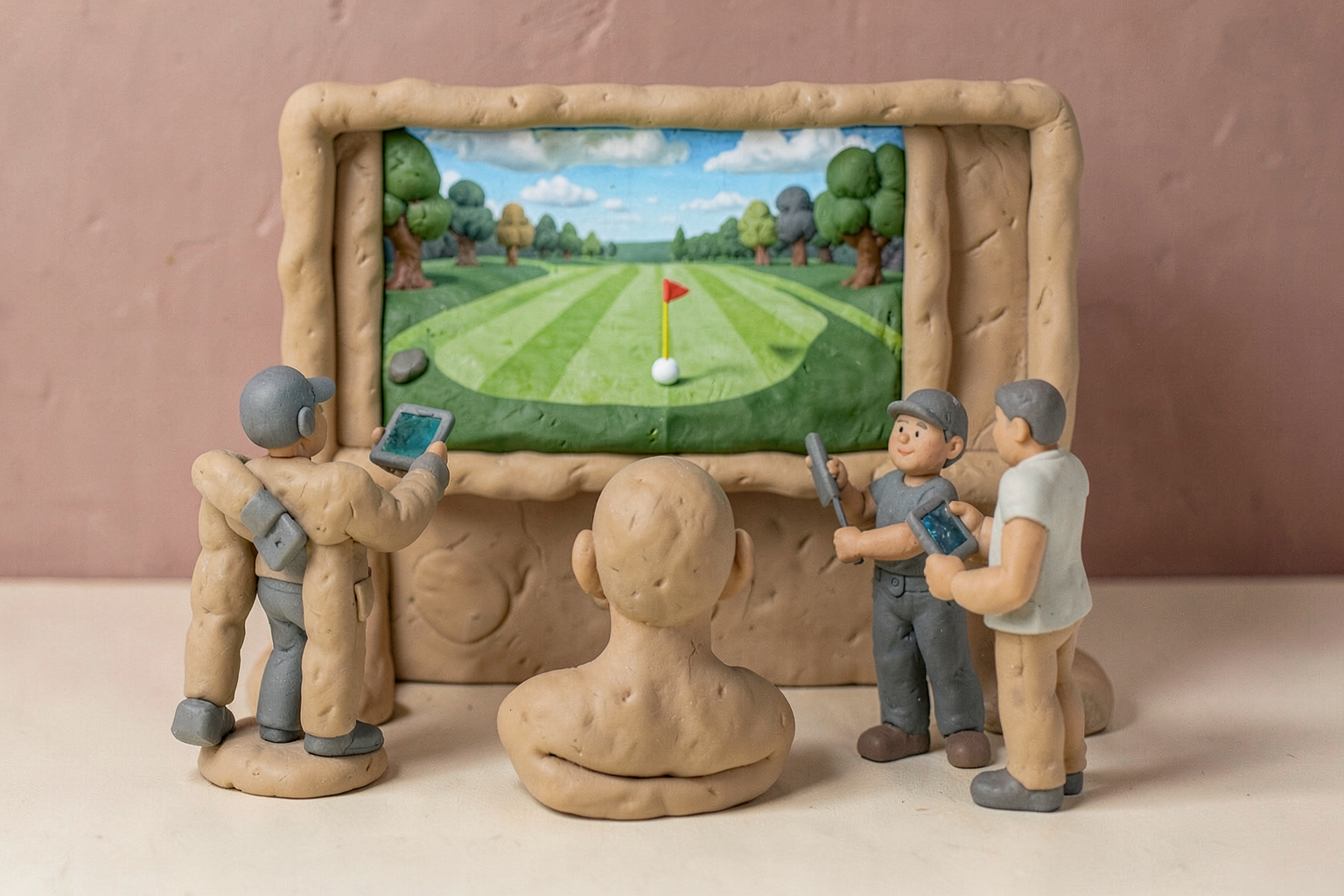
In an indoor golf bay, a player swings a club toward a screen showing a course. A device that detects the shot follows the ball's virtual path. Nearby players watch the display, while the golfer checks a mobile phone as the round's score is recorded.
What changes in this design
A reader might assume that scores for indoor screen golf and a later round on a real course are kept separately.
Here, shots on a screen golf course are sensed and turned into virtual ball movement. Each user's mobile terminal calculates scores for that virtual play and the successive play on an actual field.
This connects two golf settings within one scoring approach: a screen course and later play on an actual field. It helps explain that the phone is part of keeping score.
Separate Scorebooks, Familiar Default
Golf scoring usually seems to belong to the place where the ball is played: a screen-golf session keeps its own tally, while a later actual-field round begins another. The obvious headline of US20260263898A1, published September 10, 2026, is automatic scoring. The more useful question sits underneath it: what should a scoring routine preserve when play moves from a screen golf course to successive actual-field play? Not necessarily. The filing does not make the settings identical; it changes what the routine is asked to notice. You may recognize the old default because it feels efficient, almost too sensible to question. The published record made me look twice because that is a smaller and more interesting correction than a new tally alone.
That correction becomes clearer if you picture the arrangement before assigning it grander language. On a screen golf course, the system senses a user's shots and simulates virtual ball movement, meaning it represents the movement of a ball within the screen-golf setting. The patent places automatic score calculation with virtual play and successive actual-field play through each user's mobile terminal. The scene remains intentionally close to daily experience: one person, a screen course, a later field setting, and a portable device named as part of the scoring arrangement. Nothing in that picture requires you to collapse the two settings into one. The usual division has the air of a courteous librarian shelving two sessions on separate shelves. You can see why the filing gives you reason to pause at that shelf before deciding what a score is allowed to belong to.
That picture needs a few modest terms, since they do most of the work. “Hybrid” here identifies an arrangement that spans virtual play and successive actual-field play; it does not erase the difference between them. “Virtual ball movement” is the simulated movement just described, while “successive actual-field play” names the actual-field phase that follows virtual play. A “mobile terminal” is the user's mobile device as named in the filing, and the arrangement uses it in automatic score calculation. The words should be held at that scale. The patent names a sequence and its participants without requiring a larger story for the point at hand. The label has the air of a restrained committee agreeing that the handoff deserves a name. That restraint matters, because the next point concerns a mechanism rather than any broader outcome.
Mobile Terminal, Shared Sequence
With those terms in place, the mechanism can stay pleasingly plain. The filing describes a sequence in which the system senses a user's shots on a screen golf course, simulates virtual ball movement, and automatically calculates scores for virtual and successive actual-field play using that user's mobile terminal. Each part has a different job in the description: sensing responds to the user's shots, simulation supplies the virtual movement, and score calculation reaches the two stated kinds of play. The mobile terminal enters less like a trophy case and more like a patient stage manager keeping the sequence in view. That image does not make the device responsible for everything. It simply reflects that the filing gives the terminal a role in score calculation. A modest revision sits inside the routine: scoring is described in relation to the succession, not only to the first setting.
Because the terminal is named inside the calculation, the purpose comes into focus without becoming grand. The filing describes automatic calculation of scores for virtual play and for successive actual-field play, using each user's mobile terminal. Its purpose, at the level the published record provides, is therefore a scoring arrangement that addresses both named phases. The wording keeps the screen golf course and actual field as distinct settings while placing them in succession. What made me look twice was the refusal to let the familiar boundary do all the organizing. A routine can look settled until a tiny change in sequence reveals a question it had quietly avoided. That adjustment is modest enough to arrive without a brass band, yet specific enough to change the question you ask. The question is not whether one setting defeats the other; it is what, in this arrangement, is meant to be carried through the succession.
Scoring Across Two Settings
That question travels beyond golf without enlarging the facts at hand. When a routine moves between settings, you can ask a concrete first question: which information is meant to follow the person, and which is meant to remain tied to the place? You can ask a second: when a personal mobile device is included, is its role in the stated sequence clear enough for a reader to see? Those questions do not add a feature to this patent. They are transferable observations about where a routine draws its boundary. The first guards against treating every change of setting as a reset by reflex; the second guards against treating a named device as scenery. I think that is worth your attention here, because US20260263898A1 directs the eye to scoring at the point where virtual play is followed by actual-field play. The old default is tidy, like a label-maker that insists every context needs a fresh drawer. Do not let location decide the whole score.
The record, briefly. US20260263898A1, “Hybrid Golf System And Method For Automatic Scoring Using User’S Mobile Terminal In The Same” A hybrid golf system senses a user's shots on a screen golf course, simulates virtual ball movement, and automatically calculates scores for virtual and successive actual-field play using each user's mobile terminal.
More angles on this
- When Support Height Becomes the QuestionAnother reading from the same A63B classification family, apparatus for physical training, gymnastics, swimming, climbing, or fencing; ball games; training equipment.
- One Thread Between Two RidesAnother reading from the same A63B classification family, apparatus for physical training, gymnastics, swimming, climbing, or fencing; ball games; training equipment.
- CPC A63B: Apparatus for physical training, gymnastics, swimming, climbing, or fencing; ball games; training equipmentThe official classification family this record was filed into, published in the USPTO Cooperative Patent Classification scheme.
- A Small Condition Inside the HostAnother reading from the neighbouring A63F classification family, card, board, or roulette games.
- A Different Route for the Same DoseAnother reading from the wider A61K classification family, preparations for medical, dental or toiletry purposes.
Read around this one:Public patent recordUSPTO published figure