Field Notes
One Thread Between Two Rides
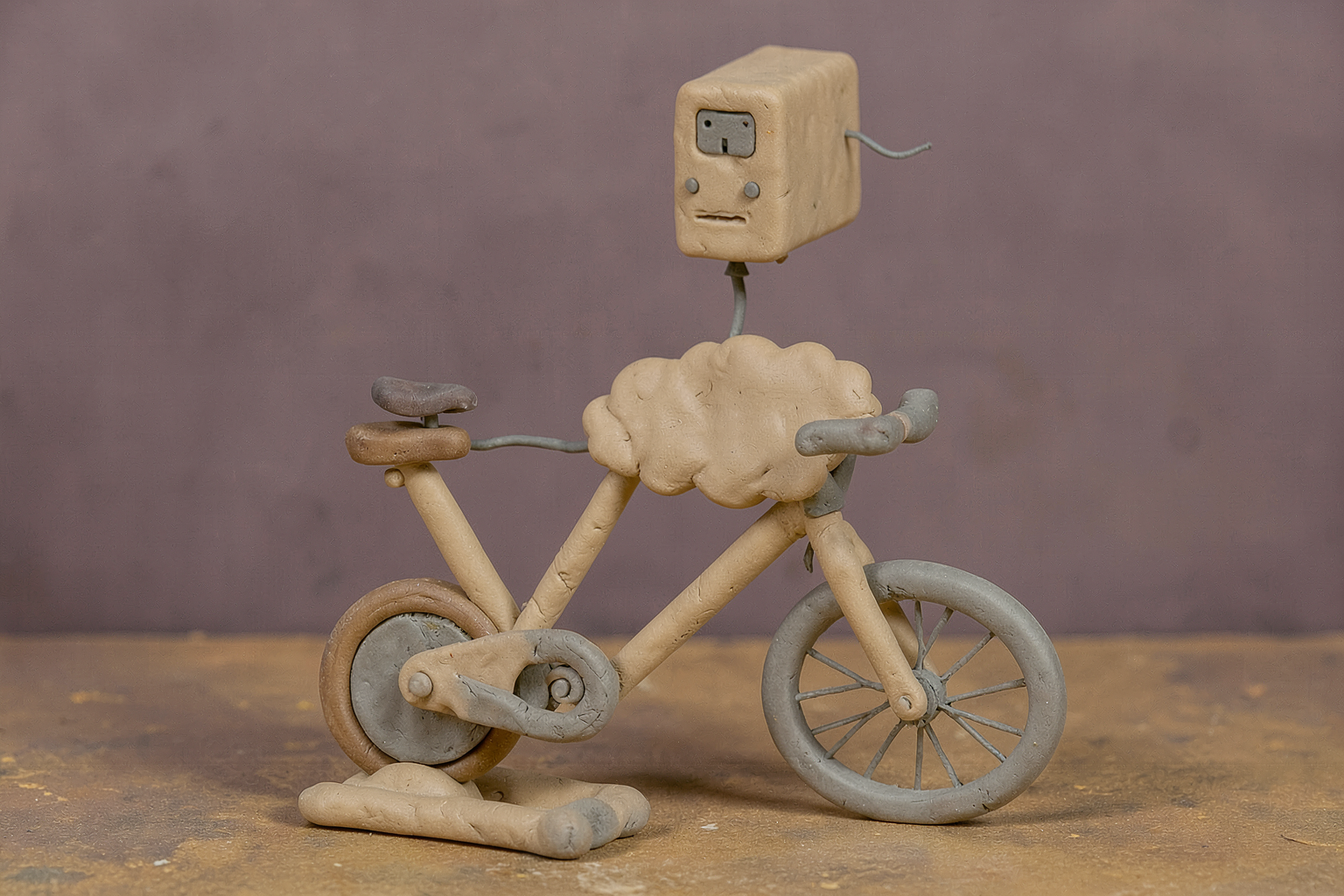
Exchange Data and Circuit form one stated connection: A system comprises a stationary bike and a bicycle configured to exchange data via a Wide-Area Network.

First, the setting
Many people want to exercise while staying close to home, especially when weather, schedules, or distance make an outdoor ride awkward. Pedaling indoors can feel quiet and solitary, so shared conversation and a sense of company can make the activity feel more connected to everyday social life.
At home, a person pedals a stationary bike while looking at a screen and speaking toward a microphone. Elsewhere, someone rides a bicycle and hears the conversation through a speaker. A camera may show a face or the surrounding path, while people nearby notice the rider talking as they move.
What changes in this design
A reader might assume a stationary bike session and a bicycle ride happen separately, without a built-in way for the two users to communicate by sound over a long-distance network.
Here, the stationary bike and bicycle are configured to send information back and forth through a wide-area network. That connection enables audio interaction between their users. The embodiments can include microphones, speakers, processing circuits, a camera, and a screen.
It shows that the focus is connecting the people using two kinds of bikes, not only the bike hardware itself. The record establishes audio interaction, but does not state the roles of the camera, screen, or processing circuits.
Stationary Bike, Distant Bicycle
The arrangement gives two rides one thread. Picture yourself settling on a bike that stays in one place while another user is on a bicycle elsewhere: a familiar beginning, then a line reaching outward. The patent, published September 10, 2026, as US20260263875A1, is titled System For Physical Activity, And Related Method. What made me look twice was the modest pairing of a stationary bike and a bicycle configured, or set up, to exchange data. The arrangement feels less like two people starting the same workout and more like two rooms agreeing to leave a door ajar. The picture begins with common equipment, but its after-effect appears in the relation between the two sides. That is an observation from the published arrangement, not a report of how any particular ride feels.
That door image needs ordinary labels before it can carry much weight. A stationary bike is a bike that remains in place, while the bicycle is named alongside it as the other part of the system. The filing says the two are configured, meaning set up, to exchange data through a Wide-Area Network. A Wide-Area Network is a connection that can span distant places. The stated purpose is audio interaction between users, meaning an exchange of sound between them. The Wide-Area Network has the air of a patient stage manager rather than a loud new companion. That image may seem fussy, yet it puts the route and the human-facing purpose in their proper places. You are being asked to notice a relationship, not a grand new identity for either bike.
Data, Sound, and Sight
Once that route and purpose are held apart, the next part becomes easier to read. The purpose named in the published record stays narrow: audio interaction between users. For you, the practical diagnostic is to ask what a distant link is meant to keep available after the obvious activity has begun. Here, the supported answer is sound exchanged between users, not a larger tale we might be tempted to supply. The patent also describes some versions with microphones and speakers, the parts that take in and play sound. That makes the interpretive order useful: identify the two kinds of bike, name the network route, and then keep the sound exchange in view. In other words, the order prevents the familiar machines from disappearing behind the connection.
Because that purpose remains narrow, the other described parts can be named without asking them to become more than they are. Some versions include microphones, speakers, processing circuits, a camera, and a screen. A processing circuit is an electronic component that handles signals; a camera captures an image; a screen displays one. The filing describes those parts in versions of the arrangement, while allowing the reader to see that image-related pieces are also present. The screen and camera are less like a scoreboard and more like a small window that knows it should not interrupt. That comparison stays deliberately bounded: it is a way to notice the listed components, not a statement about what a user sees, does, or achieves. The components form a case to consider, not a stage on which to invent an outcome.
Against that collection of parts, an ordinary choice comes into view: whether the thread between people is carried wholly by them or partly by the arrangement around them. Imagine the broad version as two people maintaining contact by themselves, with every lapse or handoff resting in their own coordination. This filing describes a different organizational gesture, in which a stationary bike and a bicycle exchange data through a Wide-Area Network and support audio interaction between users. The contrast is not a contest between kinds of rides, and no score is needed for it. It is a change in who carries the burden: less of the thread sits with the user alone, and more is assigned to the named bikes, network, and components. What I think is worth your attention is this transfer before any sweeping conclusion is added to it.
Who Holds the Thread
After that burden shifts, two transferable observations stay close to the ground. Familiar objects do not need to be remade to change the shape of a shared moment; the stationary bike and bicycle remain recognizable while their connection is given a role. Technical parts also deserve plain names before they receive grand meanings: a microphone takes in sound, a speaker plays it, and a Wide-Area Network spans distance. I leave the patent with a smaller question than I began with: when an ordinary choice puts a thread between two users, which side should carry it? US20260263875A1 does not settle that question for every setting. It gives the question a compact frame: two kinds of bike, data across a Wide-Area Network, and audio interaction held in the space between. That after-effect is memorable, but it goes no farther than the published arrangement.
The record, briefly. US20260263875A1, “System For Physical Activity, And Related Method” A system comprises a stationary bike and a bicycle configured to exchange data via a Wide-Area Network, enabling audio interaction between users; embodiments use microphones, speakers, processing circuits, a camera, and a screen.
More angles on this
- The Small Condition Beneath a Cycling System's Big SwitchAnother reading from the same A63B classification family, apparatus for physical training, gymnastics, swimming, climbing, or fencing; ball games; training equipment.
- A Cart Container at the Moment of HandoffAnother reading from the same A63B classification family, apparatus for physical training, gymnastics, swimming, climbing, or fencing; ball games; training equipment.
- CPC A63B: Apparatus for physical training, gymnastics, swimming, climbing, or fencing; ball games; training equipmentThe official classification family this record was filed into, published in the USPTO Cooperative Patent Classification scheme.
- CPC B62J: Cycle saddles or seatsThe official classification family this record was filed into, published in the USPTO Cooperative Patent Classification scheme.
- Inside toolAnother reading from the neighbouring A63H classification family, toys, e.g. tops, dolls, hoops or building blocks.
Read around this one:Public patent recordUSPTO published figure