Field Notes
When Support Height Becomes the Question
Flat Circular Disc is in this setup, this is a thin, round piece with a level face, like a flat coin or plate. Its particular job is not stated.
First, the setting
Strength training often involves lifting a heavy bar from a rack, lowering it with control, and returning it safely when the effort is finished. People use this kind of exercise to build confidence, practice movement, and challenge their bodies. The difficulty is that a lift can become hard to manage when no nearby training partner is available.
In a home gym or training room, a person stands or lies beneath a loaded barbell and moves it through a lifting motion. A support device sits close to the bar and can be positioned near the person’s working height. If the bar needs to come down, the nearby support changes where it can rest.
What changes in this design
In this context, a spotter means another person present during a weightlifting exercise. Other usual setups are not stated.
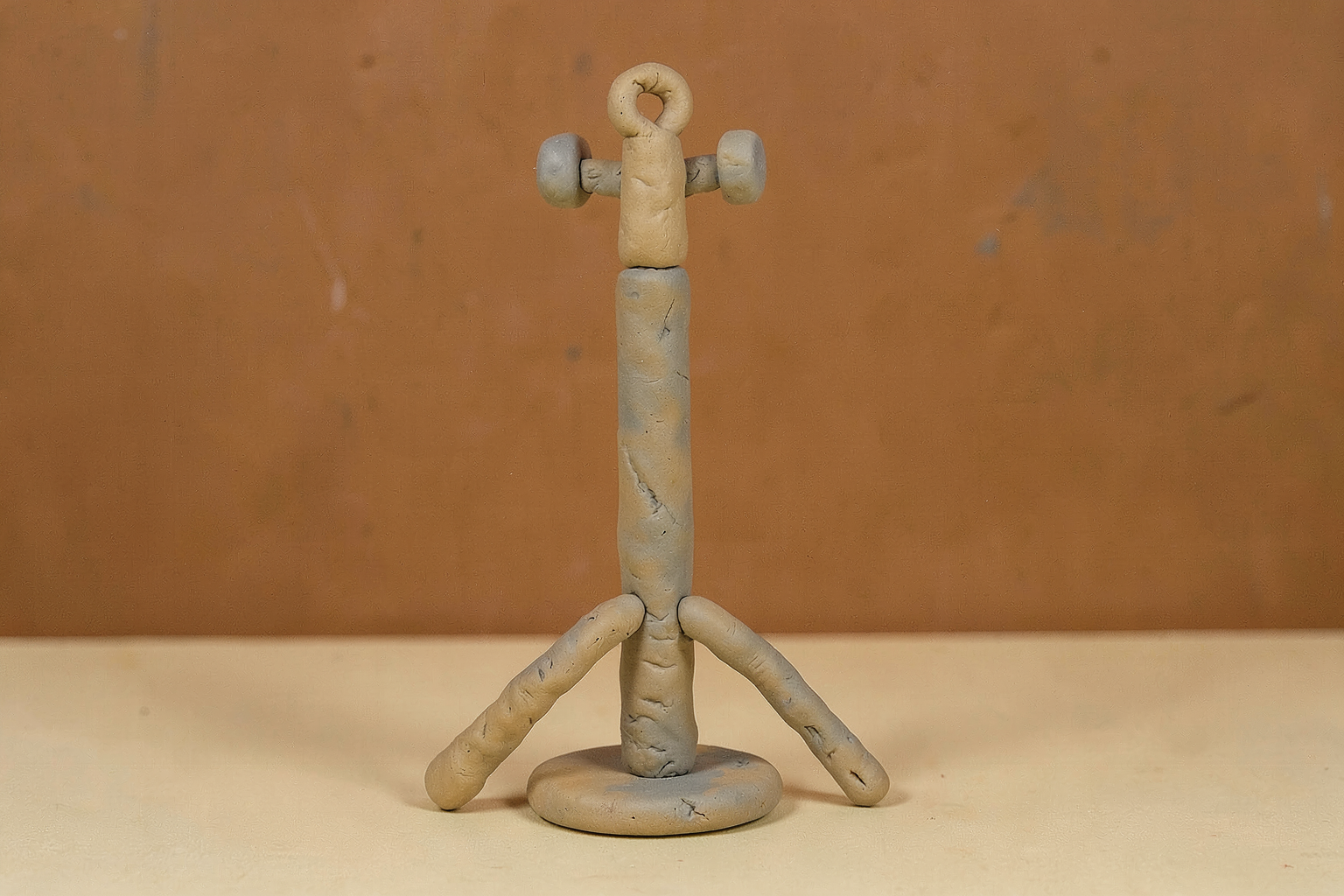
Here, an attachment fits on the barbell and allows the user to adjust support height. It is intended for weightlifting exercises without a spotter, and includes a vertical support, a flat round piece, and three arms.
The focus is on setting a support height so a person can do weightlifting exercises without a spotter. Details about how adjustment or operation works are not stated.
Barbell, Attachment, and Support Height
When a barbell needs a support point and no spotter is nearby, what should happen at the boundary between the bar and the attachment? That is the practical question that pulled me into US20260263863A1, published September 10, 2026, under the title Self Spotting Barbell Attachment. The filing describes an attachment that fits on a barbell and lets a user adjust support height for weight lift exercises without a spotter. That places the attention not on a grand new ritual around lifting, but on the exact moment when the bar meets a supporting arrangement. The arrangement feels less like a dramatic rescue and more like a quiet stage manager waiting at the right height. What made me look twice was the restraint of that proposition: rather than asking you to imagine an unseen helper, it asks you to notice where assistance is positioned. For you, the useful opening question is therefore not whether the attachment changes lifting, a conclusion the published record does not establish, but where a system puts assistance when a task calls for it.
Parts at the Meeting Point
That question becomes clearer once the picture stays deliberately small. The filing generally places a vertical support, a flat circular disc, and three support arms in the attachment, alongside its fit on the barbell and adjustable support height. A vertical support is the upright element named in the description; a flat circular disc is a round, flat piece; and support height is simply the height at which support can be set. The three support arms are three named supporting pieces in that arrangement. A flat circular disc has the air of a patient little table that knows its only job. Yet the published record does not give this reader permission to assign every unseen connection or movement to those parts, so their relations deserve to remain a picture, not a made-up blueprint. That restraint matters because words like attachment and support can sound finished while still leaving the precise assembly outside what was provided.
With that picture in hand, the mechanism can be understood at the level the filing supplies. The attachment fits on the barbell, and the user can adjust its support height to perform weight lift exercises without a spotter. That is the whole transfer worth holding onto: an adjustable relationship is assigned to the boundary where the barbell and attachment meet, while the vertical support, flat circular disc, and three support arms give the described arrangement its visible vocabulary. The three support arms have the air of a small committee: present, practical, and unlikely to request a spotlight. More importantly, the components are not a license to claim a particular sequence, load behavior, or outcome, because the published description here does not provide those particulars. The mechanism is therefore best read as an organizational move: identify the place where a task needs adjustable support, then gather named parts around that point.
Adjustable Support as a Design Question
That organizational move makes the contrast observable before it becomes ambitious. Before the attachment enters the picture, the question is framed around a barbell and the possible presence of a spotter; after it enters the picture, the filing directs attention to an attachment on the barbell with support height the user can adjust. The difference is not a proven improvement, and it should not be dressed up as one. It is a shift in where you look: from the person who might stand nearby to the adjustable support described at the bar. The arrangement is less like replacing a human story and more like moving a label from the edge of a page to the line it clarifies.
That before-and-after supplies a design observation you can carry away without borrowing any unprovided result. A boundary becomes easier to discuss when the adjustable condition is named plainly: here, support height is not atmosphere, it is the setting the user can adjust. A second observation follows from the same picture: a collection of parts becomes more legible when it is introduced as a working picture before it is turned into jargon. The upright support, round disc, and three arms give the eye handles without pretending to fill in every detail. I think that distinction is worth attention because it keeps curiosity useful. It lets you ask what a system is arranging before you announce what it achieves.
From there, the takeaway stays modest. A barbell attachment described in a published record can prompt a broader systems question without proving a broad conclusion: when support must be adjustable, which boundary deserves the clearest explanation? For this filing, the answer presented is the meeting of a barbell with an attachment whose support height can be changed, described through a vertical support, flat circular disc, and three support arms. I cannot tell from this material exactly how those elements connect or behave, and the interesting thing is that you do not need to pretend otherwise to learn from the framing. Try a small experiment the next time an everyday object has to bridge two things: point to the boundary, name the setting that can change, then separate the visible parts from the outcome you merely hope for. If the picture becomes clearer, the question has done its quiet work.
The record, briefly. US20260263863A1, “Self Spotting Barbell Attachment” A self spotting barbell attachment fits on a barbell and lets users adjust support height to perform weight lift exercises without a spotter; it generally includes a vertical support, a flat circular disc, and three support arms.
More angles on this
- A Weightlifting Machine’s Setting Is Not Yet a PromiseAnother reading from the same A63B classification family, apparatus for physical training, gymnastics, swimming, climbing, or fencing; ball games; training equipment.
- When Green Measurements Leave Room for JudgmentAnother reading from the same A63B classification family, apparatus for physical training, gymnastics, swimming, climbing, or fencing; ball games; training equipment.
- CPC A63B: Apparatus for physical training, gymnastics, swimming, climbing, or fencing; ball games; training equipmentThe official classification family this record was filed into, published in the USPTO Cooperative Patent Classification scheme.
- The Quiet Boundary Between a Tabletop Game and Its MemoryAnother reading from the neighbouring A63F classification family, card, board, or roulette games.
- When a Tableware Cabinet Takes On More of the ChoreAnother reading from the wider A47L classification family, domestic washing or cleaning ; suction cleaners in general.
Read around this one:Public patent recordUSPTO published figure