Objects
When a Tableware Cabinet Takes On More of the Chore
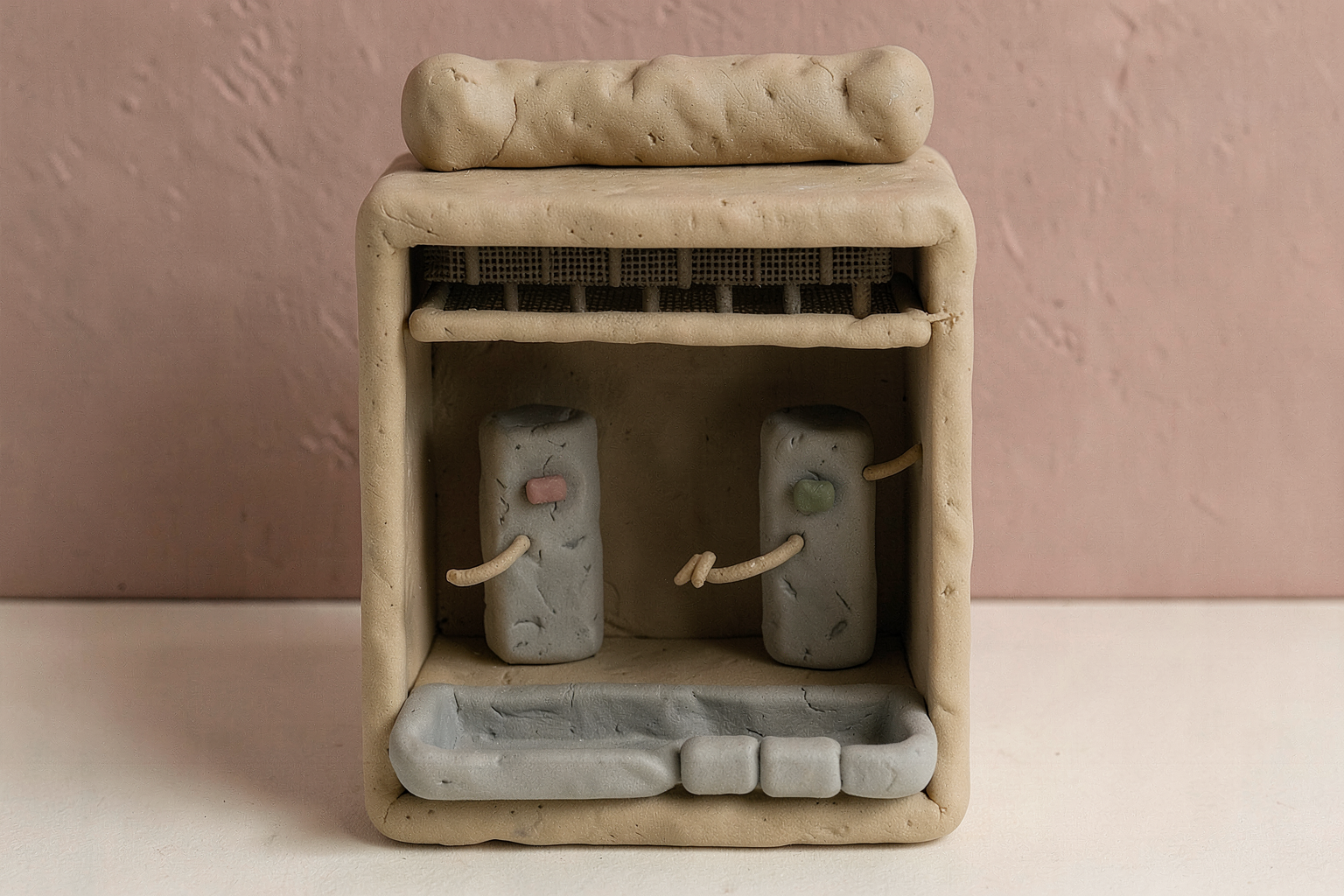
Start with Device and Key detail: A household appliance has a closable cabinet, washing-water and detergent supply devices, a water-collection compartment, and shelves.

First, the setting
After meals, dishes collect food residue, grease, and moisture. Cleaning them takes time and attention, especially when a household has shared meals and a busy kitchen. People look for practical ways to keep tableware clean, orderly, and ready for the next use.
In a kitchen, someone opens a cabinet-style appliance and places plates, cups, and utensils on shelves or racks. Water moves through the interior with detergent, while the door stays closed during the washing cycle. Later, the person unloads clean tableware and puts it away.
What changes in this design
A reader might expect tableware to be washed in one appliance and kept in a separate cupboard or cabinet afterward. Interior walls may simply be ordinary surfaces.
Here, one closable cabinet combines shelves for storage with water and detergent supplies for washing. Its inner walls are made to repel water or otherwise resist adhesion, and its first supply device can move between resting and working positions.
It is worth knowing because the cabinet is presented as a place for both washing and keeping tableware, with attention to what happens on its interior walls.
Walls Take the Question
A closable cabinet, shelves, supplies for washing water and detergent, a water-collection compartment, and a first supply device that moves between rest and operational positions form the obvious headline: a household appliance for washing and storage of tableware. The more useful question is quieter: when tableware is both washed and stored in this arrangement, which part of the system is expected to carry the awkward attention that might otherwise fall on you? The published record, US20260262914A1, dated September 10, 2026, does not ask us to imagine a grand new ritual. It points instead to a cabinet whose interior and one supply device are asked to take on defined roles. That is the arrangement that made me look twice, because ownership can change long before anyone gives the change a name.
That question becomes clearer once the patent's wall language is taken seriously. Hydrophobic means resistant to water. Preventing adhesion means making it harder for something to stick. The filing describes inner walls that are chemically or mechanically hydrophobic or that prevent adhesion, and it does not ask the reader to choose an unlisted reason for either condition. This language is less like an instruction to a person than a quiet reassignment of duties to a surface. The distinction is modest, yet it steers attention away from a vague promise of cleanliness and toward the particular place where the arrangement puts responsibility: the cabinet's inner walls.
Cabinet Roles in Motion
With the terms set, the patent offers a compact picture rather than a full domestic drama. A closable cabinet supplies the enclosure; shelves supply places for tableware; washing-water and detergent supply devices are named alongside them; and the water-collection compartment is a compartment for collecting water. Those are ordinary pieces described together, but their placement holds the thread from the walls: the surroundings are not mere backdrop. The cabinet has the air of a librarian who has been asked to mind the room as well as hold the books. That image matters only as a way of seeing the arrangement clearly, not as a claim about results: the published record identifies components and wall properties, not a measure of how any task turns out.
From that picture, the mechanism worth watching is the stated movement of the first supply device. A rest position is the position identified as rest, and an operational position is the position identified as operational; the filing says the first device moves between them, but supplies no further choreography in the facts here. The first supply device has the air of a stage manager, waiting in a rest position before an operational position calls it forward. Yet the sober point survives the image. A component that occupies two named positions makes its role visible as a change of placement, while the walls make their role visible by their condition. One part changes where it is; another is described by what its surface resists or prevents. Together, those details are where the system begins to redistribute attention.
That redistribution supplies the counterpoint to the obvious headline. The comparison is not between a supposedly better appliance and an ordinary one, because the filing gives no basis for that contest. It is between two ways of assigning burden in your mental picture: a broad version leaves the interior as a passive setting and leaves more of the noticing with the person, while this arrangement directs attention to an interior wall condition and a supply device that shifts position. A cabinet can be less like a mute container and more like a quiet committee assigning jobs to its own parts. The transferable observation is concrete: whenever a system names both a surface condition and a movable element, ask which attention each is meant to carry, and do not let a broad label hide that division.
Burden at the Cabinet Door
For your own field test, keep the question at the cabinet door: what has been asked to do the noticing, the user or the arrangement? First, separate the task from the components that carry it. A device may be called household equipment for washing and storage, but this published record directs the eye to a closable cabinet, shelves, washing-water and detergent supplies, water collection, treated-or-nonadhering inner walls, and one first supply device that changes between named positions. Second, ask whether the responsibility has moved from a person's repeated attention to a physical condition or a part's placement, without pretending that the document proves an outcome. I think that is worth your attention because it is a small but durable systems habit: look for the moment the burden changes hands. Here, the handoff stays bounded by the published description, but the cabinet no longer reads as scenery; it reads as part of the assignment.
The record, briefly. US20260262914A1, “Household Appliance For Washing And Storage Of Tableware” A household appliance has a closable cabinet, washing-water and detergent supply devices, a water-collection compartment, and shelves. Its inner walls are chemically or mechanically hydrophobic or prevent adhesion, and the first supply device moves between rest and operational positions.
More angles on this
- When Dirty Water Talks Back: Turbidity as the Cue in a Floor ScrubberAnother reading from the same A47L classification family, domestic washing or cleaning ; suction cleaners in general.
- Two Liquids at the Dock: A Question About Cleaning BoundariesAnother reading from the same A47L classification family, domestic washing or cleaning ; suction cleaners in general.
- CPC A47L: Domestic washing or cleaning ; suction cleaners in generalThe official classification family this record was filed into, published in the USPTO Cooperative Patent Classification scheme.
- Flip-Up Potty Seat: The Quiet Question of Where a Child's Seat Waits Between UsesAnother reading from the neighbouring A47K classification family, sanitary equipment; accessories therefor, e.g. toilet accessories.
- The Small Condition Beneath a Cycling System's Big SwitchAnother reading from the wider A63B classification family, apparatus for physical training, gymnastics, swimming, climbing, or fencing; ball games; training equipment.
Read around this one:Public patent recordUSPTO published figure