Machines
When Dirty Water Talks Back: Turbidity as the Cue in a Floor Scrubber
Controller plus Scrub-Brush Force carry the practical point: A floor treatment machine has a wet-process system and controller that dispense and agitate cleaning solution.

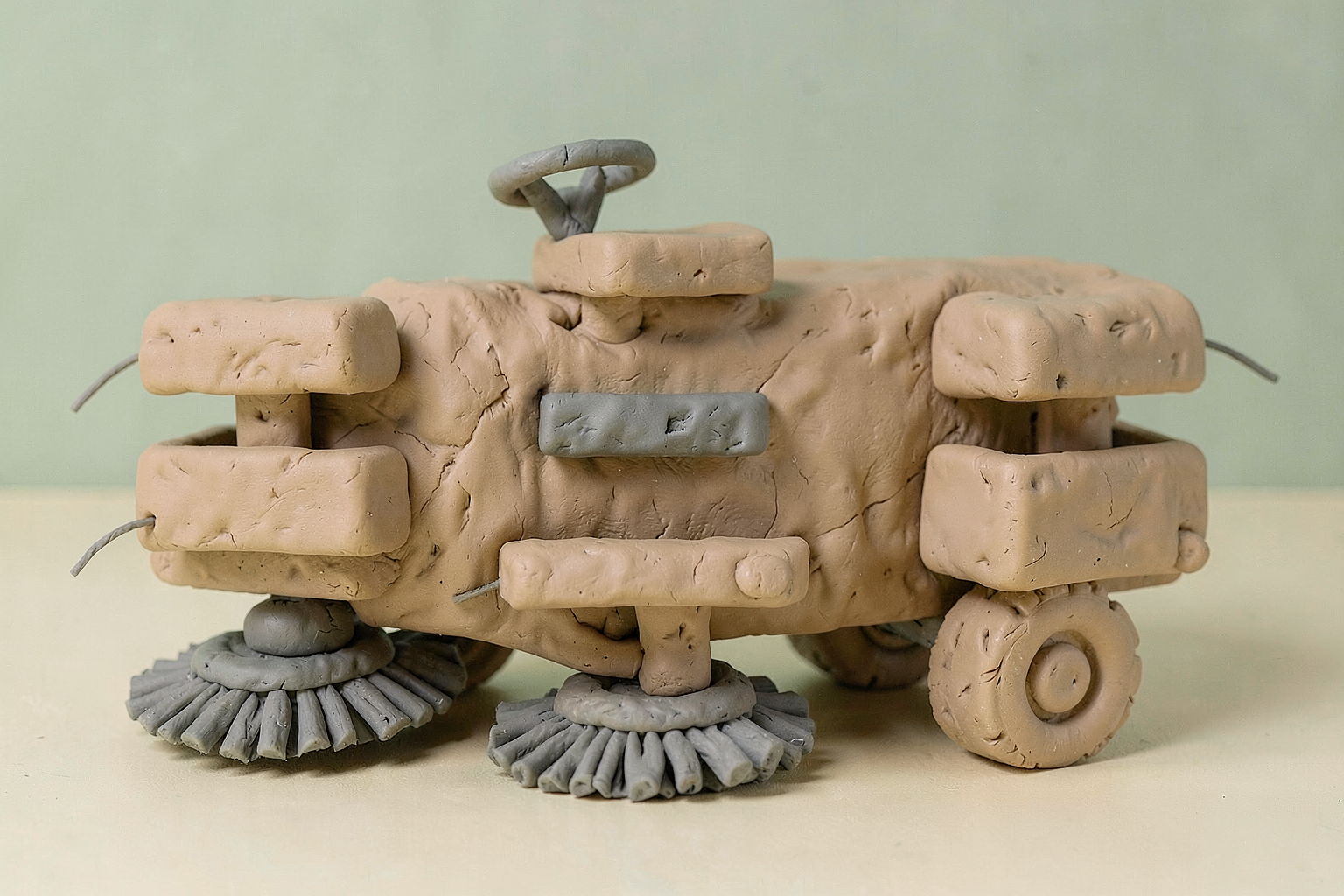
First, the setting
Floors in busy places collect tracked-in dirt, drink spills, dust, and marks from everyday traffic. People clean them so shared spaces feel cared for, safer to walk through, and ready for the next wave of visitors.
In a grocery aisle after a spill, a worker guides a wheeled floor-cleaning machine along the tiles. Water and cleaning liquid reach the floor, brushes turn underneath, and the machine draws damp liquid back up. Nearby, shoppers hear the low mechanical sound and step around the freshly cleaned path.
What changes in this design
Many readers would picture a floor scrubber using the same liquid flow, detergent amount, and brush pressure throughout a cleaning pass.
Here, the machine checks turbidity, meaning the cloudiness of liquid it has collected. Its controller uses that reading to alter solution flow, detergent concentration, or scrub-brush force.
The collected liquid becomes part of the machine's decision-making. What cloudiness levels trigger changes, and what cleaning result follows, are not stated.
From dispensed solution to cloudy return
If you watched a floor scrubber cross a lobby, could you tell when it decided to work harder? The filing for US20260262896A1, published September 10, 2026, under the title Adaptive Wet-Process Systems And Methods For Floor Treatment Machines, suggests the answer lives in a handoff most people never think about. Cleaning solution goes down, a scrub brush agitates it against the floor, and then the machine pulls the used liquid back up. That return trip is where the timing gets interesting, because the liquid coming back carries a record of what it just met. The filing describes a controller that looks at that recovered liquid and lets what it finds shape the settings that follow. The dirty water stops being waste and starts behaving less like trash and more like a report card handed back to the scrubber. What made me look twice is the direction of the information: it flows backward, from the end of the process to its start, in one continuous loop.
Turbidity, the controller, and three adjustable settings
That loop only makes sense once the parts have names, so here they are in short steps. The wet-process system is simply everything that handles liquid: it dispenses cleaning solution onto the floor, agitates it with a scrub brush, and recovers the liquid afterward. The controller is the decision-maker that coordinates those steps. Turbidity is the one specialist word worth learning here; it means how cloudy a liquid is, how much suspended material keeps light from passing cleanly through it. Clear water has low turbidity, and water full of loosened grime has high turbidity. The filing describes the machine detecting the turbidity of the recovered liquid, which treats cloudiness as a readable parameter rather than an unpleasant side effect. The controller has the air of a stage manager watching the wings, waiting for a cue that arrives in a bucket.
With those roles assigned, the mechanism reads as a sequence of handoffs. First, solution leaves the machine and meets the floor. Second, the brush works it in. Third, the machine recovers the liquid and the turbidity reading is taken. Fourth, the controller adjusts one of three things: solution flow, meaning how much liquid is dispensed; detergent concentration, meaning how strong that liquid is; or scrub-brush force, meaning how hard the brush presses. The filing names those three as alternatives, joined by an or, so the machine has more than one way to respond to the same cloudy reading. I think that detail deserves attention, because a single sensed parameter feeding several possible adjustments is a different design from one sensor tied to one dial. It is as if the mop bucket had been given a clipboard and a quiet vote on what happens next.
Before and after the cloudiness check
So why route the decision through the recovered liquid at all? The purpose, as the filing frames the arrangement, is adaptation: the wet process changes its settings in response to what the floor actually gave back, rather than holding whatever settings were chosen at the start. The name itself, adaptive wet-process systems, says as much. The patent does not need to promise any particular result for the logic to be clear, and nothing here should be read as one. What it offers is a place to look. The end of a cleaning cycle carries evidence about the beginning, and the filing chooses to listen at that point instead of guessing upstream.
That choice is easiest to see as an observable before-and-after. Before, picture an ordinary wet-cleaning routine: someone picks a solution setting, a detergent mix, and a brush pressure, and those stay put across the whole floor whether a patch is lightly dusty or heavily soiled. After, picture the arrangement in this filing: the same three settings exist, but each one can shift once the recovered liquid shows how cloudy it is. The distinction is not that one machine cleans and the other does not; both dispense, scrub, and recover. The distinction is when the decision gets made. In the ordinary version it happens once, before the work begins. In the filed version it is tied to a handoff that keeps recurring, the moment used liquid comes back and gets read. Nothing in the filing tells me how that compares in practice, so the contrast here is about structure, not scorecards.
That structural point travels well beyond floors, which is why it seems worth your attention. One transferable observation is that the output of a process is often the cheapest sensor you already have, if you decide to read it. Another is that tying a reading to several possible responses, rather than one, gives a system room to choose the adjustment that fits. A third is that the timing of a handoff matters as much as its contents: information that arrives after the work is still useful if the loop is short enough to act on it. Here is a small experiment for this week. Pick a routine you repeat, such as rinsing dishes or editing a draft, and notice what comes out at the end. Ask whether that leftover could tell you to change the amount, the strength, or the force of the next round. My guess is that you will find at least one quiet report card you have been pouring away.
The record, briefly. US20260262896A1, “Adaptive Wet-Process Systems And Methods For Floor Treatment Machines” A floor treatment machine has a wet-process system and controller that dispense and agitate cleaning solution, recover liquid, detect recovered-liquid turbidity, and adjust solution flow, detergent concentration, or scrub-brush force based on that parameter.
More angles on this
- Two Liquids at the Dock: A Question About Cleaning BoundariesAnother reading from the same A47L classification family, domestic washing or cleaning ; suction cleaners in general.
- A Dishwasher Sprayer's Quiet Lesson in AlignmentAnother reading from the same A47L classification family, domestic washing or cleaning ; suction cleaners in general.
- CPC A47L: Domestic washing or cleaning ; suction cleaners in generalThe official classification family this record was filed into, published in the USPTO Cooperative Patent Classification scheme.
- CPC A46B: BrushesThe official classification family this record was filed into, published in the USPTO Cooperative Patent Classification scheme.
- A Toilet Seat and the Consequence of a Powered MoveAnother reading from the neighbouring A47K classification family, sanitary equipment; accessories therefor, e.g. toilet accessories.
Read around this one:Public patent recordUSPTO published figure