Machines
A Toilet Seat and the Consequence of a Powered Move
Assembly plus Sensor-Based Control carry the practical point: An automatic toilet seat assembly has electrical.

First, the setting
Bathrooms are places where people expect privacy, cleanliness, and simple routines. Shared spaces especially need fixtures that can be used by many people and then kept ready for the next person. That everyday concern leads people to explore ways of handling movement, cleaning, and contact around a toilet.
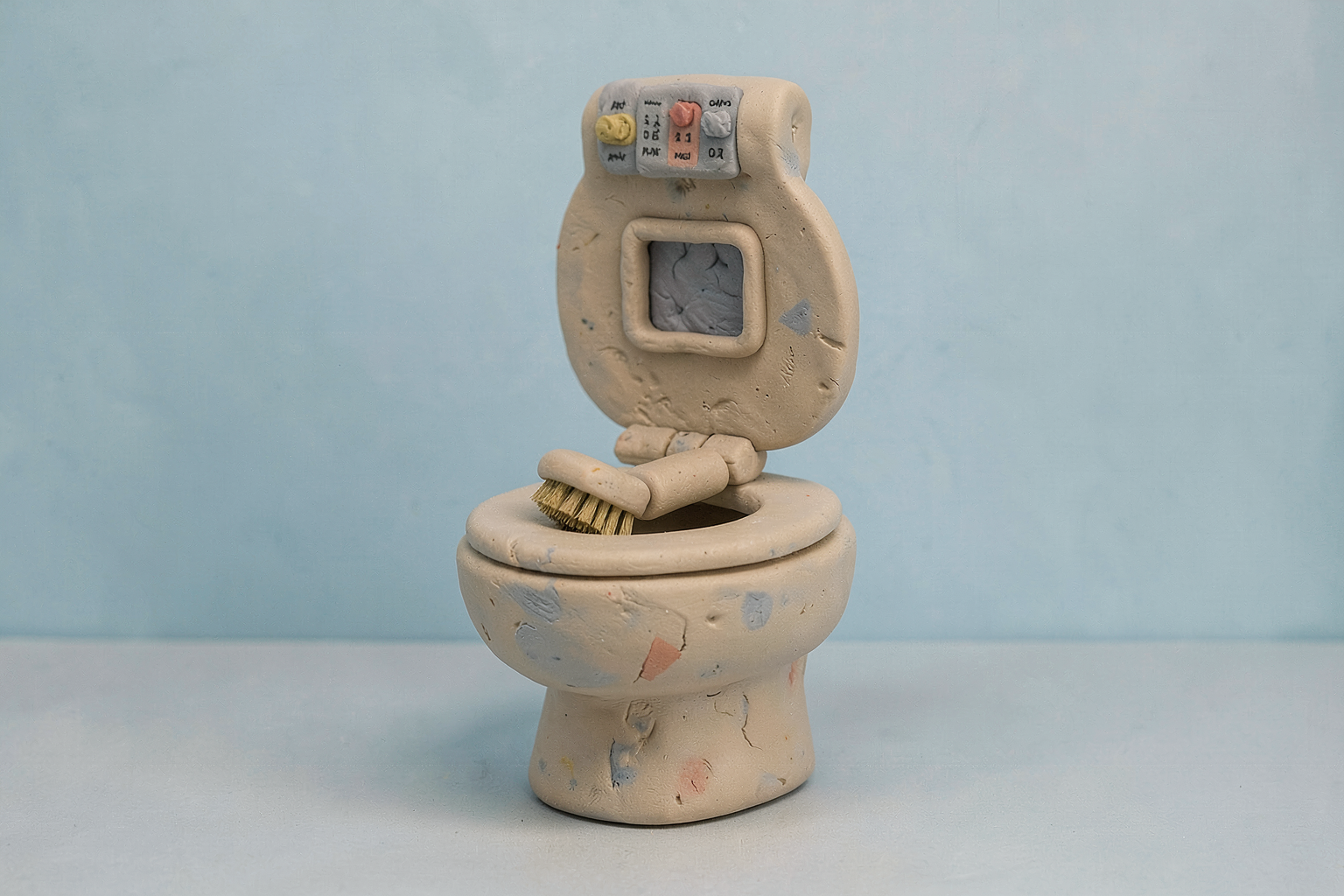
In a restroom, a person approaches a toilet with a seat and lid that can move without being lifted by hand. Parts beneath the seat may rotate, while cleaning liquid is directed into the bowl area. Nearby, the fixture has power, controls, and enclosed moving components around ordinary bathroom use.
What changes in this design
Most people would expect to lift or lower a toilet seat by hand and clean it separately, using a cleaner and a brush or cloth.
This unit brings powered seat movement, two-axis rotating brush assemblies, a cleaning-fluid dispenser, a containment seal, and controls that use sensors into the same toilet-seat assembly.
It is worth knowing because the subject is not just the seat itself. It includes cleaning and control equipment, although what sensor readings trigger which actions is not stated.
Powered Movement, Brushes, and Fluid
A seat that moves under power is the first physical detail you can picture when you imagine using the assembly described in US20260262889A1, published September 10, 2026 under the title Automatic Toilet Seat Assembly. You can hold that moving surface in mind before the other named pieces arrive: a familiar seat now joined to electrical, mechanical, and fluidic subsystems. What made me look twice was the after-effect of the ordinary choice to give the seat powered movement: it asks you to consider every neighboring action in relation to it. For an editor's eye, that physical detail opens a systems question instead of a product verdict. The question is whether a routine object becomes clearer when its parts are allowed to take turns.
That question brings the other named pieces into focus. The filing describes dual-axis rotating brush assemblies - brushes that rotate around two axes, or directions of turn - alongside a cleaning-fluid dispenser, meaning a component that dispenses cleaning fluid. It also names a containment seal, a seal designated for containment, plus sensor-based control, where sensors participate in directing the assembly. These terms may sound like a component drawer tipped onto a workbench, yet they point toward one purpose: bringing movement, brushing, liquid, containment, and control into one automatic toilet-seat assembly. Seen this way, the assembly is less like a lone scrubber and more like a small stage manager holding a cue list. The phrase matters because it moves your attention from any one part to the relationships the named parts invite you to consider.
Containment and the Order Question
Those relationships are where the after-effect becomes practical. The published record identifies electrical, mechanical, and fluidic subsystems: electricity for the electrical portion, moving physical parts for the mechanical portion, and cleaning liquid for the fluidic portion. A clean paper experiment is to write the five named elements - powered seat movement, brushes, fluid dispenser, containment seal, and sensor-based control - on separate cards, then draw an arrow only when one element changes what you need to consider about another. The exercise is not a claim about an operating sequence; it reveals why sequence is worth asking about. With those cards in view, brush motion and dispensed fluid become questions that sit beside containment, while sensing becomes a control question. The containment seal has the air of a librarian at the edge of a busy table, giving the boundary its label. That is the practical diagnostic: do not ask first which part is most impressive; ask what its presence makes the next part answer.
The Loop Between Parts
Once you ask that, the difference between a familiar seat and this assembly becomes visible as a relationship, not a contest. A familiar seat can be regarded as one object; this published record places powered movement beside rotating brushes, cleaning fluid, a containment seal, and sensor-based control. That does not establish that one arrangement outperforms another, and it does not need to. The revealing contrast is that allowing the seat to move under power leaves a residue of coordination around it. The sequence is less like adding clever parts and more like giving each part a turn on a very short clipboard. What I think is worth your attention is that the clipboard image describes responsibility rather than sophistication: liquid raises a containment question, movement raises a timing question, brushes raise a contact question, and sensors raise a decision-point question without pretending the filing supplies further particulars.
That restraint makes the wider lesson more durable. First, when a design combines electrical, mechanical, and fluidic subsystems, label the handoff between categories before admiring the individual component; the word between is often where an ordinary choice leaves its most consequential after-effect. Second, when a description names a seal and sensors alongside an action, ask two separate questions: what is meant to stay within a boundary, and what information is meant to guide the assembly? Those questions are transferable because they are diagnostic, not predictive. They help you read a compact arrangement without inventing a performance story for it. The filing's named pieces give you enough to practice that discipline while leaving unprovided operating detail where it belongs: unclaimed by the reader.
And that is why the chain remains useful even after the component names blur: seat movement leads your attention to coordination; coordination leads you to brushes and dispensing; brushes and dispensing lead you to containment; containment leads you to sensor-based control; and control leads back to the moving seat. The loop is an editorial inference from how the published record groups its subsystems, not a claim that it dictates a fixed operating order. I leave with a modest test for you: when a familiar object gains one powered motion, notice the quiet questions that gather around that motion instead of rushing to call the object transformed. Here, the questions are tangible enough to picture: a moving seat, brushes rotating about two axes, a dispenser for cleaning fluid, a containment seal, and sensor-based control. The return matters because the first concrete detail still carries the whole thought: a seat that moves under power, with the rest of the assembly visible as the consequences of noticing it.
The record, briefly. US20260262889A1, “Automatic Toilet Seat Assembly” An automatic toilet seat assembly has electrical, mechanical, and fluidic subsystems, including dual-axis rotating brush assemblies, a cleaning-fluid dispenser, a containment seal, powered seat movement, and sensor-based control.
More angles on this
- CPC A47K: Sanitary equipment; accessories therefor, e.g. toilet accessoriesThe official classification family this record was filed into, published in the USPTO Cooperative Patent Classification scheme.
- CPC E03D: Water-closets or urinals with flushing devices; flushing valves thereforThe official classification family this record was filed into, published in the USPTO Cooperative Patent Classification scheme.
- When Capsule Recognition Needs Another ComparisonAnother reading from the neighbouring A47J classification family, kitchen equipment; coffee mills; spice mills; apparatus for making beverages.
- When Soil, Vehicle, and Control Share the Next ChoiceAnother reading from the wider A01B classification family, soil working in agriculture or forestry.
- The Closet That Borrows Nearby Floor Only While You Need ItAnother reading in the same Machines category on this site.
Read around this one:Public patent recordUSPTO published figure