Machines
The Closet That Borrows Nearby Floor Only While You Need It
Start with System and Retracted State: A closet system has a fixed frame and a storage section that extends from a retracted state to an expanded one.

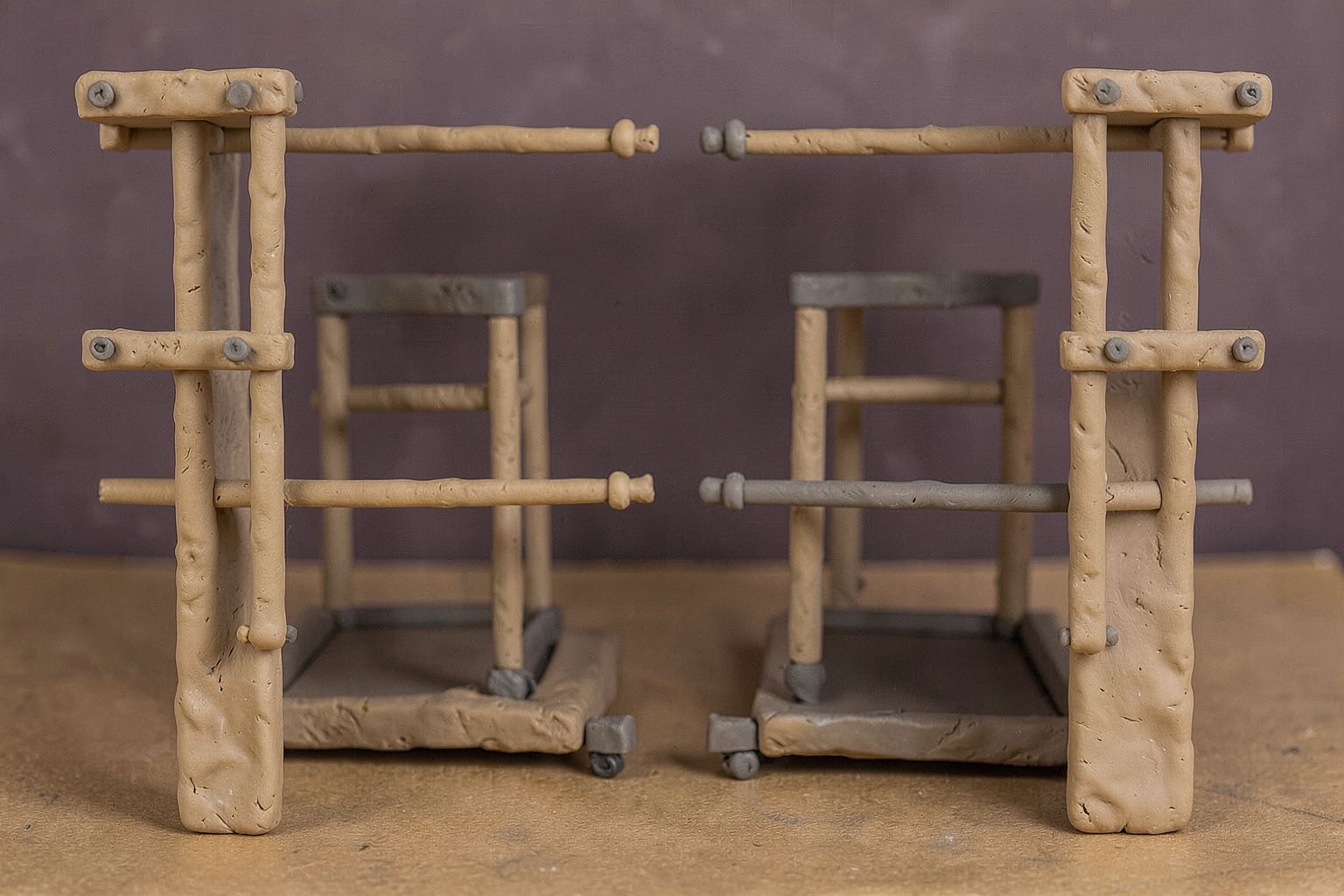
First, the setting
Most homes and apartments have less room than the people living in them would like. Closets fill up quickly with clothes, shoes, bags and bedding, and in a small bedroom or studio every bit of floor is fought over. Furniture designers keep looking for ways to store more without making a room feel cramped or blocking the way through it.
Picture someone in a small bedroom pulling on a handle while a section of the closet glides outward along tracks into the open floor beside it. Shelves, a hanging rod and drawers come within reach, lit from inside. Once they have picked out an outfit, they push the section back, and the walkway between the bed and the wall is clear again.
What changes in this design
An ordinary closet stays the same size all the time. Whatever floor it covers is gone for good, so in a tight space you either accept a cramped closet or give up living area to make it bigger.
This record describes a fixed outer frame with a storage section that moves between a tucked-in position and an extended one. It can travel on sliding tracks, swinging arms, rails that slide out of one another like a telescope, or electric motors. A steadying mechanism keeps it lined up, and the inside can hold adjustable shelves, hanging rods, drawers and lights.
It treats floor space as something that can be shared over time instead of claimed permanently. Anyone living in a studio or a small bedroom will recognize the trade-off it tries to soften: storage you can actually reach, without that storage taking up the room all day.
Where the closet borrows its floor
A fixed frame stays put, and a storage section moves away from it into a neighboring area, then comes back. That is the core relationship in US20260262827A1, published September 10, 2026, under the title Expandable Closet System And Method For Maximizing Storage Efficiency In Compact Spaces. Hold it in your head as one practical picture: a closet that is small most of the day and larger for the few minutes when you are actually choosing a shirt. The sliding itself was not what made me look twice. The borrowing was. The filing describes the storage section extending from a retracted state, meaning tucked back inside the frame, to an expanded state, meaning pushed out into nearby space, and doing so when access is needed. That raises a question the patent invites but does not answer outright: once floor space can be lent, what decides when it is taken, and what keeps the loan orderly while it lasts? The storage section behaves less like a piece of furniture and more like a polite lodger, taking the spare room only while it is needed.
Rails, arms and a steadying system
That question starts with vocabulary, because the filing lists several ways to make the move and each one implies a different kind of handoff. Sliding tracks are guides the section rides along in a straight line, the way a drawer runs. Pivot arms are hinged links that swing the section outward on an arc instead of pushing it straight. Telescoping rails are nested rails that slide out of one another to extend their reach, much like the leg of a camera tripod. Motorized actuators are small powered units that do the pushing and pulling for you. Alongside these, the filing names a stabilization system whose job is to prevent misalignment. In everyday terms, it keeps the moving part square to the fixed part so it does not twist, sag or jam on the way out. The stabilization system has the air of a stage manager standing in the wings, making sure nothing drifts off its mark between scenes.
Go back to the same closet for a moment and picture the section in its retracted state, sitting inside the frame, with the neighboring floor free for whatever else that space is used for. When you want your clothes, the section extends, and the filing allows its interior to hold adjustable shelves, hanging rods, drawers and lighting. The lighting is a small detail but a telling one, since a storage section that has just moved into borrowed territory is not much use if you cannot see into it. Everything you reach for travels with the section, so the interior arrives as one unit rather than as loose fittings that have to find their places again.
Following that unit as it moves shows where the real design work sits. The frame holds its footprint permanently. The nearby area holds its footprint most of the time. The moving section is the thing that crosses the boundary between them. Each drive option in the filing handles that crossing differently. A track or a telescoping rail keeps the path straight and predictable, a pivot arm trades the straight path for a swing that sweeps a wider patch of floor, and an actuator takes the push out of your hands entirely. In every version, the stabilization system is what turns the crossing into a controlled transfer instead of a shove. I could not tell from the published record exactly how that system is built, and guessing would add nothing. What matters is that the patent names alignment as its own part of the arrangement instead of leaving it as an afterthought.
A test for any shared space
Naming that part is what separates this arrangement from the broad, ordinary version of the same task, which is just a bigger closet, or a cupboard whose doors happen to open into a room. In the ordinary version, shared floor is lent informally: a door swings out, someone leaves it open, and the space quietly becomes storage until somebody walks into it. A vague handoff is the kind a committee agrees to over coffee, with nobody quite sure who holds the keys afterward. The filing frames a clearer alternative. It has two defined states, retracted and expanded, a defined mechanism for moving between them, and a defined part responsible for keeping the move true. The space does not drift between uses; it changes hands on purpose and comes back on purpose.
Two observations carry well beyond closets. First, when a system borrows a resource from a neighbor, the borrowing is easiest to trust when the system has exactly two named states and nothing ambiguous in between. Second, the part that does the moving matters less than the part that keeps the move aligned, because a transfer that goes slightly crooked every time is worse than one that never happens. Both apply just as well to a fold-down desk, a shared calendar slot, or a computer that takes extra memory during busy hours. My suggestion for one calm test: the next time you look at anything that expands into shared space, ask whether you can say in one sentence what it looks like once it has fully given that space back. If you can, the handoff is clear. If you cannot, the space has probably been borrowed for longer than anyone meant.
The record, briefly. US20260262827A1, “Expandable Closet System And Method For Maximizing Storage Efficiency In Compact Spaces” A closet system has a fixed frame and a storage section that extends from a retracted state to an expanded one, borrowing space from a nearby area when access is needed. Sliding tracks, pivot arms, telescoping rails or motorized actuators move it, a stabilization system prevents misalignment, and the interior can hold adjustable shelves, hanging rods, drawers and lighting.
More angles on this
- The Retractable Drawer Divider That Holds On By Leaning, Not FasteningAnother reading from the same A47B classification family, tables; desks; office furniture; cabinets; drawers; general details of furniture.
- A drawer connector that turns once, then declines to be talked out of itAnother reading from the same A47B classification family, tables; desks; office furniture; cabinets; drawers; general details of furniture.
- CPC A47B: Tables; desks; office furniture; cabinets; drawers; general details of furnitureThe official classification family this record was filed into, published in the USPTO Cooperative Patent Classification scheme.
- When a Shredder's Boundary Becomes the QuestionAnother reading from the neighbouring A47J classification family, kitchen equipment; coffee mills; spice mills; apparatus for making beverages.
- Rethinking the Guard That Fits Across LimbsAnother reading from the wider A41D classification family, outerwear; protective garments; accessories.
Read around this one:Public patent recordUSPTO published figure