Field Notes
Flip-Up Potty Seat: The Quiet Question of Where a Child's Seat Waits Between Uses
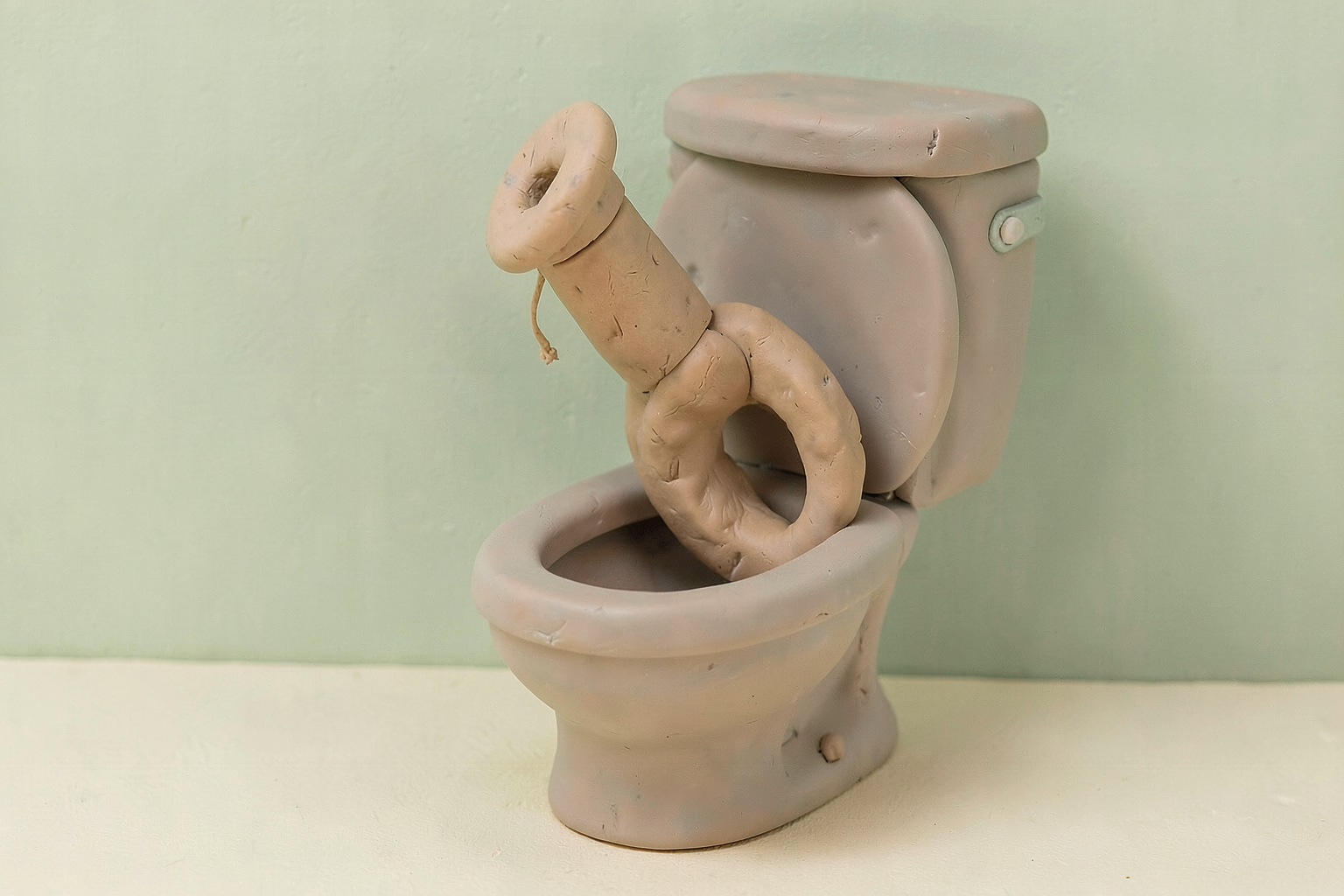
The central pairing is Key detail with Arrangement: A flip-up potty seat includes a ring connected to a mount by a hinge.
First, the setting
Potty training is a stage almost every family goes through, as a toddler moves from diapers to using the toilet. Adult toilet seats are too wide for small bodies, so young children can feel wobbly or worry about slipping in. Parents look for ways to make the change feel safe and calm, keep the bathroom clean, and avoid clutter in a room the whole household shares.
In a family bathroom, a parent lifts the toilet lid, and a smaller child-sized ring swings down from it to rest on top of the regular seat. The toddler climbs up, sits snugly, and finishes. Afterward the parent folds the ring back up against the lid. The seat is ready for the adults again, and nothing is left on the floor or carried from room to room.
What changes in this design
A child's potty seat is often a loose ring. Someone sets it on the toilet when the child needs it, then lifts it off and props it against a wall, tucks it beside the toilet, or hangs it on a hook until next time.
In this record the ring is not loose. It stays attached to the toilet lid through a mount and a hinge. The ring swings down onto the adult seat for the child and swings back up when the adults need the toilet. It never has to be carried anywhere.
Anyone who has potty trained a child knows the seat has to go somewhere between uses, and that it gets handled a lot. Keeping it attached to the lid changes where it waits and how often hands touch it. That is the convenience and cleanliness the record is aiming for.
A small seat with a two-place problem
What do you do with the child's seat when an adult needs the toilet? A parent in a shared bathroom really does ask that, and it is a more useful question than the headline this filing invites. The obvious story about US20260262888A1, published September 10, 2026, is that someone has made potty training easier, and that may well be the hope behind it. The question underneath is smaller and more interesting: where does a temporary piece of equipment go when nobody is using it? The filing describes a flip-up potty seat that sits on a regular adult toilet seat and attaches to the toilet lid, so the child-sized seat has a home that is neither the floor nor the edge of the bathtub. My view is that this minor condition deserves a name, because it turns up far beyond bathrooms: the in-between state of a thing that is needed often but not all the time. A loose child seat can have the air of a houseguest who never quite knows where to stand.
Ring, hinge, mount, and the lid
To answer that question in short practical steps, start with the parts the filing names. A ring is the opening a child actually sits on, sized smaller than the adult seat beneath it. A mount is the piece that holds the assembly in place, and here it connects to the toilet lid. A hinge is the joint between the two, the same kind of pivot a door swings on, which lets the ring rotate instead of being lifted off and carried away. The filing calls the result an inter-conversion, which in plain language means the setup can be switched back and forth between a child configuration and an adult one without taking anything apart. Put together, the arrangement reads less like an accessory and more like a small piece of furniture that has agreed to fold itself out of the way.
That switching is where the contrast becomes visible, and it is easiest to see as a simple before-and-after. Before, with an ordinary removable trainer seat, the ring has to be picked up, set down somewhere, and found again later, and each of those moments may mean hands touching something that has just been on a toilet. After, in the arrangement the filing describes, the ring stays attached through the hinge and the mount, so the change is a flip rather than a trip across the room. Nothing in the published record measures how much time or contact that saves, and claiming a number would be invention. What you can see from the description alone is that the number of separate places the seat occupies drops from several to one, and that one place is fixed to the toilet itself.
Where a temporary seat should rest
With that contrast in view, the mechanism turns out to be modest, and the modesty is the point. The hinge does the work: it lets the ring come down onto the adult seat when a child needs it and go up toward the lid when an adult does. Because the mount ties the assembly to the lid, the ring travels with a part of the toilet that already moves, so nobody has to manage an extra object. Using it asks for no new habit beyond lifting and lowering, which people already do with the lid itself. In design terms, the filing borrows an existing motion instead of inventing one, as if the toilet lid had been quietly promoted to a storage shelf that also happens to close.
That borrowed motion explains the purpose the filing states: making potty-training use more convenient and more sanitary. Those are intentions, not results, and the record reports no testing, so the fair reading is that the design aims to cut down on handling and loose parts. The difference from the broad, ordinary version of the task matters here. The ordinary task is simply putting a smaller seat on a bigger one; this filing cares about the transitions, the repeated moment when the bathroom passes from a child to an adult and back again. That is a narrower problem than training in general, and to my eye a more honest one. We tend to design for the steady state and leave the switching to whoever happens to be standing there.
That brings the bounded lesson back to the opening question, and it applies well outside bathrooms. First, when a tool is needed on and off, ask where it rests between uses, because the resting place often decides whether the tool gets used at all. Second, attaching a temporary part to something that already moves can be simpler than finding it a separate home. Neither point shows that this particular seat works better than any other, and the filing makes no such comparison. For a small experiment, pick one object in your home that you set up and put away every day, and for one week note each place it sits in between. If the list has more than one entry, you have found your own version of the condition this potty seat is trying to solve.
The record, briefly. US20260262888A1, “Flip-Up Potty Seat” A flip-up potty seat includes a ring connected to a mount by a hinge, allowing placement on a regular adult toilet seat and attachment to the toilet lid; it provides an inter-conversion intended to make potty training use more convenient and sanitary.
More angles on this
- A Toilet Seat and the Consequence of a Powered MoveAnother reading from the same A47K classification family, sanitary equipment; accessories therefor, e.g. toilet accessories.
- CPC A47K: Sanitary equipment; accessories therefor, e.g. toilet accessoriesThe official classification family this record was filed into, published in the USPTO Cooperative Patent Classification scheme.
- A Folding Pressure Vessel Where Valves Decide Whether Liquid or Gas Comes OutAnother reading from the neighbouring A47J classification family, kitchen equipment; coffee mills; spice mills; apparatus for making beverages.
- When a Marker Gives Depth a ReferenceAnother reading from the wider A61B classification family, diagnosis; surgery; identification.
- A Fixed Center in a Bed That MovesAnother reading in the same Field Notes category on this site.
Read around this one:Public patent recordUSPTO published figure