Objects
When a Marker Gives Depth a Reference
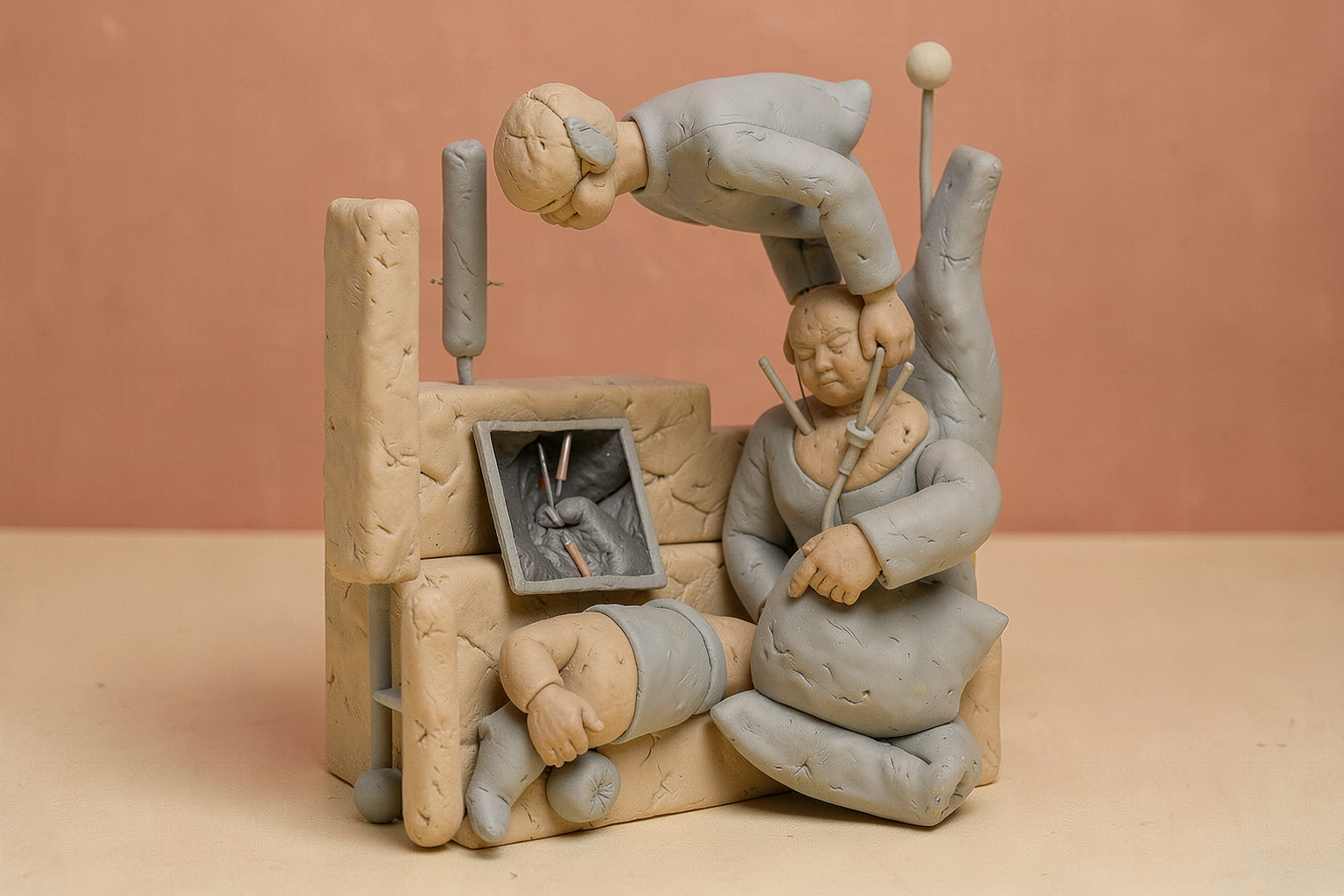
Start with Surgical Field Image and Device: A processor acquires a camera-captured surgical field image. It keeps the central design choice visible.

First, the setting
During surgery, clinicians must understand the body area they are working in while keeping their attention on the patient and the tools in their hands. Views from cameras can help make small or hard-to-see spaces visible, giving the care team another way to follow the work as it unfolds.
In an operating room, a camera may show the surgical area on a nearby screen while clinicians handle instruments beside the patient. The image changes as tools move and the camera angle shifts. Staff around the room can glance at the display as part of the shared view of the procedure.
What changes in this design
Looking at a camera picture may make it easy to see the operation area, but it does not necessarily provide a fixed distance for each point. A reader might otherwise treat it simply as an image.
The processor first makes a map of depth differences in the camera image. It then estimates the marker's actual distance and uses that estimate to turn the difference map into a map of distances.
The result expresses distance on an absolute scale, rather than only which areas appear nearer or farther. What those distances are used to measure or decide is not stated.
Depth Signals in the Surgical Field
At the moment a camera-captured surgical field image has been acquired, the depth question is already in motion: one arrangement produces a view of nearer and farther, and the next choice is whether that view can be tied to a fixed reference. The published patent, US20260262917A1, titled Medical Support Device, Medical Support Method, And Medical Support Program and published September 10, 2026, describes a processor that takes that route. What caught my attention is not a grand promise around the image, but the disciplined handoff from an uncertain relation to a defined value. The practical purpose, as the filing frames its arrangement, is to turn a depth picture that is relative into an absolute depth map through a marker.
That handoff needs two plain terms before it can be interesting. A relative depth map is a picture of depth arranged in relation to itself: it can distinguish which pictured locations are nearer or farther than others without, by itself, supplying a fixed depth for each location. An absolute depth map instead gives those locations depth against a reference. The filing describes estimating a marker's absolute depth, then converting the relative depths into absolute depths. That sequence matters because it gives the uncertainty a named location rather than treating every part of the image as equally unresolved. With the terms settled, the picture becomes simpler to hold in your head.
With that picture in place, imagine a surgical field image whose distances have an internal order but no settled scale. A marker appears inside that arrangement, and its absolute depth is the specific piece estimated by the processor. The marker has the air of a quiet stage manager, standing in one place so the rest of the scene can take its cues. The processor first acquires the camera-captured image and generates the relative depth map, so the anchor arrives after a relation has been established rather than before one exists. I looked twice at that ordering because it makes the next mechanism feel less mysterious: the decision turns on one specified signal, not on a vague wish for more certainty.
Marker Anchors the Depth Map
That second look leads directly to the mechanism. The processor acquires the surgical field image, generates the relative depth map, estimates the marker's absolute depth, and converts the map's relative depths into an absolute depth map. Each step changes what the next one can mean. The image supplies visible material; the relative map organizes depth as comparison; the marker estimate supplies a fixed reference; and the conversion changes the form of the mapped depths. That conversion is less like adding another picture and more like a librarian placing a label on shelves that were already there. As a practical diagnostic, take any system that can rank positions but must make a choice using fixed values: ask what signal establishes the reference, when it is introduced, and whether the final output actually applies it across the earlier arrangement. Once those questions are visible, a comparison becomes possible without pretending the filing says more than it does.
Defined Responses Beyond Relative Maps
Once the sequence is stated, the contrast is not between a clever system and an inadequate one. It is between stopping at an ordinary broad task, recognizing relative depth, and carrying that relation through a defined response, converting it using an estimated absolute depth for the marker. The patent's bounded distinction is therefore easy to state: the relative map is not left as the endpoint. The marker's estimated absolute depth participates in turning it into an absolute depth map. That defined response is less like a brass band announcing certainty and more like a restrained committee checking the one reference it was given. The phrasing is worth your attention because it replaces a guess about scale with an explicit question about the anchor.
That change supplies a transferable consequence beyond this published record. First, whenever a design gives you comparisons but asks you to act on values, look for the signal that bridges those two forms rather than assuming the comparison is enough. Second, make the anchor inspectable in the explanation: you should be able to say what serves as the reference and what changes after it is known. A third useful observation follows from the order here: mapping the relationship and applying the reference are separate moves, so a clear account should not blur them together. Try the three-beat test on another system you encounter: identify the uncertain relation, identify the reference that constrains it, then identify the output changed by that reference. The consequence you can carry elsewhere is modest but durable: a decision becomes easier to examine when its signal trail is visible from relation to anchor to result.
The record, briefly. US20260262917A1, “Medical Support Device, Medical Support Method, And Medical Support Program” A processor acquires a camera-captured surgical field image, generates a relative depth map, estimates a marker's absolute depth, and converts relative depths into an absolute depth map.
More angles on this
- Borrowed Warning Lights and the Shift of Visual ResponsibilityAnother reading from the same G06T classification family, image data processing or generation, in general.
- Tuning the Flight from the Furrow in an Agricultural Survey SystemAnother reading from the same G06V classification family, image or video recognition or understanding.
- CPC A61B: Diagnosis; surgery; identificationThe official classification family this record was filed into, published in the USPTO Cooperative Patent Classification scheme.
- CPC G06T: Image data processing or generation, in generalThe official classification family this record was filed into, published in the USPTO Cooperative Patent Classification scheme.
- The Small Surface Change Inside ExerciseAnother reading from the neighbouring A61F classification family, filters implantable into blood vessels.
Read around this one:Public patent recordUSPTO published figure