Groundwork
Borrowed Warning Lights and the Shift of Visual Responsibility
Automakers want windshields to paint virtual brake lights onto the cars ahead, turning decades of stalled radio safety data into split-second visual warnings.

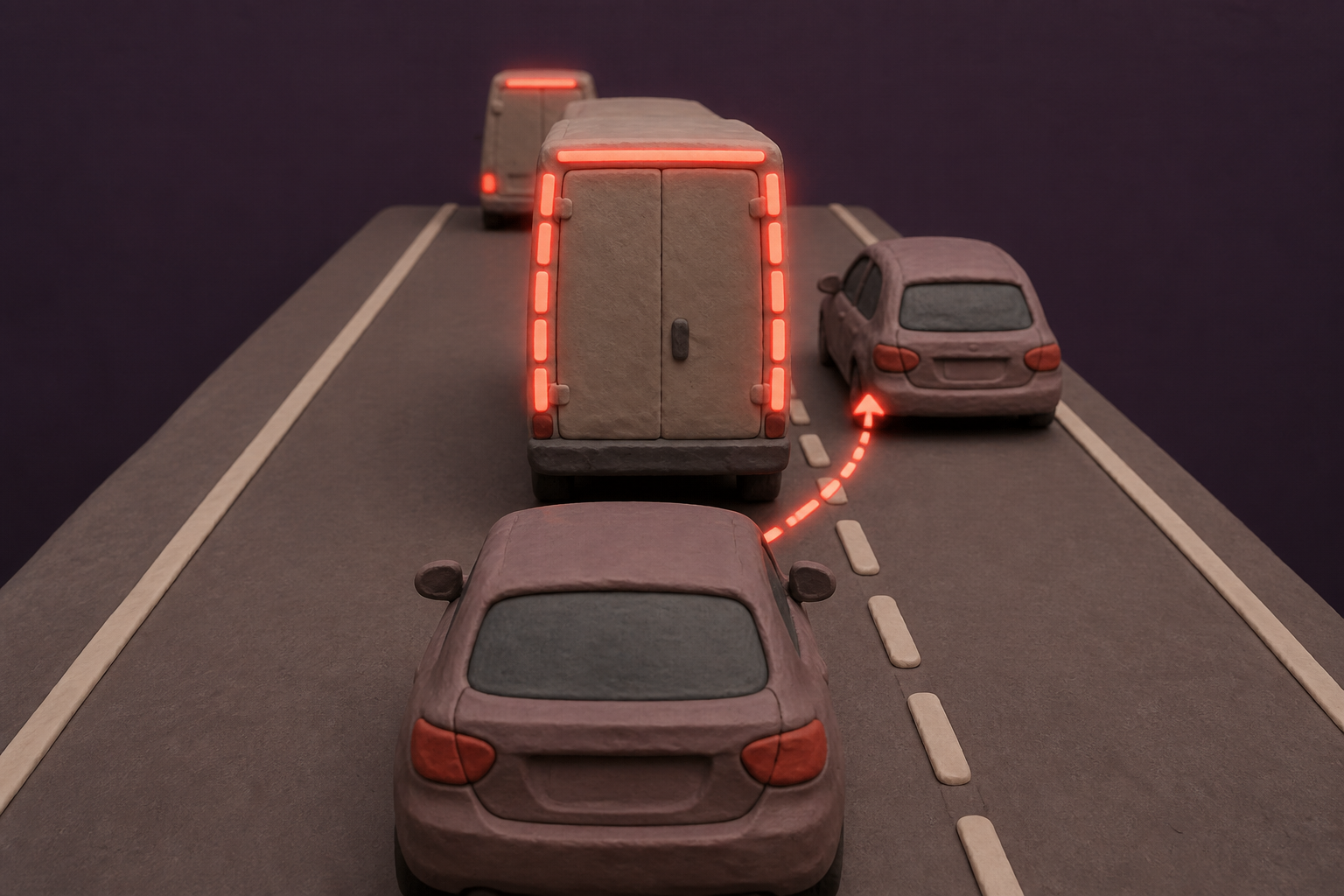
What changes in this design
Normally, a motorist can only react to the actual brake lights of the automobile directly in front of them. If traffic further ahead slows down, the person behind has no visual indicator until the middle driver steps on the pedal.
Rather than waiting for the intermediate automobile to brake, the trailing car obtains information from it. When that shared feed signals that an obscured road user has illuminated its brake lamps, an augmented reality graphic showing lit brake lights is shown directly on the intervening car.
This approach passes visual warnings through traffic so a following driver sees braking events happening beyond their direct line of sight, even if the driver between them has not yet responded.
The blind spot behind a tall bumper
We have all stared at the tailgate of a delivery truck, blind to the sudden stop unfolding two vehicles ahead. That ordinary moment of obscured vision causes a startling amount of road trauma. According to National Highway Traffic Safety Administration data, rear-end collisions make up approximately 29 percent of all automobile crashes in the United States, spanning between 23 and 30 percent in federal studies, and account for 7.5 percent of fatal crashes. In 2020 alone, out of 419,400 people involved in rear-end collisions, over 99 percent suffered injuries while less than one percent died. The issue is rarely a driver refusing to brake. It is the simple geometry of blocked sightlines and human reaction times measured in tenths of a second.
Carmakers have tried to tackle this perceptual delay from inside the cabin. In 2020, Mercedes-Benz introduced its production augmented reality head-up display and Level 3 Drive Pilot on the W223 S-Class platform. By integrating 22 camera and radar sensors with its MBUX system, the vehicle projects spatial visual cues directly into the driver's forward field of view. Head-up displays help keep telemetry and collision warnings in a driver's line of sight, reducing glance time away from the roadway during abrupt deceleration. But even sophisticated onboard sensors cannot peer through the sheet metal of the car directly ahead.
Twenty years of quiet spectrum
I doubt many motorists realize how close connected-car safety came to dying in committee. Back in 2010, an agency study estimated that connected vehicle-to-vehicle warning systems could prevent up to 79 percent of all traffic accidents. The concept seemed obvious: vehicles should broadcast their position, speed, and braking telemetry directly to nearby cars over radio links. In 2016, federal transportation officials issued a draft rulemaking to mandate vehicle-to-vehicle communications in light vehicles, but the effort stalled amid regulatory uncertainty, spectrum disputes, and slow automotive adoption.
The airwaves tell a similar story of delay. In October 1999, the Federal Communications Commission set aside 75 megahertz in the 5.9 gigahertz band for intelligent transportation safety. After two decades of negligible rollout from automakers, the regulator reallocated the lower 45 megahertz to unlicensed Wi-Fi in November 2020. That shift left only 30 megahertz for safety, split between legacy short-range communications and Cellular V2X, which enables direct vehicle-to-vehicle sidelink transmission over the PC5 interface without relying on commercial cell towers.
Painting ghost lamps on the car ahead
A recent patent filing, published under number US20260260563A1 as "Brake Light Display Of Obscured Road Users In Augmented Reality," suggests a clever way around that roadblock. Instead of waiting for fully autonomous vehicles or displaying abstract text alerts, the application tries to turn radio data into immediate visual instinct.
The mechanism described in the published record is straightforward. A trailing vehicle identifies a preceding vehicle and establishes a wireless link to receive its sensor data. If those transmitted feeds reveal that another road user further ahead is braking, but the intervening vehicle has not yet hit its brakes, the rear car's head-up display generates an augmented reality symbol of active brake lights. Crucially, the system fixes these synthetic red lights directly onto the preceding vehicle. To the driver behind, the car in front appears to light up with brake lamps before its driver has touched the pedal.
The friction of milliseconds
I find the patent's core trick both elegant and slightly unsettling. Translating raw radio packets into a synthetic brake lamp works with existing driver reflexes instead of demanding a new visual interpretation. But cooperative perception between moving vehicles is technically fragile. Research into augmented cooperative perception shows that streaming unfiltered hazard data across vehicle displays causes severe driver cognitive overload and inattentional blindness. Fast-filtering algorithms can prune those distractions while adding only 12.6 milliseconds of latency, and task-oriented multi-scale semantic compression can preserve high-confidence obstacle detection while holding end-to-end latency below 16 milliseconds.
The real danger lies in what happens when those wireless links are attacked or delayed. In evaluations of latency attacks on cooperative perception, researchers using the CP-FREEZER framework demonstrated that adversarial packet perturbation can increase end-to-end latency by more than 90 times. On real vehicle testbeds, that perturbation pushed computation delays past three seconds. In highway traffic traveling at speed, three seconds of lag is fatal. That latency window is where our confidence in automated alerts begins to fray.
The part worth watching
What we cannot yet verify on real asphalt is how drivers will react when synthetic visual cues flicker or lag. Augmented reality is convincing only when digital graphics stay perfectly anchored to physical objects in the world. If a ghost brake light glitches during heavy rain or appears half a second late during sudden deceleration, driver trust can evaporate immediately.
In our assessment, turning invisible vehicle-to-vehicle telemetry into an unmistakable visual cue is the right instinct, but it leaves little margin for error. Automakers spent two decades letting dedicated safety frequencies sit idle while rear-end collisions injured hundreds of thousands of people every year. Projecting synthetic brake lights onto real tailgates is an ambitious attempt to revive that stalled connected vision. If engineers can keep latency strictly under 20 milliseconds and keep windshields free of clutter, this optical shortcut might finally make cooperative safety work.
Sources
Reporting for this piece drew on the published filing and the references below.
- US Patent Application US20260260563A1 - Brake Light Display Of Obscured Road Users In Augmented Reality
- Rear-end collision - Wikipedia
- Mercedes-Benz S-Class (W223) - Wikipedia
- Vehicular communication systems - Wikipedia
- Dedicated short-range communications - Wikipedia
- Cellular V2X - Wikipedia
- Head-up display - Wikipedia
- AICP: Augmented Informative Cooperative Perception
- CP-FREEZER: Latency Attacks against Vehicular Cooperative Perception
- HMS-SCP: Task-Oriented Multi-Scale Semantic Communication for V2X Cooperative Perception
The record, briefly. US20260260563A1, “Brake Light Display Of Obscured Road Users In Augmented Reality” A rear vehicle identifies a preceding vehicle and receives sensor data from it. If the transmitted data reveals that another road user's brake lights are activated while the preceding vehicle has not applied its brakes, an augmented reality symbol representing active brake lights is displayed to the rear driver, fixed to the preceding vehicle.
More angles on this
- Tuning the Flight from the Furrow in an Agricultural Survey SystemAnother reading from the same G06V classification family, image or video recognition or understanding.
- Targeting the X-Ray Opening Where Recognition Takes OverAnother reading from the same G06V classification family, image or video recognition or understanding.
- CPC G08G: Traffic control systemsThe official classification family this record was filed into, published in the USPTO Cooperative Patent Classification scheme.
- CPC B60K: Arrangement or mounting of propulsion units or of transmissions in vehiclesThe official classification family this record was filed into, published in the USPTO Cooperative Patent Classification scheme.
- Reconciling Sensor Posture and Geometry Before Generating Inspection Text CodeAnother reading from the neighbouring G06F classification family, electric digital data processing.
Read around this one:Public patent recordUSPTO published figure