Machines
A Small Opening, a Clearer Chain
A new X-ray spectroscope filing arrives as industrial X-rays gain economic ground and the problem of measuring their beams grows sharper.

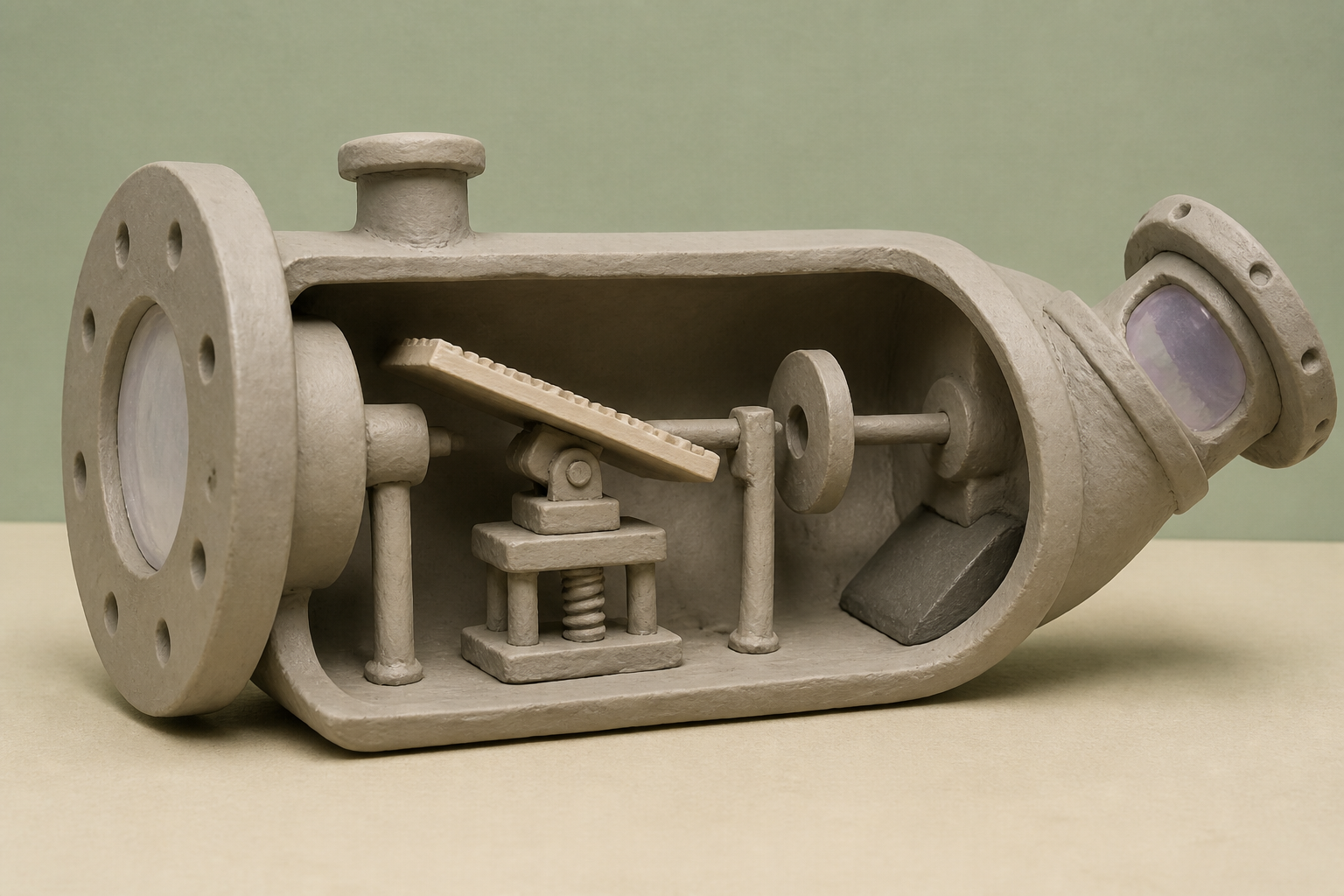
What changes in this design
Without this description, a reader might picture an X-ray device simply producing a beam or an instrument with fixed internal openings and parts.
This record describes a housing linked to an X-ray source, an adjustable diffractive piece that sends part of the beam along a spectral line, a variable opening, a window opposite that opening, and an adjustable support for the diffractive piece.
It helps separate the role of the beam-producing equipment from the surrounding instrument, which also includes adjustable parts for guiding part of the beam and setting the opening.
Fifty thousand cubic meters
A volume, not a patent, is where I started: 40,000 to 50,000 cubic meters a year. In a 2024 China-specific economics presentation, Wei Peng reported that 7 MeV X-rays were already cheaper than gamma irradiation above that annual throughput, even with 12% conversion, as cobalt-60 prices rose. It is not a global price sheet. But it marks a real turn in the industrial irradiation argument. For us, that changes what a beam-measuring device means.
A 2009 flash tube
That change sent me back to a 2009 filing by Advanced Fusion Systems. Its flash X-ray irradiator argued that cobalt-60's 1.33 MeV line exceeded the threshold at which radioactivity is induced, while X-ray sources had not economically matched gamma-source fluence. It proposed 1-100 ns pulses, cathode current densities up to 80,000 A/cm2, energies from 0.1 to 5 MeV, and roughly 16 kGy per pulse for sterilization and remediation without radioisotopes.
Two years later, another patent from the company turned the same pulsed-source premise toward chemical reactions usually driven by heat and pressure. It listed tar-sands upgrading and making sulfuric acid and sodium chloride, while setting a 1.22 MeV ceiling above which it said materials become radioactive. Those patents don't strike me as proof that every proposed application worked. Those patents read to me as a 17-year bet on controllable, high-intensity X-rays.
A window and a crystal
On August 27, 2026, that bet produced a small but telling new filing: US20260253760A1, High Power And High Precision X-Ray Spectroscope. Its assignee is Advanced Fusion Systems, and the application was filed February 5, claiming priority to a February 7, 2025 provisional. The device matters, I think, because any X-ray machine asked to do more industrial work needs a way to know exactly what is in its beam.
Claim 1 describes a housing coupled to an X-ray generator, an adjustable diffractive element, a variable aperture, an output window, and an adjustable mount. The element directs part of the beam along a spectral line; the aperture passes only that selected line. In plain terms, I read the proposed instrument as sorting a beam's energies so they can be examined one at a time. The claim gives us adjustable parts, not a numerical resolution target.
Sixty millielectronvolts
The filing cites a 2011 nitrogen experiment as its outside precision reference. On a Berkeley synchrotron, it measured 390-418 eV with 60 meV resolution and fixed nitrogen's K-shell binding energy at 409.64 +/- 0.02 eV. Those figures held my attention because they belong to a very different setting from a housing attached to an X-ray source. They are a benchmark, not evidence that this apparatus reaches it.
A lab-scale von Hamos spectrometer with a bent HAPG crystal reported energy precision below 1 eV and resolution below 10 eV on copper and iron K-alpha lines. That is serious capability, but it is not a clean head-to-head comparison: the lines and geometry differ, and precision is not resolution. A 2020 review made the broader point that high energy resolution and resonant techniques were not yet feasible in the laboratory. The resulting gap is, to me, this filing's central tension.
The harder half of the problem
Here is where I come down. A high-power X-ray machine has limited practical value if its operators cannot separate and verify the beam it makes. The spectroscope is therefore a sensible missing piece in the company's older program. Still, high precision is an outcome, not a collection of adjustable parts. Claim 1 offers no measured resolution. Until the device is compared with established crystal spectrometers, I would treat its title as an ambition.
If it becomes a cabinet X-ray system, FDA rules would limit leakage to 0.5 mR in one hour at 5 cm outside the housing, averaged over 10 cm2, and require two interlocks on each door, one physically disconnecting high voltage. This filing's status as a finished cabinet product is not something I assume. Beam measurement does, I think, belong beside those safeguards. The 2024 China-specific analysis suggests X-rays are winning an economic argument at high throughput. The harder argument is whether a practical instrument can characterize them with the confidence demanding work requires.
Sources
Reporting for this piece drew on the published filing and the references below.
- High Power and High Precision X-Ray Spectroscope, US20260253760A1
- Flash X-ray irradiator, US 8,019,047
- Method and apparatus for inducing chemical reactions by X-ray irradiation, US 9,406,478
- K-shell x-ray spectroscopy of atomic nitrogen
- Reflection efficiency and spectra resolutions ray-tracing simulations for the VOXES HAPG crystal based Von Hamos spectrometer
- Modern X-ray spectroscopy: XAS and XES in the laboratory
- Compliance Guide for Cabinet X-Ray Systems
The record, briefly. US20260253760A1, “High Power And High Precision X-Ray Spectroscope” An X-ray spectrographic apparatus has a housing coupled to an X-ray generation device, an adjustable diffractive element that directs a portion of an X-ray beam along a spectral line, a variable aperture, an output window opposite the aperture, and an adjustable mount for the diffractive element.
Identity details. The saved title-page transcription needs review, so names are not repeated here. Check the official published title page.
More angles on this
- CPC G21K: Handling of particles or ionising radiation not otherwise provided for; irradiation devices; gamma ray or x-ray microscopesThe official classification family this record was filed into, published in the USPTO Cooperative Patent Classification scheme.
- Shift Register Unit, Driving Method Thereof, Display Substrate And Display Marks a Pause Worth NoticingAnother reading from the wider G11C classification family, static stores.
- When a Signal Stops Reporting and Starts Shaping the Next DecisionAnother reading in the same Machines category on this site.
Read around this one:Public patent recordUSPTO published figure