Machines
A Towing Marker Wants To Be Seen
Deere's engineers solved a sixteen-year-old tractor alignment problem with a metal fin you sight down by eye. I think the choice says more than the fix.

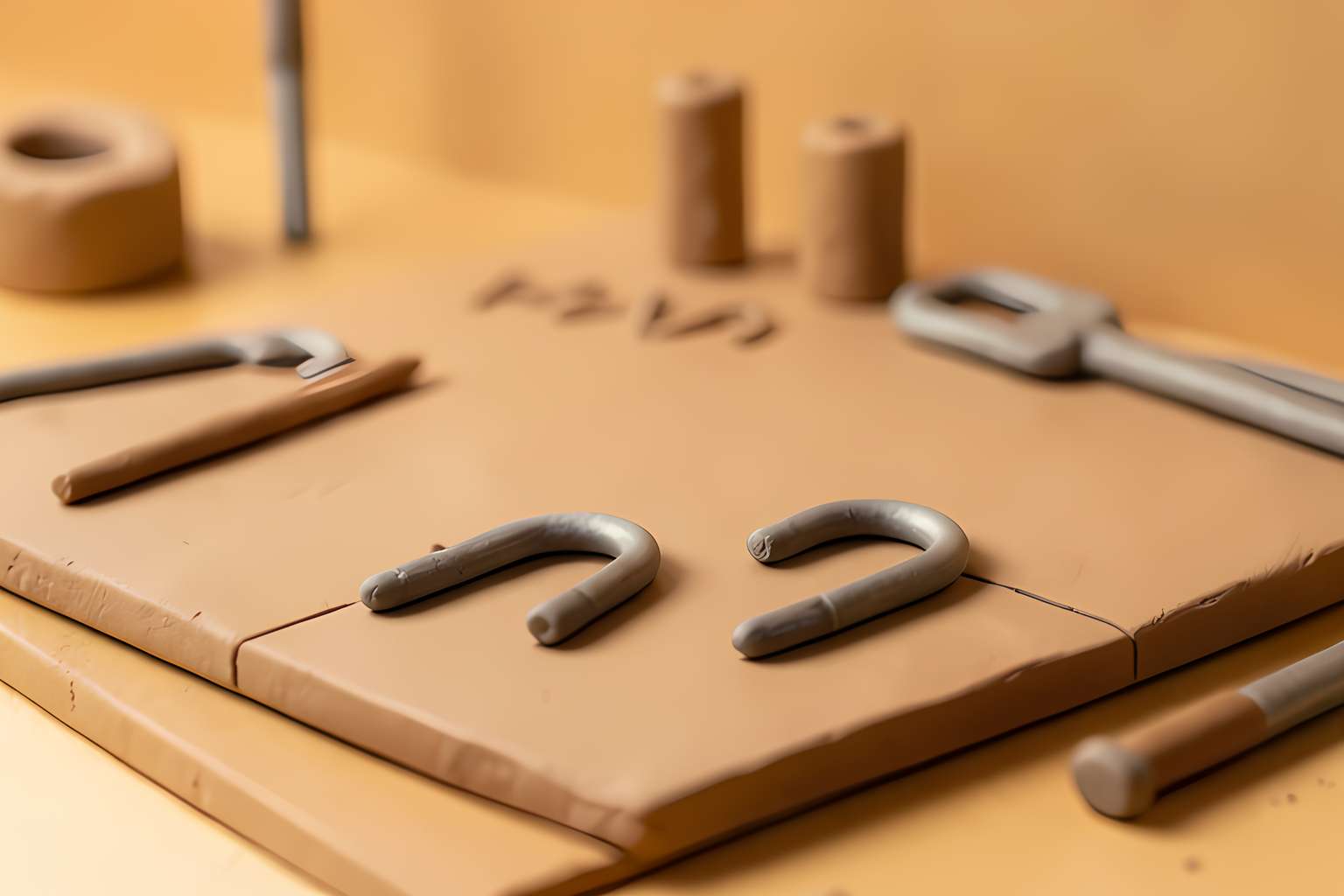
What changes in this design
Without visible middle-line references, a person lining up a projecting connector with the pulled tool may have to judge where each part's center lies.
This record describes visible reference marks on both the swivel tongue and the towed implement. The marks show each part's centerline for towing alignment.
It is worth knowing because it focuses attention on the two centerlines that need to be brought into alignment for towing.
How poorly a lot of implements follow
In January 2013, a precision farming specialist at an Ontario equipment dealer, Paul Smith, said something I keep coming back to: "Once you've got a highly accurate RTK guidance system on the tractor, you come to realise how poorly a lot of implements follow." Satellite guidance didn't create that drift. It made the drift visible.
The trade press had been on it for years. A British farming weekly laid the mechanics out in February 2010: correction holds the tractor to about two centimetres, and then the trailed implement slides anyway, mostly from gravity pulling it downhill as it works across a slope. Two tiers of fix were already on sale: one that steers the tractor off its own line so the implement gets dragged back, and a pricier one that steers the implement itself.
Auto-steer on the big farms, not the small
The Economic Research Service at the US Department of Agriculture gives a sense of scale. Auto-steer and guidance covered 58.4 percent of corn acres in 2016 and 64.5 percent of cotton in 2019. The split by farm size is where it gets interesting: 73 percent of the largest corn farms, those over 1,725 acres, against 10 percent of farms under 200 acres.
And the agency is careful about what guidance does. It automates the steering of the tractor, and makes no claim about independent control of the implement. That gap is a market.
A raised fin along the swivel tongue
Which brings me to the filing. On January 31, 2025, two engineers at Deere & Company, Shashwat Thorat and Austin J. Jones, filed an application for alignment markers on towing assemblies. It published on August 6, 2026, and is still pending.
The mechanism is a raised fin running along the centerline of the swivel tongue, and a protrusion on the implement pointing back at it. Line them up by eye and the two read as one straight line. It's a gunsight. The operator uses it to calibrate the assembly and to verify afterwards that nothing has shifted. No power, no sensor, nothing to update.
The classification caught me: the application carries two codes, one for implement hitches and one for automatic guidance. This is a hand-eye aid living inside an autosteer system.
A webcam and a printed marker, 6.4 millimetres
A 2024 paper in an American agricultural engineering journal makes that look like a decision rather than a limit. Nguyen, Cho and Tokuda put an ordinary webcam on a tractor and a printed fiducial marker on the implement, and measured how precisely it could locate one relative to the other. Detection was 100 percent at a metre. Translation error stayed under six millimetres and rotation under a degree, averaging 6.4 millimetres and 0.6 degrees across varied outdoor light.
A machine-readable marker already does automatically, to millimetres, what a fin asks a person's eye to judge. The difference is everything that comes attached. The cross-vendor standard for letting an implement control tractor functions requires conformance testing, and an exchange of digital certificates and a shared key before automated control is enabled. A fin requires none of it.
Sixteen cameras in January, a settlement in July
Twenty-five days before that application was filed, at CES on January 6, 2025, the same company showed its second-generation autonomy kit: a tillage tractor with 16 cameras for a 360-degree view, an orchard tractor adding Lidar, an autonomous dump truck, a battery-electric mower. The case made for it was labor: roughly 2.4 million farm jobs to fill each year.
Then the year went sideways. Fiscal 2025 revenue came in at $45.7 billion, down 12 percent. And on July 8, 2026, two days after this application published, the company settled an antitrust suit brought by the FTC and five states, agreeing for ten years to give farmers and independent shops the same repair resources its dealers get: reading and clearing fault codes, technical manuals, and the reprogramming and pairing of electronic components.
The harder half of the problem
Setup and calibration is the step nobody sells. It isn't a line on a spec sheet, and it's the first thing skipped on a long day. It's also, going by two decades of trade coverage, where a fair share of the accuracy people paid for quietly goes.
I don't think the fin is a small idea badly dressed. I think it's an honest read of where things fail. A stamped piece of metal can't be bricked, can't expire, can't be gated behind a dealer login, and doesn't have to negotiate a key with anything. That's a real argument.
It's also the argument against. A sight line can't be logged, checked or audited, and it only works with somebody in the seat, looking. That's the one thing the rest of the plan is trying to do without.
Sources
Reporting for this piece drew on the published filing and the references below.
- US20260223760A1 - Alignment markers for towing assemblies
- FTC, States Secure Settlement with Deere & Company, Advancing Farmers' Right to Repair
- John Deere Reveals New Autonomous Machines & Technology at CES 2025
- Most Row Crop Acreage Managed Using Auto-Steer and Guidance Systems (USDA ERS)
- Deere's challenging 2025 ends on a high note
- Implement steer keeps trailed equipment on track (Farmers Weekly)
- Implement steering keeps pulled implements on the right track
- Tractor Implement Management (TIM) - AEF Online
The record, briefly. US20260223760A1, “Alignment Markers for Towing Assemblies” The abstract describes alignment markers on a swivel tongue and towed implement that mark their centerlines for towing alignment.
More angles on this
- The Leveling Bar Has a Very Firm Opinion About LevelAnother reading from the same A01B classification family, soil working in agriculture or forestry.
- A Work Vehicle, Taking Its Job Quite PersonallyAnother reading from the same A01B classification family, soil working in agriculture or forestry.
- CPC A01B: Soil working in agriculture or forestry; parts, details, or accessories of agricultural machines or implements, in generalThe official classification family this record was filed into, published in the USPTO Cooperative Patent Classification scheme.
- The Seed Method's Extremely Serious Fresh StartAnother reading from the neighbouring A01C classification family, planting; sowing; fertilising.
- Ruts Have Filed a Formal ComplaintAnother reading of a record filed by the same applicant, Deere & Company.
Read around this one:Public patent recordUSPTO published figurePatent issue-date index