Machines
An Arc Wall's Timed Handoff
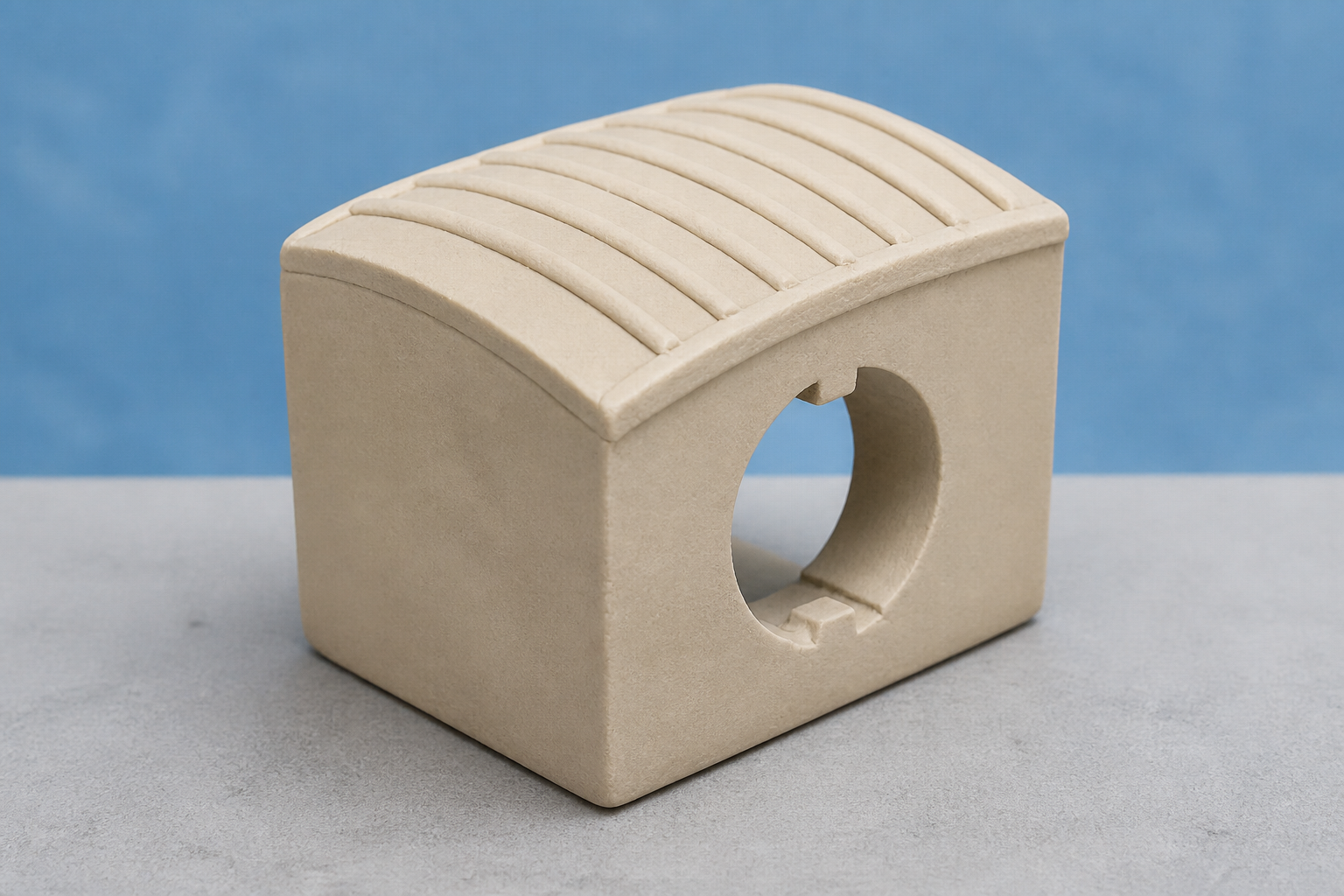
Housing plus Heat Dissipation Structure carry the practical point: A solenoid valve coil housing has a body with a cavity for the coil and an arc-shaped outer wall.

First, the setting
Many everyday machines need to start, stop, or redirect the flow of water, air, or other fluids without someone standing beside them. A laundry machine, heating system, or workshop tool may respond to a switch or sensor. People work on these parts because reliable control helps machines run calmly and safely.
Inside a home appliance or building system, a compact metal or plastic valve may sit behind a panel, joined to pipes and wires. When the machine receives a signal, a small electromagnetic coil - wire that becomes magnetic when powered - moves a part inside the valve. Nearby, a person notices water arriving, air changing direction, or a cycle beginning.
What changes in this design
Without further detail, a reader might picture the coil inside a plain curved casing with a smooth outside surface.
This casing has an arc-shaped outer wall with raised features, indented features, or both, so that its outside has more exposed area.
More exterior area is intended to improve heat dissipation while the coil operates. That makes the casing's visible shape part of how it handles operating heat.
Arc Wall, Cavity, Coil
An arc-shaped outer wall is the first detail you can picture: it belongs to a body with a cavity for a coil, and a heat dissipation structure sits recessed in that wall and/or projects from it. The obvious headline is an exterior shaped to offer more surface area. The more useful question is about timing: when coil operation begins, how does a housing stop being only the place around a component and take on the stated job of helping with heat dissipation? I looked twice because the patent makes that handoff visible in the wall itself, before any broad conclusion about what the whole valve might mean. The visual detail is modest, but its placement makes the question more exact.
That initial picture needs names before it earns interpretation. The publication is US20260260801A1, titled Solenoid Valve And Coil Thereof, And Housing Of Coil, and dated September 3, 2026. A cavity is a hollow space, and its stated role here is to hold the coil. An arc-shaped outer wall is simply the curved exterior wall named in the filing. Heat dissipation means moving heat away during coil operation; surface area means the amount of exterior face made available for that effort. Recessed means set inward, while protruding means extending outward. The title puts the valve, coil, and housing in view, but the described detail stays narrowly with the housing. I think those plain terms matter because they keep the reading attached to a particular arrangement rather than to a vague idea of a cooler-looking housing.
Housing Takes Its Turn
With those terms fixed, the mechanism can be followed without pretending it is more complicated than the published description. The body supplies a cavity for the coil; its arc-shaped outer wall supplies the exterior location; the heat dissipation structure is recessed in that wall and/or protrudes from it. The stated connection is enlargement of surface area. That sequence is worth holding onto: the coil is not described as doing the outer wall's work, and the outer wall is not described as replacing the coil. Each has a separate assignment, with the housing geometry taking up its role at the point operation makes heat dissipation relevant. No additional material, dimension, or thermal path is part of the arrangement stated here, and none is needed to notice that division.
Surface Area Shows the Handoff
Because that division of roles is the mechanism's point, the purpose comes into focus without overextending it. The patent says the recessed and/or protruding structure enlarges surface area and improves heat dissipation during coil operation. That is a bounded statement about why the exterior is shaped as described. This reading cannot supply a size, material, temperature, comparison against another housing, or an outcome beyond the improvement stated. The consequence worth noticing is timing rather than drama: the outer wall has been given an explicit task during operation. That restraint is not a gap to decorate with guesses. It is the boundary that lets the editorial point remain useful.
That purpose changes the fair comparison. A broad, ordinary picture of a housing is a body that contains something; this filing instead identifies an outer wall whose form is tied to surface area for a stated heat-dissipation purpose. The curve is less like a decorative casing and more like a stage manager making room for the next cue. The recessed and/or protruding structure has the air of a librarian finding extra shelf space without moving the building. The housing reads less like a container on standby and more like a quiet committee assigned to the moment operation begins. These images do not add mechanics the patent never gives; they make one relationship visible: interior coil operation, then exterior geometry with a named job. That is the counterpoint to the obvious headline. More surface area is not the whole idea; the interesting part is where the responsibility is placed.
Once that relationship is visible, two transferable observations are ready for you. A useful design question is not only what an outer surface looks like, but at what moment it acquires a job. Another is whether a part merely holds a neighboring part or has a specifically stated role once that neighbor operates. Taken together, those habits help you notice responsibility changing at an interface, even when the visual change is as contained as an indented or raised detail. This filing invites both questions without answering any larger contest about superiority. I would keep the distinction small: a cavity receives the coil, while an arc-shaped outer wall carries a recessed and/or protruding heat dissipation structure whose stated purpose is to enlarge surface area and improve heat dissipation during operation. That return to the first physical detail is why the handoff holds: the curve is not asked to tell the whole story, only to show you where the next responsibility begins.
The record, briefly. US20260260801A1, “Solenoid Valve And Coil Thereof, And Housing Of Coil” A solenoid valve coil housing has a body with a cavity for the coil and an arc-shaped outer wall. A heat dissipation structure is recessed and/or protrudes from that wall to enlarge surface area and improve heat dissipation during coil operation.
More angles on this
- CPC H01F: Magnets; inductances; transformers; selection of materials for their magnetic propertiesThe official classification family this record was filed into, published in the USPTO Cooperative Patent Classification scheme.
- CPC F16K: Valves; taps; cocks; actuating-floats; devices for venting or aeratingThe official classification family this record was filed into, published in the USPTO Cooperative Patent Classification scheme.
- Holding the Mechanical Line on a Hair-Thin WireAnother reading from the neighbouring H01B classification family, cables; conductors; insulators; selection of materials for their conductive, insulating or dielectric properties.
- The Oblong Carrier and the Mechanical Signal of AlignmentAnother reading from the wider H10P classification family, generic processes or apparatus for the manufacture or treatment of devices covered by class H10.
- How Four Transistors Distinguish a Pixel Setting from a Working PromiseAnother reading in the same Machines category on this site.
Read around this one:Public patent recordUSPTO published figure