Field Notes
Holding the Mechanical Line on a Hair-Thin Wire
Proterial is pushing fluororesin insulation down to ten micrometers to protect fragile micro-wires in medical probes, even as universal chemical bans loom.

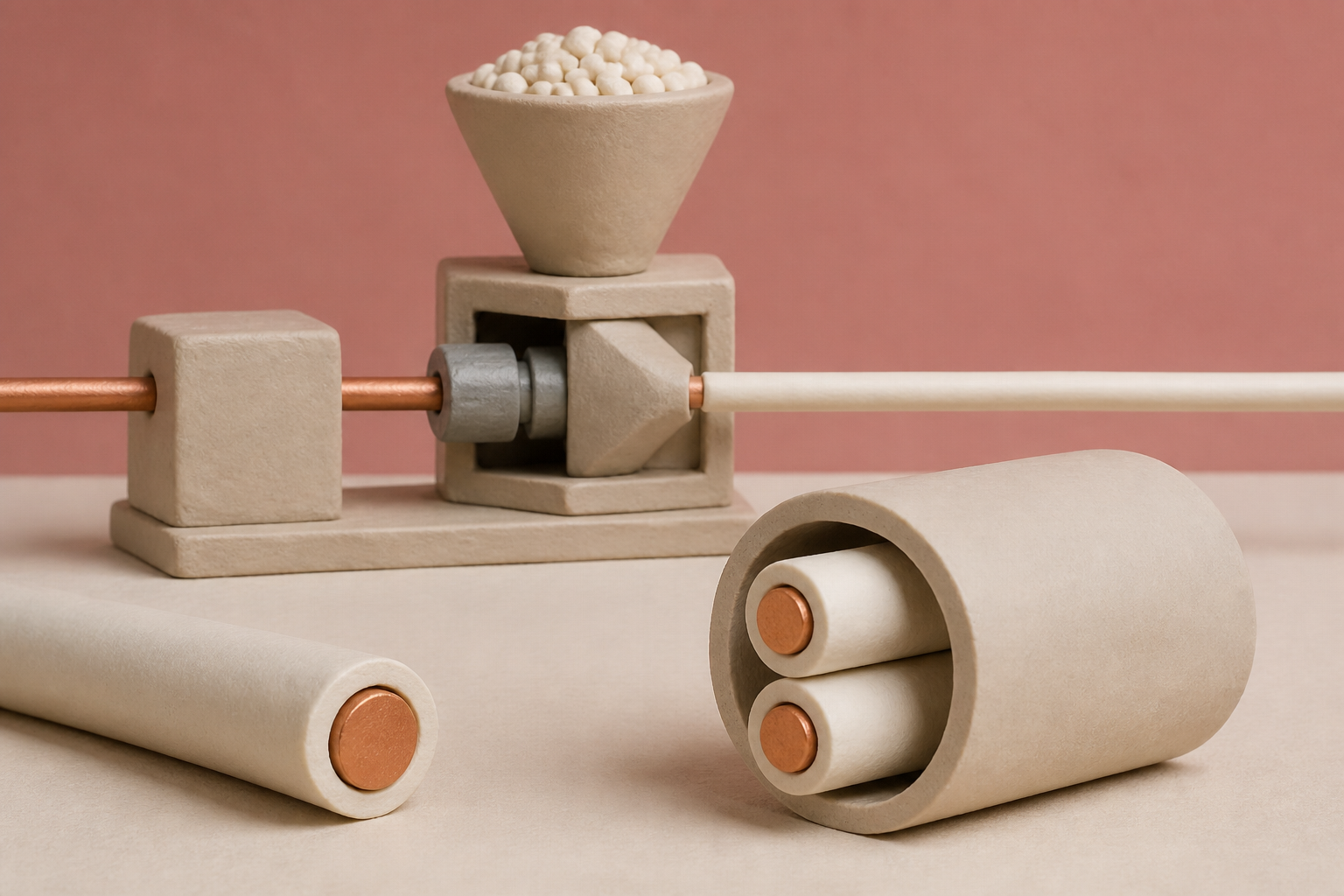
What changes in this design
People generally expect microscopic wires to sacrifice toughness, assuming a paper-thin protective layer will easily crush or tear under external force.
The record specifies a wire no wider than 0.1 millimeters with a 10 to 30 micrometer fluororesin jacket that resists at least 15 Newtons per 50 millimeters of crushing force under standard testing.
Miniature cables must survive physical manufacturing and use without breaking, showing how specialized polymer coatings can protect tiny conductors in tight spaces.
A bundle of three hundred thousand flexes
When I look at an ultrasound diagnostic probe in an examination room, it is easy to forget how much delicate hardware sits inside the handheld wand. Medical ultrasound cables bundle hundreds of individual miniature coaxial lines into a single flexible sheath that must survive over 300,000 mechanical bending, pulling, and twisting cycles during its working life. Inside those assemblies, individual high-strength copper alloy wire strands measure just 10 micrometers in diameter, configured across ultra-fine gauges like 46 AWG for low capacitance and 48 AWG for high capacitance.
The sonographer moving that wand back and forth over a patient needs crisp, high-frequency imaging, and that signal clarity depends directly on low electrical capacitance. That requirement leaves cable engineers facing a stubborn physical trade-off. The insulating layer surrounding each microscopic conductor must be extraordinarily thin to keep the bundle flexible, yet electrically stable enough to prevent signal loss and mechanically resilient enough not to split or crush under continuous movement. In flexible endoscopes, diagnostic catheters, and high-frequency analytical probes, a split in the insulation means electrical crosstalk or outright device failure.
The limits of standard wire enamel
The traditional answer to electrical insulation at microscopic scales is magnet wire enamel. Manufacturers like ELEKTRISOLA produce ultra-fine coated wires using polyimide, polyurethane, and polyesterimide formulations governed by standards such as IEC 60317, NEMA MW 1000C, and JIS C 3202. On a 41 AWG bare conductor measuring 0.071 mm in diameter, a 12-micrometer enamel coating creates a finished wire with an outer diameter of 0.083 mm. That thin polymer skin delivers an impressive dielectric breakdown rating of 220 volts per micrometer, yielding 2,640 volts of total breakdown protection.
I could not find an easy way around the trade-offs in those specification sheets when reading through the technical baselines for fully insulated wire. While polyimide enamels tested under UL 2353 and IEC 60317-56 provide tensile strengths of 310 N/mm2, room-temperature breakdown voltages exceeding 100 volts per micrometer, and thermal cut-through resistance up to 260 degrees Celsius, enamels have higher dielectric constants than fluorinated resins. At the high signal frequencies required for modern medical imaging, standard enamel jackets introduce higher dielectric losses, dampening the faint electrical signals returning from deep inside human tissue.
Squeezing fluororesin below one tenth of a millimeter
Fluororesins solve the electrical dilemma through exceptionally low dielectric loss, low surface friction, and natural biocompatibility. The practical difficulty has always been that fluoropolymers are mechanically softer and far harder to extrude into uniform, micron-scale jackets without pinholes or structural weak spots. A newly published patent application, US20260260778A1, assigned to Tokyo-based Proterial, Ltd., tackles that specific manufacturing barrier.
What caught our attention in the published record is the mechanical crush threshold. Proterial describes an insulated electric wire comprising a conductor enclosed by an insulator composed mainly of fluororesin with a thickness of only 10 to 30 micrometers, bringing the overall outer diameter of the wire down to 0.1 mm or less. Despite creating a sheath that is roughly a fraction of the width of a human hair, the filing specifies that the insulator maintains a crush strength of at least 15 N/50 mm under the standard UL 2556 test protocol. In my view, achieving that degree of crush resistance in an extruded fluoropolymer layer this thin explains why the company is patenting the manufacturing method rather than just the geometry of the wire.
The threat of a universal chemical ban
This technical refinement lands at an uncertain moment for fluorinated materials. European Union regulatory authorities are advancing a universal restriction proposal under the REACH chemical framework that seeks to eliminate the entire class of per- and polyfluoroalkyl substances, known collectively as PFAS. Because the regulatory definition covers all fluorinated polymers, medical-grade fluororesins are caught directly in the scope of the proposed bans.
Industry assessments gathered by groups such as PlasticsEurope highlight the lack of ready substitutes for these applications. An independent technical study conducted for the European fluoropolymers sector found that fluorine-free alternatives face fundamental physical and technical limits that prevent drop-in replacement in high-performance electrical insulation. Their broader socio-economic reports warn that blanket restrictions could disrupt hundreds of billions of euros in European industrial and high-tech manufacturing, specifically threatening strategic supply chains in medical diagnostic equipment, catheters, and precision sensors.
Where the risk actually sits
We often assume that industrial innovation can swap out controversial chemistries whenever environmental regulators demand it, but the physics of micro-cables tells a different story. If you ask whether Proterial's micro-extrusion method solves the looming regulatory clash, our answer is that it actually sharpens it. By demonstrating that high-strength fluororesin jackets can be extruded down to 10 micrometers while surviving rigorous crush testing, the company is anchoring the next generation of medical diagnostics even more firmly to fluoropolymer chemistry.
Proterial, which generated 747.3 billion yen in consolidated revenue for FY2025 following its 2021 buyout and separation from its former parent company, is betting that the dielectric and mechanical properties of fluororesins remain irreplaceable at sub-0.1 mm dimensions. As international regulators debate whether to grant sweeping exemptions for healthcare applications or enforce strict chemical phaseouts, manufacturers are not stepping back from fluoropolymers. Instead, they are refining their extrusion techniques to squeeze the material right to the edge of its physical limits.
Sources
Reporting for this piece drew on the published filing and the references below.
- US Patent Application US20260260778A1: Insulated Electric Wire, Cable, And Method For Manufacturing Insulated Electric Wire
- Probe Cables for Ultrasound Diagnostic Equipment | Proterial, Ltd.
- Medical and Analytical Equipment | Proterial, Ltd.
- Enamelled Wire Types | ELEKTRISOLA
- Fully Insulated Wire Technical Data | ELEKTRISOLA
- Medical Equipment - Fluoropolymers | PlasticsEurope
- Assessment of Alternatives - Fluoropolymers | PlasticsEurope
The record, briefly. US20260260778A1, “Insulated Electric Wire, Cable, And Method For Manufacturing Insulated Electric Wire” The insulated electric wire includes a conductor surrounded by an insulator with an outer diameter of 0.1 mm or less. The insulator is composed mainly of fluororesin with a thickness of 10 to 30 micrometers and has a crush strength of at least 15 N/50 mm under the UL 2556 standard.
More angles on this
- CPC H01B: Cables; conductors; insulators; selection of materials for their conductive, insulating or dielectric propertiesThe official classification family this record was filed into, published in the USPTO Cooperative Patent Classification scheme.
- CPC C05F: Organic fertilisers not covered by subclasses C05B, C05C, e.g. fertilisers from waste or refuseThe official classification family this record was filed into, published in the USPTO Cooperative Patent Classification scheme.
- Inside electric vehicle adapter inspection deviceAnother reading from the neighbouring H01R classification family, electrically-conductive connections.
- The Oblong Carrier and the Mechanical Signal of AlignmentAnother reading from the wider H10P classification family, generic processes or apparatus for the manufacture or treatment of devices covered by class H10.
- Timing the Molecular Handoff in Preeclampsia DetectionAnother reading in the same Field Notes category on this site.
Read around this one:Public patent recordUSPTO published figure