Groundwork
Inside electric vehicle adapter inspection device
As automakers scramble to bridge EV charging plugs, a GM patent reveals how hard it is to test portable adapters that carry a thousand volts.

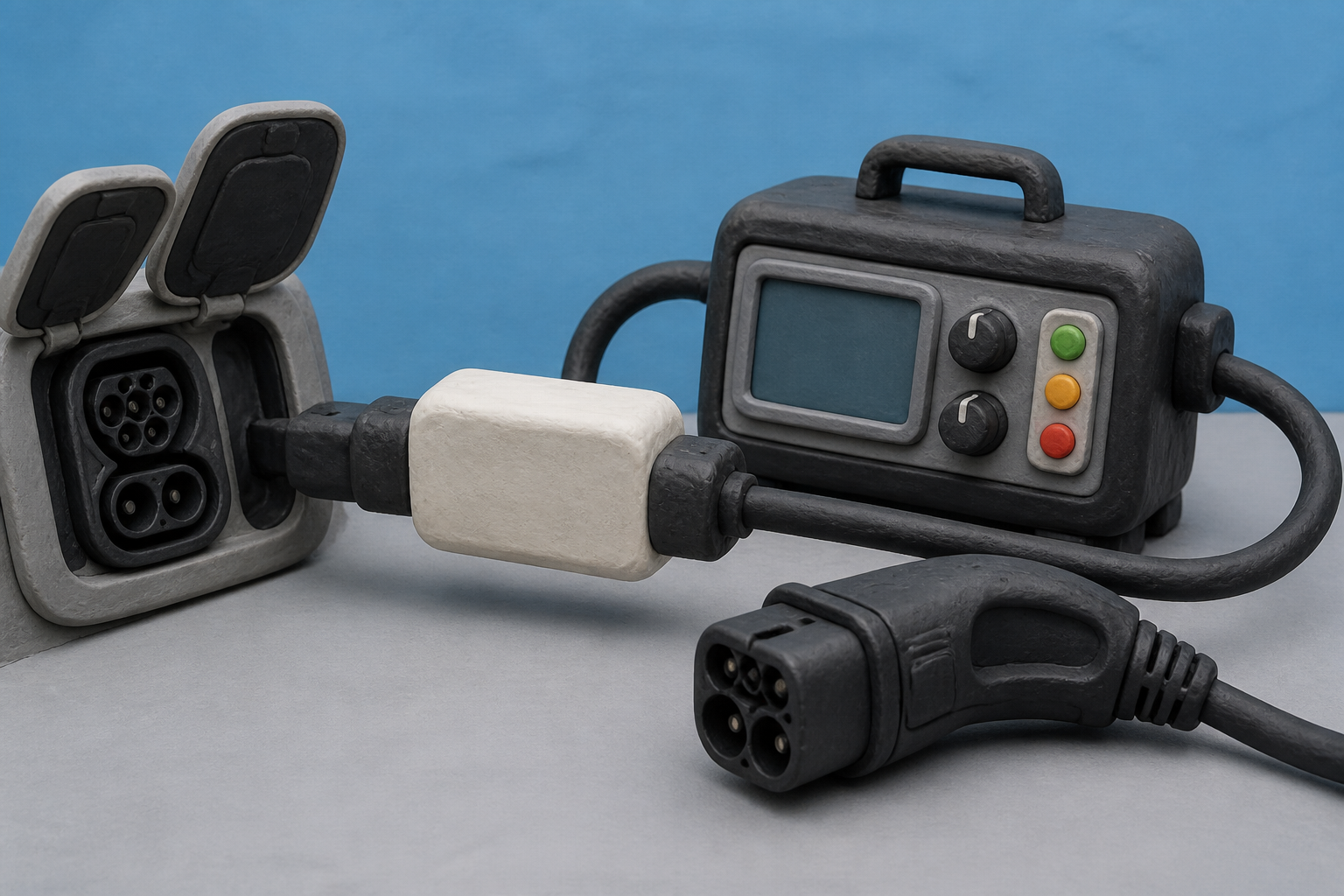
What changes in this design
Drivers typically have no easy way to test a charging adapter, often assuming it works until it fails to charge or shows obvious damage during everyday use.
Instead of guessing, this unit connects to the adapter to measure voltage, current, and temperature during low and high power tests, comparing those numbers to set thresholds to decide if the unit passes.
Evaluating whether an adapter meets operating limits gives users a direct answer about its overall health, replacing uncertainty with measured sensor comparisons.
Nine defective plugs and a calendar coincidence
On March 3, 2026, General Motors published a quiet customer satisfaction bulletin numbered N252541510. The campaign directed dealers to collect and replace Level 2 charging adapters across several electric models, including the Cadillac Lyriq, Chevrolet Blazer EV, and GMC Hummer EV. The scope was minuscule, covering just nine vehicles in the United States, but the instructions were strict: service technicians had to physically take possession of the old hardware before handing over a new one.
What caught my eye was the calendar. Exactly one year before that bulletin went out, on March 3, 2025, GM filed a patent application for a specialized diagnostic box designed to solve that precise headache. Published on September 3, 2026, under filing US 2026/0259281 A1, the patent describes an inspection device built to determine the ongoing health of portable charging adapters. Instead of waiting for an adapter to fail in a customer's driveway, GM sketched out a tool that tests the plug on a shop bench.
A benchtop box for a thousand volts
Go/no-go diagnostic boxes are not new to electric vehicles. Back in 2012, a Connecticut test equipment maker patented a handheld wand with simple pass/fail lights, but that device was built to test stationary charging pedestals. GM's filing takes the same go/no-go philosophy and points it at the loose, driver-carried adapter. The proposed device sandwiches an adapter between an inlet and a coupler, using five internal sensors to measure voltage, current, and temperature before a green or red indicator tells the technician whether the hardware can be trusted.
When we look at the electrical loads involved, the caution makes immediate sense. As automakers pivot toward Tesla's charging standard, formalized as SAE J3400, these portable plastic-and-copper plugs are no longer handling trickle currents. The standard supports direct-current charging up to 1,000 volts and 1,000 amperes, alongside alternating current and vehicle-to-grid power flows. That extreme electrical span is why GM's patent splits its inspection routine into distinct phases, running voltage-only checks at low power before switching on temperature sensors and ammeters under high-voltage loads to verify interoperability across standards like J1772, CCS, and CHAdeMO.
The whack-a-mole grey market
GM was not the only one worried about loose adapters. In late 2024, a federally funded consortium of national laboratories ran failure analyses across the charging supply chain and singled out driver-provided adapters as the single highest safety risk. The physical danger is straightforward. If a worn or badly manufactured adapter separates while passing massive fast-charging currents, the resulting electrical arc can generate blistering temperatures almost instantly.
Certified adapters from carmakers sell for $100 to over $300, but online retailers are flooded with cheap uncertified imports. In Canada, provincial electrical safety inspectors have described intercepting these unapproved plugs as an endless game of whack-a-mole because standalone accessories fall outside normal building and electrical installation codes. Automakers have tried to protect themselves by writing warranty clauses that deny coverage if an unapproved adapter fries a battery pack. I doubt a disclaimer alone will keep bargain hardware out of glove compartments, especially when drivers face thousands of fast chargers with incompatible plugs.
The harder half of the problem
The impulse behind GM's patent is understandable: isolate the adapter, run it through a sensor matrix, and give it a clean bill of health. But real charging incidents do not always happen where the sensors are looking. In October 2025, dashcam video showed an electric car bursting into flames during a charging attempt in Hope, British Columbia. First-wave headlines immediately blamed the driver's third-party adapter, framing it as the exact nightmare scenario safety experts had warned about.
When Technical Safety BC released its official investigation report, the story fell apart. The third-party adapter had been used roughly fifty times without incident. The blast was caused by a short circuit inside a battery module within the charging station itself, which had logged repeated, unaddressed electrical resistance faults before the explosion. The adapter was destroyed by a fire that started upstream.
That discrepancy is where our neat engineering models bump against messy reality. We can build benchtop sensors to verify that a chunk of molded resin and copper meets tolerance, but an adapter is only as safe as the power flowing into it. Isolating the plug from the station and the car is a tidy ambition, yet our real-world charging faults rarely happen in a vacuum.
Sources
Reporting for this piece drew on the published filing and the references below.
- Electric Vehicle Adapter Inspection Device For Determining The Health Of An Electric Vehicle Charging Adapter
- ChargeX Consortium Addresses EV Charging Adapter Safety and Reliability
- A regulatory grey zone: Not all EV charging adapters are created equal
- FreeWire charger, not third-party adapter, found responsible for explosion in Hope, B.C.
- GM launches free replacement program for EV charging adapters
The record, briefly. US20260259281A1, “Electric Vehicle Adapter Inspection Device For Determining The Health Of An Electric Vehicle Charging Adapter” An inspection device for determining electric vehicle charging adapter health includes an inlet, a coupler, and a go/no-go mechanism. Multiple sensors on the inlet and coupler measure voltage, current, and temperature under low and high voltage currents. The go/no-go mechanism determines adapter health by comparing sensor measurements to acceptable ranges, thresholds, or to each other.
More angles on this
- CPC G01R: Measuring electric variables; measuring magnetic variablesThe official classification family this record was filed into, published in the USPTO Cooperative Patent Classification scheme.
- CPC B60L: Propulsion of electrically-propelled vehiclesThe official classification family this record was filed into, published in the USPTO Cooperative Patent Classification scheme.
- Photon Detection Marks a Pause Worth NoticingAnother reading from the neighbouring G01J classification family, measurement of intensity.
- Thermal Imaging Camera Device Makes the Next Move Easier to SeeAnother reading from the wider G03B classification family, apparatus or arrangements for taking photographs or for projecting or viewing them.
- Audio-Based Modal Estimation Treats the Relationship as the PointAnother reading in the same Groundwork category on this site.
Read around this one:Public patent recordUSPTO published figure