Groundwork
Audio-Based Modal Estimation Treats the Relationship as the Point
A patent about listening to a struck machine tool lands as manufacturers and researchers work to stop striking machines at all.

What changes in this design
Without this method, a reader might only know that a spindle speed must be chosen. How people ordinarily choose it is not stated.
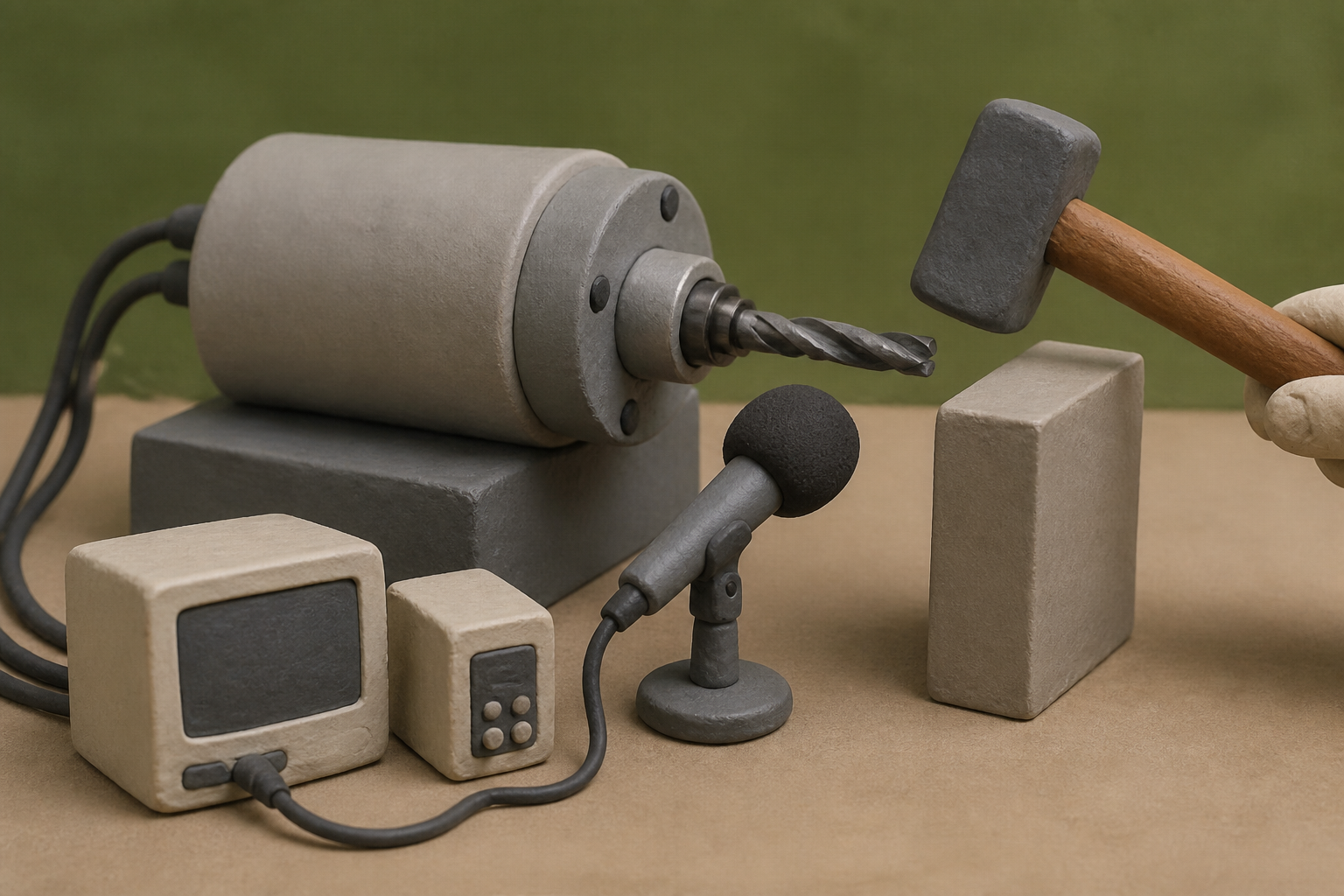
Here, the machine tool is struck with a hammer or another impact device. Its resulting vibration sounds are collected and examined with an FFT, a way to separate sound into its frequency ingredients, to identify natural vibration frequencies and select a related spindle speed.
It is worth knowing because the method treats the machine's own vibration sounds as information for choosing a spindle speed. What result this choice produces is not stated.
Taylor's 1907 complaint
In 1907, Frederick Taylor called machining vibration "the most obscure and delicate of all the problems facing the machinist." The line holds my attention because the difficulty is so physical: a tool, a workpiece, and a machine can begin feeding vibration back into a cut until a planned operation becomes unstable.
Half a century later, Tobias and Fishwick's regenerative-chatter theory gave the problem its enduring map: the stability-lobe diagram. It connects cutting conditions to places where vibration settles down or takes over. Every later method for choosing spindle speed, including the tap test, is trying to find one of those safer places.
The hammer on the tool
US20260257310A1 begins at the oldest end of that chain. A machine tool is struck with a hammer or other impact device; its vibration sounds are collected; an FFT identifies natural frequencies; and those frequencies guide selection of a related spindle speed.
FFT analysis is a sensible way to turn a short burst of sound into a list of frequency peaks. I can see the attraction of making the setup less elaborate than the conventional digital tap test, where a modal hammer hits the tool tip and an accelerometer measures the response. A frequency peak, though, is not yet a machining instruction until it is connected to a usable spindle-speed choice. The application keeps the impact itself, however, as the starting move.
A microphone is not an absurd sensor in a machine shop. A 2020 end-milling study placed a MEMS microphone 500 mm from the workpiece and estimated machining parameters with less than 1% error against dynamometer measurements when the nominal depth of cut was known. That result concerns cutting, not a hammer strike, but it establishes that useful machine information can travel through air.
A microphone before cutting
The broad sequence in this filing is not new. A U.S. Department of Commerce patent filed in 1999 and granted in 2002 already described exciting a tool without cutting, using a microphone for lathe tools to find resonant-frequency peaks, and selecting stable spindle speeds from them.
I don't think age alone makes a later application uninteresting. Practical changes in sensing, setup, cost, or analysis can matter greatly on a shop floor. The published material limits my assessment to the broad approach, not whether the application's legal claims differ from that older patent's claims. Still, "listen to the tool, find resonance, choose speed" has been public territory for roughly a quarter century.
Three exits from the tap
Other filings show how much effort has gone into avoiding the awkward parts of tap testing. GF Machining Solutions received a 2018 patent for pooling chatter and machining data from networked machines into a shared stability-lobe database. An operator could choose a chatter-free speed from accumulated knowledge rather than test the particular machine first.
The same manufacturer later patented an automated impact device. Its 2022 patent describes manual strikes on rotating machine structures as carrying high injury risk and producing poorly repeatable force and impact location; it also says automated hammers available at the time were very costly. A microphone does not solve either concern if a person still has to deliver the blow.
Fanuc's sensorless-chatter patent, filed in 2023 and granted in February 2026, goes further in the other direction. It detects chatter from spindle-motor torque or current and servo signals, then adjusts speed, without a hammer, microphone, or accelerometer. The direction of travel in our sources seems clear: extract more from operation itself, or from prior measurements, and interrupt production less.
The open question
A 2025 study of operational modal analysis makes the pressure on impact testing sharper. It found modal frequencies from ordinary milling vibration without a hammer, matching static hammer-test frequencies within 10% and frequencies during actual cutting within 3%. Its authors argue that stopping production for impact testing makes the method unsuitable for condition monitoring.
I'd want to know whether an audio-based impact test can earn its retained ritual: how repeatable are its microphone placement and strike conditions, how does it compare with an accelerometer-based tap test, and when is it better than listening during cutting? The filing may have answers in its claims and technical details, but the larger story is already visible. This is a new attempt to simplify a familiar measurement while the surrounding field is working to make that measurement disappear.
Sources
Reporting for this piece drew on the published filing and the references below.
- Machining vibrations
- US6349600B1 - Device for stable speed determination in machining
- US10042922B2 - Database for Chatter Predictions
- US11243138B2 - Automatic Impact Inducing Device
- US12539574B2 - Sensorless chatter detection
- Non-Invasive Estimation of Machining Parameters during End-Milling Operations Based on Acoustic Emission
- Modal identification of machine tool spindle units by output only operational modal analysis
- Using Digital Tap Testing to Measure Machining Dynamics
The record, briefly. US20260257310A1, “Audio-Based Modal Estimation” A machine tool is struck with a hammer or other impact device, and resulting vibration sounds are collected and FFT analyzed to identify natural vibration frequencies for selecting a spindle speed related to those frequencies.
More angles on this
- Inside the haptic deviceAnother reading from the same G01H classification family, measurement of mechanical vibrations or ultrasonic, sonic or infrasonic waves.
- CPC B23Q: Details, components, or accessories for machine tools, e.g. arrangements for copying or controllingThe official classification family this record was filed into, published in the USPTO Cooperative Patent Classification scheme.
- CPC G01H: Measurement of mechanical vibrations or ultrasonic, sonic or infrasonic wavesThe official classification family this record was filed into, published in the USPTO Cooperative Patent Classification scheme.
- Work Machine Marks a Pause Worth NoticingAnother reading from the neighbouring B23B classification family, turning; boring.
- Coating Mechanism And Coating Device Questions the Default ArrangementAnother reading from the wider B05C classification family, apparatus for applying fluent materials to surfaces, in general.
Read around this one:Public patent recordUSPTO published figure