Machines
Work Machine Marks a Pause Worth Noticing
A new power-tool filing joins a long race to stop kickback, while the injury numbers used to explain it remain deeply unsettled.

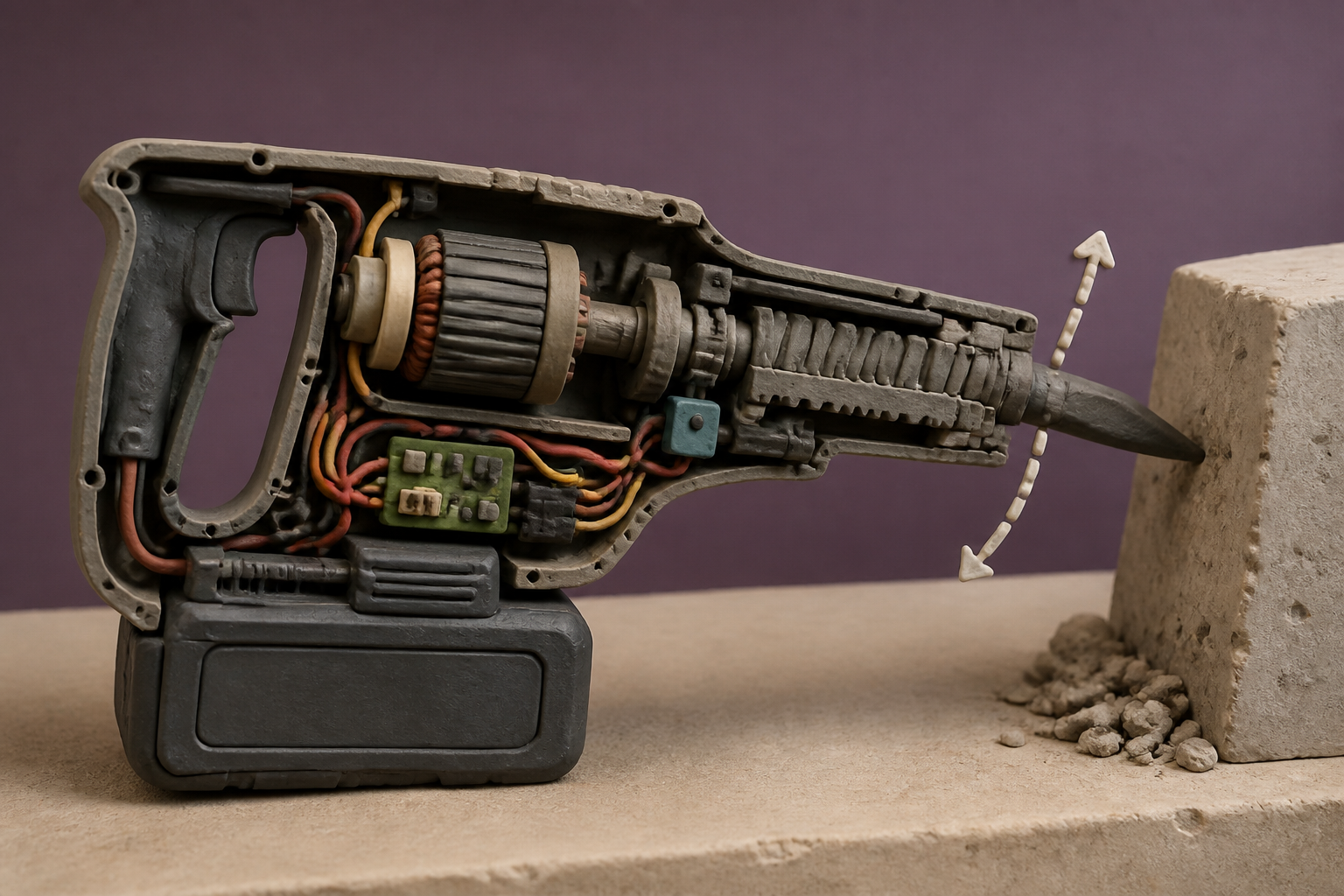
What changes in this design
Without this feature, a reader might expect the motor to continue accelerating without a current-based decision to slow or stop it. The record does not state how other work machines normally handle this situation.
Here, a microcomputer checks motor current during acceleration. If the reading reaches a loaded threshold rather than the no-load value, it turns on swing control and reduces the motor's speed or stops it.
The pause is conditional: it occurs when the current reading indicates a load during acceleration, rather than happening at every start.
At the cut
A spinning angle-grinder wheel can catch in a cut, bind, and force the tool out of the user's control in an instant. A safety page attributes nearly 25,000 annual U.S. injuries to angle-grinder use, including kickback, broken wheels, and flying fragments. That number is where I started, because it makes a small electronic intervention sound urgently necessary.
Yet the dangerous event is not one neat thing. The same safety material describes wheel breakage as inherent to abrasive wheels and says many recorded injuries arise from shattering wheels or lost segments. Kickback is real and frightening, but it is only one failure in a sequence that may also involve a damaged disc, an insecure workpiece, poor protection, or a rushed hand.
Current before braking
Into that narrow instant comes US 2026/0257283 A1, published September 3 after being filed on May 26, 2023. Koki Holdings calls it a Work Machine, though its listed classification puts it with portable drilling tools rather than construction equipment. The application describes a microcomputer watching centrifugal-direction acceleration and motor current together: the response to a sudden swing comes only when the motor is drawing a loaded current, not merely spinning free.
That extra condition is the point. A controller that reacts to every sharp movement would be a nuisance; one that reacts when the motor is working against a load may be better at distinguishing a genuine bind from ordinary motion. What I take from the filing is not a new kind of brake, but a tighter question asked before a motor is slowed or stopped. The published material does not establish the exact product form, so I would not call this an angle-grinder patent. It belongs, instead, to the larger effort to stop handheld tools from turning against their users.
May 26, 2023
The application spent more than three years pending while its applicant's identity kept accumulating history. Koki began in electric-drill manufacturing, became Hitachi Koki, changed hands in a 2017 KKR buyout, and adopted its present name in 2018. Reporting later described a proposed sale above $2 billion that had stalled. I see no basis to say those corporate events changed this particular safety design, but they make the long wait feel less like a clean product-development timeline.
Patent conflict was not remote from the company during that wait. In August 2024, Koki's American arm failed to revive a separate nail-gun investigation on appeal after the court found it lacked Article III standing. That dispute was unrelated to kickback control. Still, it shows a tool maker whose ordinary business includes both engineering safeguards and defending claims around them.
Two incompatible totals
This safety race is older than the new filing. A U.S. patent granted in 2008 used a Coriolis-effect rotational-rate sensor to spot kickback, then proposed pulsing power, disconnecting it, or braking. A later rival patent on twisted-motion detection cited a much earlier Japanese acceleration-based approach. Current product pages keep the contest alive: one 2026 grinder release advertises AUTOSTOP kickback control and sub-one-second braking for most wheels, while another names an electronic clutch and kickback brake for a sensed pinch, stall, or bind-up.
The numbers supporting the urgency are much less settled than the technology. A 2026 tool-safety blog gives one dataset of just over 1,260 angle-grinder injuries over five years, roughly 250 a year, almost a hundredfold below the annual total quoted elsewhere. The difference matters because we cannot responsibly treat those figures as competing measurements of the same population without knowing their definitions and collection methods. I cannot reconcile them from the published pages. Neither count tells us how many cases a current-sensing shutdown could actually prevent.
What would have to be true
For this kind of patent to matter outside a portfolio, its load-current test would have to catch real bind-ups soon enough to reduce harm, while ignoring normal movements and false alarms. It would also have to work across the messy conditions that produce injuries: different wheels, materials, battery states, grip positions, and users. That is a demanding standard for a conditional software decision made during a violent mechanical event.
I don't think the right measure is whether a tool can stop itself impressively in a product demonstration. The stronger test is whether it prevents a meaningful share of kickback injuries without giving users false confidence about wheel condition, guards, protective equipment, or how they hold the tool. The question for me is therefore not whether Koki has found a clever extra signal. It has. The question is whether that signal changes the accident that actually happens.
Sources
Reporting for this piece drew on the published filing and the references below.
- US 2026/0257283 A1 - Work Machine
- Work Machine - Justia Patents
- US7410006B2 - Power tool anti-kickback system with rotational rate sensor
- US11607789B2 - Twisted Motion Detection in Electric Working Machines
- Grinders Stats and Facts
- Tool Safety and Injury Statistics (2026)
- Milwaukee Brings Next Advancement in Angle Grinders
- 5 in. Brushless Small Angle Grinder With KICKBACK BRAKE
- KKR's $2 Billion Sale of Japanese Tools Firm Koki Has Stalled
- Koki Holdings Fails to Revive Patent Infringement Investigation
- Our History - Koki Holdings Co., Ltd.
The record, briefly. US20260257283A1, “Work Machine” A work machine uses a microcomputer that monitors motor current during centrifugal-direction acceleration and, when the current reaches a loaded threshold rather than a no-load value, activates swing control to reduce motor speed or stop the motor.
More angles on this
- Cutting Tool, And Method For Manufacturing Machined Product Treats the Relationship as the PointAnother reading from the same B23B classification family, turning; boring.
- CPC B23B: Turning; boringThe official classification family this record was filed into, published in the USPTO Cooperative Patent Classification scheme.
- Welding-Type Systems Using Fluid Sensors With Bond Resisting Substances Makes the Next Move Easier to SeeAnother reading from the neighbouring B23K classification family, soldering or unsoldering.
- The Moment a Remediation System Hands OffAnother reading from the wider B09C classification family, reclamation of contaminated soil.
- What a Steelmaking Sequence Leaves for JudgmentAnother reading in the same Machines category on this site.
Read around this one:Public patent recordUSPTO published figure