Objects
Coating Mechanism And Coating Device Questions the Default Arrangement
A tiny screw inside a battery-coating die helps explain why a manufacturing patent now sits in the middle of a U.S.-China technology dispute.

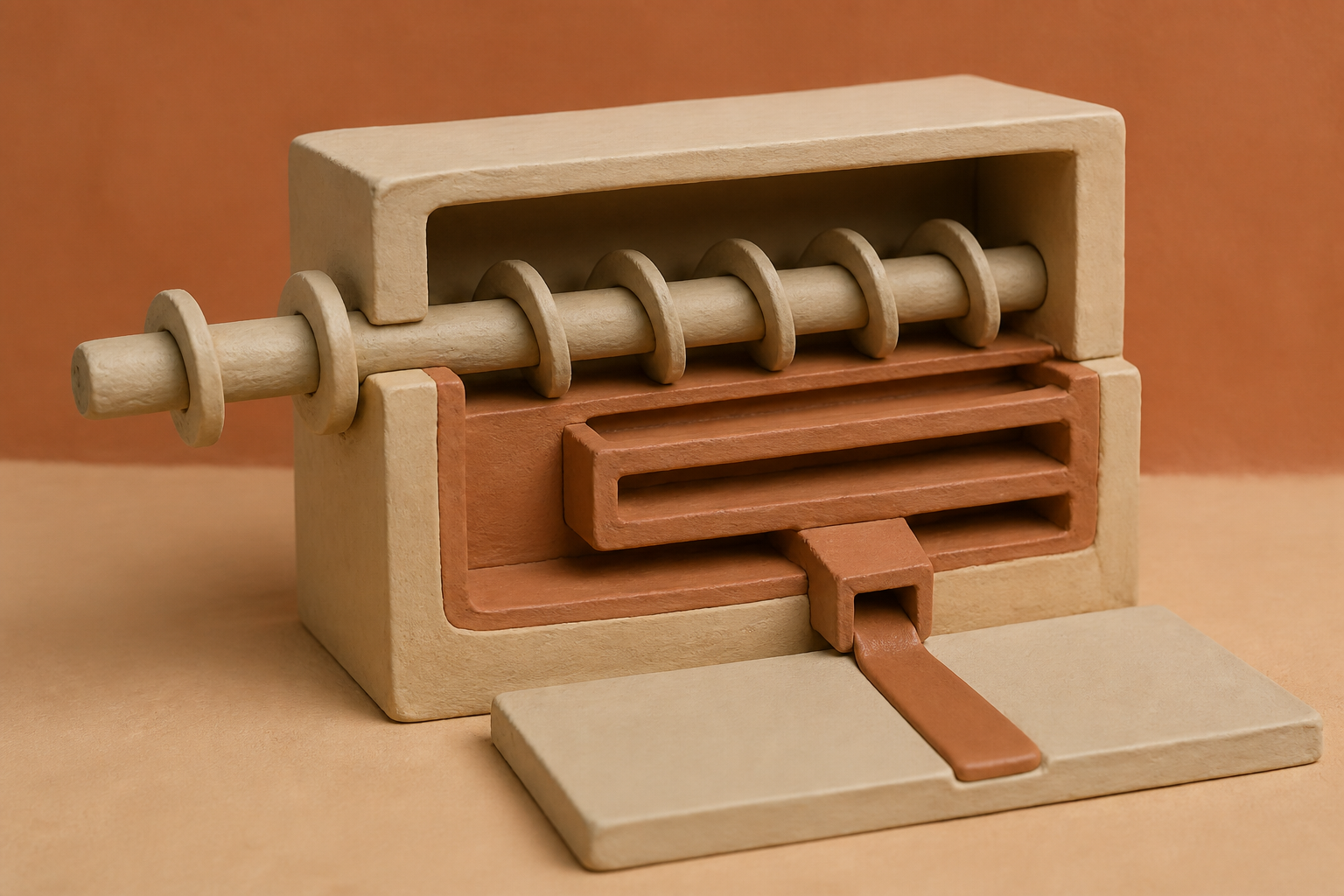
What changes in this design
How coating jobs are ordinarily arranged is not stated. A reader might simply expect material to travel straight from an inlet to an outlet.
Here, the head contains an internal speed-increasing component that sends slurry in a direction crossing the direction it takes when leaving the outlet. Its stated purpose is to raise the slurry's flow velocity.
It is worth knowing because the goal is not merely to move slurry through the head. The material is also redirected inside it, specifically to make it travel faster.
Twenty gigawatt-hours in Marshall
Ford's BlueOval Battery Park in Marshall, Michigan, is a $3 billion bet on 20 GWh of annual battery output, a two-million-square-foot site and about 1,700 jobs. Its lithium-iron-phosphate cell technology is licensed from Contemporary Amperex Technology Co., Limited, better known as CATL. In 2025, proposed federal budget language put the factory's 45X production tax credit at risk because that technology was Chinese-licensed, with the potential loss described as hundreds of millions of dollars.
That fight is usually described at the scale of subsidies, factory jobs and national policy. But the dependence runs down to equipment problems that sound much smaller: getting a thick electrode slurry to leave a coating die evenly, quickly and without variability across its width. The patent at the center of this story is about that unglamorous step.
A screw inside the die
US 2026/0257239 A1, titled "Coating Mechanism and Coating Device," is assigned to CATL and names Zhirong Weng, Liang Jiang and Lei Lu as inventors. It describes a coating head with a cavity, a feed inlet and a discharge outlet. Within that cavity, a speed-increasing mechanism distributes slurry in a direction that crosses its route toward the outlet, intended to raise the slurry's flow velocity.
The filing says slurry generally moves through the die by inertia, and warns that poor flow inside the die can seriously affect the coating. Its proposed answer is an internal screw or auger, turning before the outlet to redistribute material across the die width. The U.S. application was filed on April 27, 2026, after an August 2024 international filing and Chinese priority in October 2023. The patent, I think, is less notable as a new object than as a refusal to accept uneven flow as something that must be managed only by the shape of the die.
Three answers to one defect
The same three inventors, joined by Shengwu Zhang, appear on an earlier CATL coating-die patent with a June 2022 priority date. That one uses an adjustable turbulence assembly, and treats mismatched speed along the outlet as a direct cause of coatings that can crack, bulge or fail to form. A later patent from a different CATL inventor group uses a feedback-driven flow-regulation member instead, after noting that pressure sensors can be susceptible to environmental factors.
Those are not versions of one grand machine. They are separate, narrow attempts to control the same awkward material before it becomes an electrode. What interests me is the repetition: a turbulence part, a screw and a sensor-led regulator are three mechanical answers to a manufacturing problem that the company keeps treating as worth isolating.
A coating defect that ages a cell
A 2019 experiment at a U.S. national laboratory deliberately introduced four kinds of defect into NMC532 cathodes. Non-uniform coating produced the worst degradation of the set, worse than pinholes and agglomerates, because it created local overcharge through an imbalance between negative and positive electrode ratios. This gives a device that tackles flow before the slurry exits a different weight: it is not merely a tidy surface problem.
Conventional slot-die equipment still makes room for a slower path. A Japanese coater maker says jobs are tuned through simulations and verification tests using the actual coating fluid, across stated ranges of 1 to 200 metres per minute and 100 to 50,000 mPa.s in viscosity. That does not establish that CATL's internal screw performs better. It does, however, frame the claim: active redistribution is being offered where geometry, simulation and trials have long carried the burden. That's why I don't read the screw as a novelty for its own sake. I read it as a bet that a hard-to-tune process should have another control point.
The harder half of the problem
The scale behind that control point is large. CATL held 39.9% of global EV battery market share from January through July 2026, with 289.6 GWh installed. Its 2025 annual report put revenue at 423.7 billion yuan and production capacity at 772 GWh, plus 321 GWh under construction. The number that stays with me is not the revenue figure but the installed capacity: small gains in coating repeatability have somewhere very large to travel.
That reach sits inside a political and legal dispute, not outside it. In January 2025, the U.S. Department of Defense added CATL to its list of Chinese military companies. CATL said it had never engaged in military-related business or activities, called the designation a mistake and said it could take legal action. I can't decide a contested designation from a coating patent, and neither should a reader.
The company also brought a seventh infringement case against a domestic battery rival in January 2025, seeking 90 million yuan over a top-cover design patent; reports described cumulative claims in those cases as more than 700 million yuan. CATL is reported to hold more than 20,000 active granted patents. My judgment is that this application belongs in that larger practice of protecting and refining production know-how, even if this one document cannot tell us how much any factory improves.
The harder half of the problem is not making slurry move faster. It is deciding who can build with the accumulated know-how, under which political rules and at what cost. This filing does not answer those questions. It makes them harder to dismiss: the dispute reaches into a die cavity, where a small screw tries to keep a battery coating even.
Sources
Reporting for this piece drew on the published filing and the references below.
- US 2026/0257239 A1 - Coating Mechanism and Coating Device
- US12491531B2 - Coating die head and coating machine
- US12551919B2 - Coating die, coating apparatus, and battery production apparatus
- Global EV battery market share in January-July 2026
- Battery giant CATL responds to inclusion on US list of military-linked entities
- Why Ford is pushing ahead with its Michigan EV battery plant despite losing federal support
- Identifying degradation mechanisms in lithium-ion batteries with coating defects at the cathode
- World's top EV battery maker CATL files fresh infringement lawsuit
- Die Coater - Technical Expertise
- CATL's revenue grows 17% YOY to 423.7 billion yuan in 2025
The record, briefly. US20260257239A1, “Coating Mechanism And Coating Device” A coating mechanism has a coating head with an accommodating cavity, feed inlet, and discharge outlet. A speed increasing mechanism in the cavity distributes slurry in a direction intersecting the outlet discharge direction to increase slurry flow velocity.
More angles on this
- Corner Paint Roller Questions the Default ArrangementAnother reading from the same B05C classification family, apparatus for applying fluent materials to surfaces, in general.
- CPC B05C: Apparatus for applying fluent materials to surfaces, in generalThe official classification family this record was filed into, published in the USPTO Cooperative Patent Classification scheme.
- CPC H01M: Processes or means, e.g. batteries, for the direct conversion of chemical energy into electrical energyThe official classification family this record was filed into, published in the USPTO Cooperative Patent Classification scheme.
- Inside protective film, methodAnother reading from the neighbouring B05D classification family, processes for applying fluent materials to surfaces, in general.
- Exhaust Gas Purification Catalyst Device Treats the Relationship as the PointAnother reading from the wider B01J classification family, chemical or physical processes, e.g. catalysis or colloid chemistry; their relevant apparatus.
Read around this one:Public patent recordUSPTO published figure