Objects
Exhaust Gas Purification Catalyst Device Treats the Relationship as the Point
Cataler is trying to use less precious metal in catalytic converters just as hybrids and tighter rules make every gram matter again.

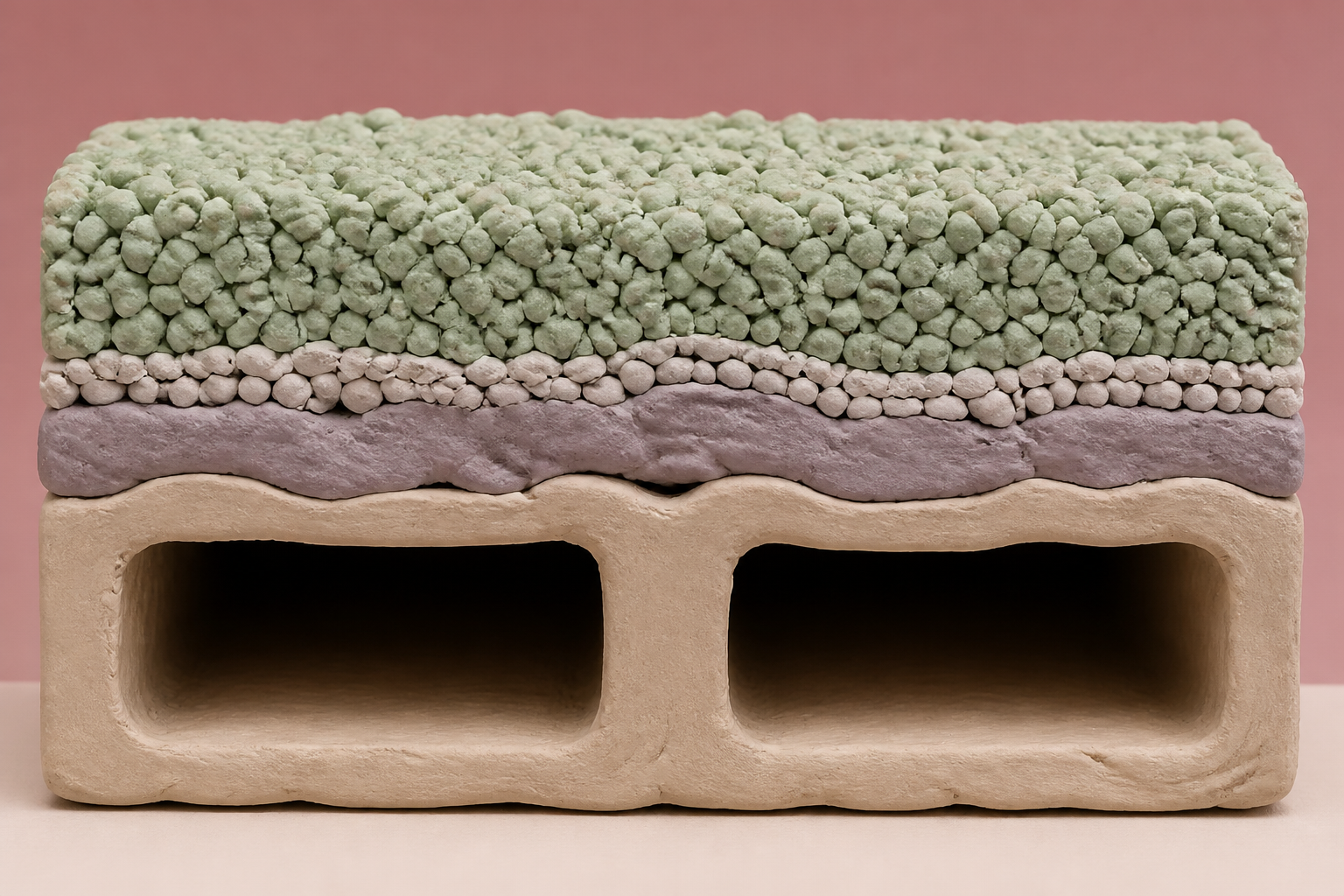
What changes in this design
Without further detail, a reader might picture exhaust cleaning as one continuous gas route with a single treatment material.
This record describes two gas flow paths separated by a partition wall, alongside three material layers: a noble-metal particle carrier, copper-ion-exchange zeolite, and inorganic oxide particles with very little noble metal.
The layout and the materials are the central idea to notice. The record identifies the parts present, but it does not state a measured result or how much purification they provide.
November 29, 2026
On November 29, 2026, Euro 7 begins applying to newly type-approved cars and vans in Europe. The rule brings smaller PN10 particle limits and longer durability requirements, pushing exhaust treatment back into the foreground just as many people had begun treating it as a fading technology. The date that bothers me is how close it sits to this patent's September 3 publication.
Cataler Corporation filed its application in November 2022, then saw it publish four years later as US 2026/0257210 A1, titled Exhaust Gas Purification Catalyst Device. That interval matters. A patent is not a product launch, but it can preserve a design choice before regulations, commodity prices, and vehicle mixes make that choice more urgent.
The hybrid count
Global hybrid and extended-range electric vehicle sales rose 83% to 1.2 million in 2024, according to one industry analysis. Those vehicles can use 10% to 20% more palladium per car than a conventional internal-combustion vehicle because cold-start cycling asks more of the catalyst. The story I keep hearing is that electric vehicles will simply erase this demand. Hybrids make that story much less tidy.
The market story has also changed quickly. In 2024, a forecast anticipated palladium falling 40% to $800 per ounce by 2028 as battery-electric vehicles displaced autocatalysts, which then accounted for 80% of palladium demand. By 2026, another forecast projected average palladium prices of $1,570 per ounce, up 37% year over year, amid physical deficits. That reversal, I think, is the proper setting for a filing focused on shaving precious metal from a working catalyst rather than abandoning the component altogether.
0.01 g/L
The device is a deliberately fussy arrangement: exhaust travels through two paths separated by a partition wall, alongside a noble-metal particle carrier layer, a copper-ion-exchange zeolite layer, and an inorganic oxide particle layer containing non-silica particles with noble-metal content below 0.01 g/L. What I find striking is not that it promises a miracle. It is the discipline of the threshold. In a market where the valuable material has become volatile again, tiny concentrations become design decisions.
The published claims show some procedural history behind that focus. Claims 1 through 11 were canceled, leaving claim 12 as the current independent claim. The claim describes the layered, divided-flow architecture in unusually direct terms. It does not, on its own, tell us the eventual on-road saving, durability, or manufacturing yield. My caution is that a patent claim marks the boundary of an attempted protection, not proof that every claimed arrangement will win in production.
A long metal-saving habit
Cataler's own history places this filing in a much older industrial habit. The company was founded in 1967 after Toyota entrusted it with catalyst research, at a time when exhaust purification technology was still new. In the 1990s it developed a palladium-only three-way catalyst, and in the 2000s it worked on a catalyst designed to reduce precious-metal use. By 2000, Japanese regulations had already driven regulated vehicle emissions to about 70% below 1978 limits and to less than 1/100 of pre-regulation 1960s levels. Cataler also expanded its North Carolina manufacturing capacity in 2019, investing $42 million in a second plant planned at 100,000 square feet.
The filing also acknowledges that this is not untouched territory. One cited Japanese reference traces to a 2008 U.S. application for a platinum-copper molecular-sieve catalyst that oxidizes ammonia slip, from a BASF Catalysts lineage. The part I cannot settle from the public material is how much of Cataler's commercial advantage would come from the exact layer arrangement, and how much from manufacturing it reliably at scale. Both questions matter more than a tidy diagram does.
The open question
The strongest reading of this patent is not that catalytic converters have escaped the electric transition. They have not. It is that the transition has created an awkward middle period in which hybrids, stricter durability rules, and precious-metal supply deficits can all make combustion cleanup more valuable per vehicle. The question I would put to any supplier is whether this kind of fine-grained architecture can cut metal use enough to matter while still controlling emissions over the longer service life Euro 7 demands.
In my view, that is why this filing deserves attention. It is a bet that the next few years will reward restraint, not retreat: use less of the expensive metal, but make the remaining material work harder. Whether that bet becomes a production catalyst is still open.
Sources
Reporting for this piece drew on the published filing and the references below.
- US 2026/0257210 A1 - Exhaust Gas Purification Catalyst Device
- History | Cataler Corporate Information
- (Exhaust Gas Purification) Catalysts | Cataler
- Palladium's comeback: EV slowdown puts the metal into a higher gear
- Platinum metals face structural hit to demand from electric vehicle revolution
- Platinum shines brightest in bullish 2026 PGM outlook
- JP2012507400A5 - Bimetallic catalysts for selective ammonia oxidation
- Euro 7 emission standard timeline
- Automotive Supplier Cataler to Build Second Manufacturing Facility in North Carolina
The record, briefly. US20260257210A1, “Exhaust Gas Purification Catalyst Device” An exhaust gas purification catalyst device has two gas flow paths divided by a partition wall, a noble-metal particle carrier layer, copper-ion-exchange zeolite layer, and an inorganic oxide particle layer containing non-silica particles with noble-metal content below 0.01 g/L.
More angles on this
- At the Filter Inlet, Ordinary Order Shows Its ConsequenceAnother reading from the same B01D classification family, separation.
- When a Catalyst Routine Folds Back on ItselfAnother reading from the same B01J classification family, chemical or physical processes, e.g. catalysis or colloid chemistry; their relevant apparatus.
- CPC B01J: Chemical or physical processes, e.g. catalysis or colloid chemistry; their relevant apparatusThe official classification family this record was filed into, published in the USPTO Cooperative Patent Classification scheme.
- CPC B01D: SeparationThe official classification family this record was filed into, published in the USPTO Cooperative Patent Classification scheme.
- A Lanyard System That Waits for EvidenceAnother reading from the wider B66F classification family, hoisting.
Read around this one:Public patent recordUSPTO published figure