Field Notes
When a Catalyst Routine Folds Back on Itself
A new palladium-recovery filing joins a costly, unresolved effort to keep a scarce metal useful without leaving it behind in medicines.

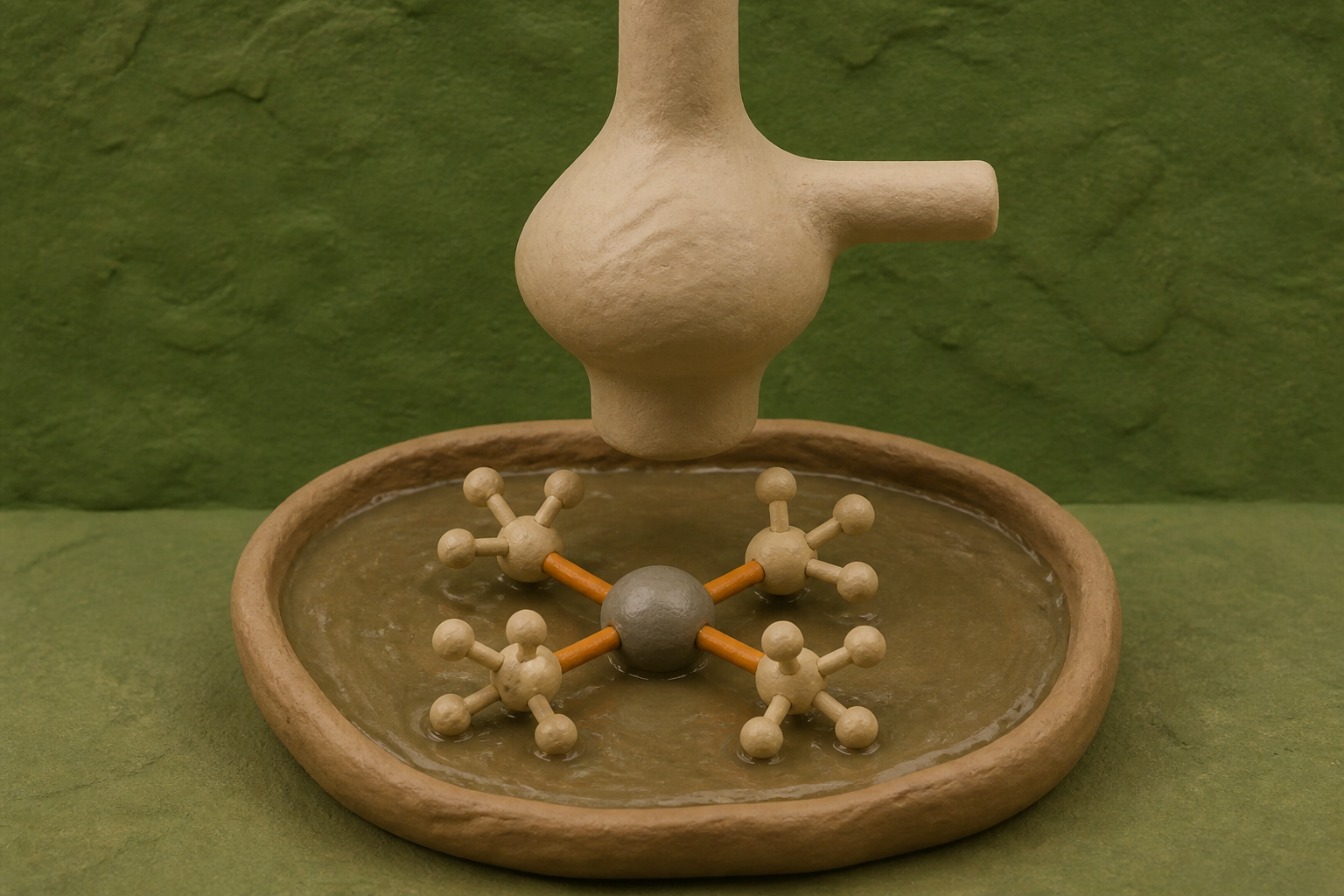
What changes in this design
Without further detail, a reader might assume recovering palladium means taking the metal out of the mixture after a reaction. A usual recovery procedure is not stated.
Here, palladium is recovered as a homogeneous palladium complex of formula (I), from a reaction mixture that already contains a homogeneous palladium complex.
This is worth noticing because the material being recovered is a particular palladium complex, rather than palladium in an unspecified form. What happens next is not stated.
Thirty minutes at room temperature
On December 30, 2025, a South Korean research institute announced a room-temperature process that it said could pull 99.9%-pure palladium from spent catalysts and electronic waste in 30 minutes. Its adsorption material reportedly holds 1,983 milligrams of palladium per gram and retains about 90% efficiency after more than ten reuse cycles.
That result is a useful opening because palladium recovery is no longer a niche clean-up task. It is a supply problem, a waste problem and, in drug manufacturing, a product-quality problem. The number I keep returning to is 30 minutes, not because speed settles the question, but because it shows how urgently recovery chemistry is being pushed out of the slow-refining model.
The metal in the bottleneck
Palladium prices have made that urgency easy to understand. A 2026 market overview traces a climb from roughly $815 an ounce in 2016 to a peak near $2,900 in March 2022, before a late-2023 range of $1,200 to $1,400. About 210 metric tons were mined in 2023, with Russia and South Africa accounting for roughly three quarters. Recycling supplied 75 metric tons that year, and had been forecast to exceed 80 metric tons in 2026.
The metal can also disappear before anyone gets to recover it. Researchers reported in 2025 that as much as 98% of palladium in conventional carbon-supported catalysts can become trapped in the carrier's micropores. Their proposed carrier uses humins, a waste product from processing plant biomass, to achieve comparable activity with far less palladium. For readers like me, that is the revealing detail: better recycling and using less metal are parallel answers to the same exposure.
A residue measured in micrograms
Palladium's value comes from work it does while dissolved. Palladium-catalysed cross-coupling was important enough to earn the 2010 Nobel Prize in Chemistry, and it remains pervasive in organic synthesis. But a catalyst that helps make a complex molecule also has to leave the finished material.
The pharmaceutical constraint is exacting. The ICH Q3D guideline places palladium in Class 2B and sets permitted daily exposures of 100 micrograms by the oral route, 10 micrograms parenterally and 1 microgram by inhalation. Those thresholds do not tell a plant how to recover a catalyst, but they help explain why a recovered complex is more interesting than a bucket of reclaimed metal.
The complex in the vessel
That is where US20260257214A1 enters. Titled "Recycling Of Homogeneous Palladium Catalyst," the filing describes methods for recovering palladium as a homogeneous palladium complex of formula (I) from a reaction mixture containing a homogeneous palladium complex. It is a small amount of public language, but it points at a consequential distinction: recovering a working chemical form rather than merely extracting palladium as an element.
I read the filing as evidence of an industry still trying to preserve value before it is destroyed. The detail I cannot establish from the public description is how well its recovered complex performs across repeated production cycles, messy feed mixtures or changing drug processes. A patent filing proposes a route. It does not, by itself, demonstrate that the route wins.
Methods already on the table
Earlier recovery work shows how many routes are already competing. A 2018 international patent described grinding, dissolving and separating catalyst materials to recover more than 90% of palladium, as an alternative to aqua regia or chlorine-gas treatment. A 2009-granted patent described thermal treatment and acid digestion, claiming complete recovery at more than 99% purity. Both treat palladium largely as a metal to be refined.
Other approaches try to keep the catalyst system closer to service. Simple acidic and basic aqueous work-up recycled commercial homogeneous palladium catalysts for three Suzuki-reaction cycles. Organic solvent nanofiltration separated and reused a homogeneous palladium catalyst system for five cycles in a drug-candidate synthesis while maintaining more than 90% conversion. Electrochemical work has used redox-mediated electrodes for related platinum and palladium catalysts. Yet a 2023 review by pharmaceutical-industry and academic authors concluded that membrane processes are not systematically the best option. That conclusion matters, I think, because it resists the comforting idea that one technical category has already solved the problem.
The part worth watching
The filing is worth watching less for the word "recycling" than for what survives the recycling. The questions I would take to any later technical disclosure are practical: how much palladium is recovered, whether the recovered complex still catalyses reliably, how often it can be reused, and whether the process reduces the final palladium burden rather than moving it into another waste stream.
No filing lets us skip those tests. Palladium is scarce, volatile in price, concentrated in supply and tightly constrained in pharmaceutical residues, so the incentive is obvious. The reason I am cautious is equally obvious: decades of acid digestion, aqueous work-up, membranes, electrochemistry and adsorption chemistry have produced real progress without an agreed best answer. This application belongs in that unfinished contest, not above it.
Sources
Reporting for this piece drew on the published filing and the references below.
- Recycling Of Homogeneous Palladium Catalyst
- Eco-friendly palladium recovery technology to safeguard resource security
- New catalyst cuts precious palladium expenditure 100-fold by using recycled waste
- Guideline for Elemental Impurities Q3D
- Palladium Market Supply And Demand: What's Driving Prices And Scarcity Right Now?
- Trio share Nobel for palladium-catalysed cross-coupling
- Recovery of palladium from catalyst materials
- Process for recovery of palladium from spent catalyst
- Recovery and reuse of homogeneous palladium catalysts via organic solvent nanofiltration
- Recovery of Homogeneous Platinoid Catalysts from Pharmaceutical Media
- A simple way of recycling of homogeneous catalyst in Suzuki reaction
- Electrochemical recycling of homogeneous catalysts
The record, briefly. US20260257214A1, “Recycling Of Homogeneous Palladium Catalyst” Methods recover palladium as a homogeneous palladium complex of formula (I) from a reaction mixture comprising a homogeneous palladium complex.
More angles on this
- When Shared Pipes Need a PlanAnother reading from the same B01J classification family, chemical or physical processes, e.g. catalysis or colloid chemistry; their relevant apparatus.
- Timing at the Kilogram-Scale Mushroom HandoffAnother reading from the same B01D classification family, separation.
- CPC B01J: Chemical or physical processes, e.g. catalysis or colloid chemistry; their relevant apparatusThe official classification family this record was filed into, published in the USPTO Cooperative Patent Classification scheme.
- CPC B01D: SeparationThe official classification family this record was filed into, published in the USPTO Cooperative Patent Classification scheme.
- A Lanyard System That Waits for EvidenceAnother reading from the wider B66F classification family, hoisting.
Read around this one:Public patent recordUSPTO published figure