Field Notes
Corner Paint Roller Questions the Default Arrangement
A Yonkers inventor's newly published corner roller extends a forty-year lineage of patents that keep re-solving the same unsolved seam.

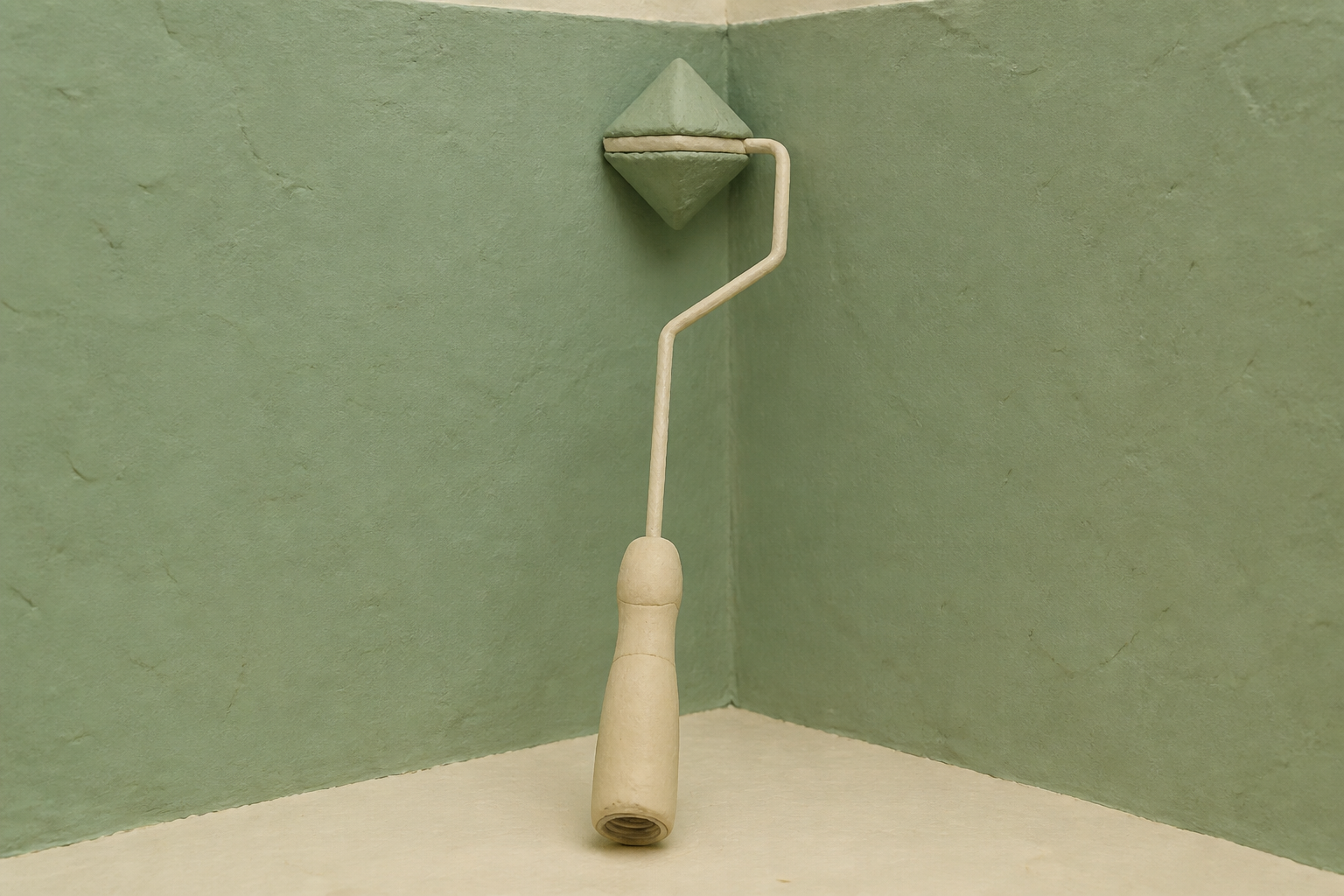
What changes in this design
A reader might picture painting a wall or ceiling with a roller whose surface is broadly even across its middle.
Here, the roller's middle is pointed, and its surface angles outward at 45 degrees from the central channel in the paint-applying end.
For someone looking at the tool, the pointed middle shape explains its target: the meeting place of a wall and a ceiling.
Forty-Three Years of the Same Corner
In 1983, an individual inventor named Ziad Al-Samman patented a corner paint roller and put the problem in plain words: the roller, he wrote, "does not adequately paint to the end of the wall at the corner junction." Anyone who has painted a room since knows the complaint by feel if not by name. A roller's cylinder is round. A wall's corner is not, so the seam where two walls meet gets left to a brush, a rag, or a shrug.
That patent was not the last word on the subject. A patent filed in 1988 added an open-cell foam attachment meant to fix the same "fuzzy edges." A patent granted in 2003 added wheels, aimed squarely at people who don't paint for a living. And this September, more than four decades after Al-Samman's filing, a Yonkers, New York inventor named Rami Badaan published a new attempt at the same corner.
A Point Added to an Old Cylinder
Badaan's application, US20260257240A1, was filed in March 2025 and published on September 3, 2026, under the plain title "Corner Paint Roller." It keeps the ordinary paint head spinning on a shaft, but gives the head's midsection a pointed profile, its circumference flaring outward at a 45-degree angle from the central channel that runs through it, so the point is meant to sit directly in the crease of a corner while the rest of the roller keeps coating the flat wall on either side.
The filing lists five earlier patents as its own prior art: the 1988 foam attachment, the wheeled corner tool, a design patent identified only by number, a patent granted in 2016 for an adjustable extension pole for a paintbrush that has nothing to do with corners at all, and one more I could not find further detail on. That extension-pole citation is a small tell. It suggests an examiner searching broadly through "painting tool" patents rather than narrowly through corner tools, which is its own quiet comment on how thin this specific category actually is.
A Yonkers Address, Twice
Three months before the patent published, a press release went out under InventHelp's name describing a client from Yonkers, New York who had brought the company "a new type of paint roller specifically designed for corners," filed under an internal reference number and offered for license to manufacturers. The release never cites a patent application or publication number, and it never names Badaan directly.
I can't call that a confirmed match. Press releases about inventions in development are common, and the overlap could be coincidence. But a lone inventor, a matching hometown, a matching product description, and a matching year make coincidence a less comfortable explanation than the plain one: this reads like the same roller, marketed through InventHelp while the patent worked its way through the office.
A Small, Already Crowded Aisle
Corner rollers are not a new idea waiting for a market to catch up. An existing product line already sells roller frames for about thirty dollars and refill sleeves in packs, with contractor cases running into the hundreds of dollars, so Badaan's design would be entering a real, if modest, retail category rather than inventing one from nothing.
That category's reputation is mixed at best. One widely used toolmaker's version of a trigger-operated corner roller was tested by a professional painter, who reported that it left visible gaps at the seam, leaked paint through its own handle, and generally made the job slower rather than faster. The reviewer's advice was to buy a plain edging pad instead, which is roughly the conclusion I kept reaching every time one of these patents promised to finally solve painting's oldest small annoyance.
The Odds Behind the License
InventHelp is required by federal law to disclose, once a year, how many of its customers actually turn a profit. For 2022 through 2024, the company reported that five of 3,507 clients made more money from their invention than they paid the company for its services, a rate of roughly one in seven hundred. Earlier disclosures put the figure at about one in 140 clients for 2015 through 2017 and about one in 200 for 2007 through 2009.
Those disclosures exist because of a 1999 law passed after complaints about invention-promotion firms, and InventHelp has also paid to settle a class action, in 2023, covering clients from 2014 through mid-2021, with individual payouts landing between twenty and two hundred fifty dollars. It isn't the only firm in this business to draw scrutiny. The Federal Trade Commission fined a competitor, Davison Design and Development, ten million dollars in 2008 for misrepresenting how selective it was and how often its clients succeeded. None of that proves anything about this particular roller, but it does mean that if this filing did move through InventHelp, the company charging for the service has told the government, in writing, that almost none of its clients ever see a return.
What the filing is really betting on
Nothing here says Badaan's roller won't work. A pointed, angled head might genuinely load paint into a corner more evenly than a wheel or a foam pad. Nobody outside a workshop seems to have tested it in public yet, and I have no basis to say it fails the way the trigger roller did.
What the pattern around it suggests is where the bet is actually placed. Four inventors across four decades have patented a fix for the same corner, one after another, and none has displaced the ordinary sash brush a painter dips at the seam. My best guess, reading the filing next to the press release and next to InventHelp's own disclosed numbers, is that this patent is less a wager on redesigning the paint roller than a wager on finding one manufacturer willing to license it before it joins the pile of corner-roller patents that came before.
That is a smaller and more ordinary story than a new invention. It might also be the truer one.
Sources
Reporting for this piece drew on the published filing and the references below.
- U.S. Patent Application Publication US 2026/0257240 A1 - Corner Paint Roller (Justia)
- InventHelp Inventor Develops New Corner Paint Roller (MBQ-917)
- US4402102A - Corner paint roller (Google Patents)
- US4872236A - Corner painting attachment for paint rollers (Google Patents)
- US6554902B2 - Device for painting wall members or corner straps (Google Patents)
- US9237799B1 (Google Patents)
- Corner+Roller (cornerroller.com)
- The Smart Paint Roller That Seems Useful But Is A Waste Of Money (Hunker)
- InventHelp Review: 99.86% Failure Rate and 4 Decades of Predatory Business Model
- Inventors beware: invention promoters may not be out to 'help' you (Digital Law Group)
- Invention Promoters Will Pay $10 Million to Settle FTC Charges (FTC.gov)
The record, briefly. US20260257240A1, “Corner Paint Roller” A corner paint roller has a paint head rotatably mounted on an elongated shaft. Its pointed midsection circumference extends outwardly at a 45-degree angle from the paint head's central channel for painting wall and ceiling corners.
More angles on this
- CPC B05C: Apparatus for applying fluent materials to surfaces, in generalThe official classification family this record was filed into, published in the USPTO Cooperative Patent Classification scheme.
- The Fan Blade Learns a Reversible TrickAnother reading from the neighbouring B05B classification family, spraying apparatus; atomising apparatus; nozzles.
- Portable Nucleic Acid Detection Device, System And Method Treats the Relationship as the PointAnother reading from the wider B01L classification family, chemical or physical laboratory apparatus for general use.
- When a Rounded Base Takes the HandoffAnother reading in the same Field Notes category on this site.
Read around this one:Public patent recordUSPTO published figure