Machines
Portable Nucleic Acid Detection Device, System And Method Treats the Relationship as the Point
A little heated tube and a light from below arrive after the boom they were built for, pointing toward a leaner future for molecular testing.

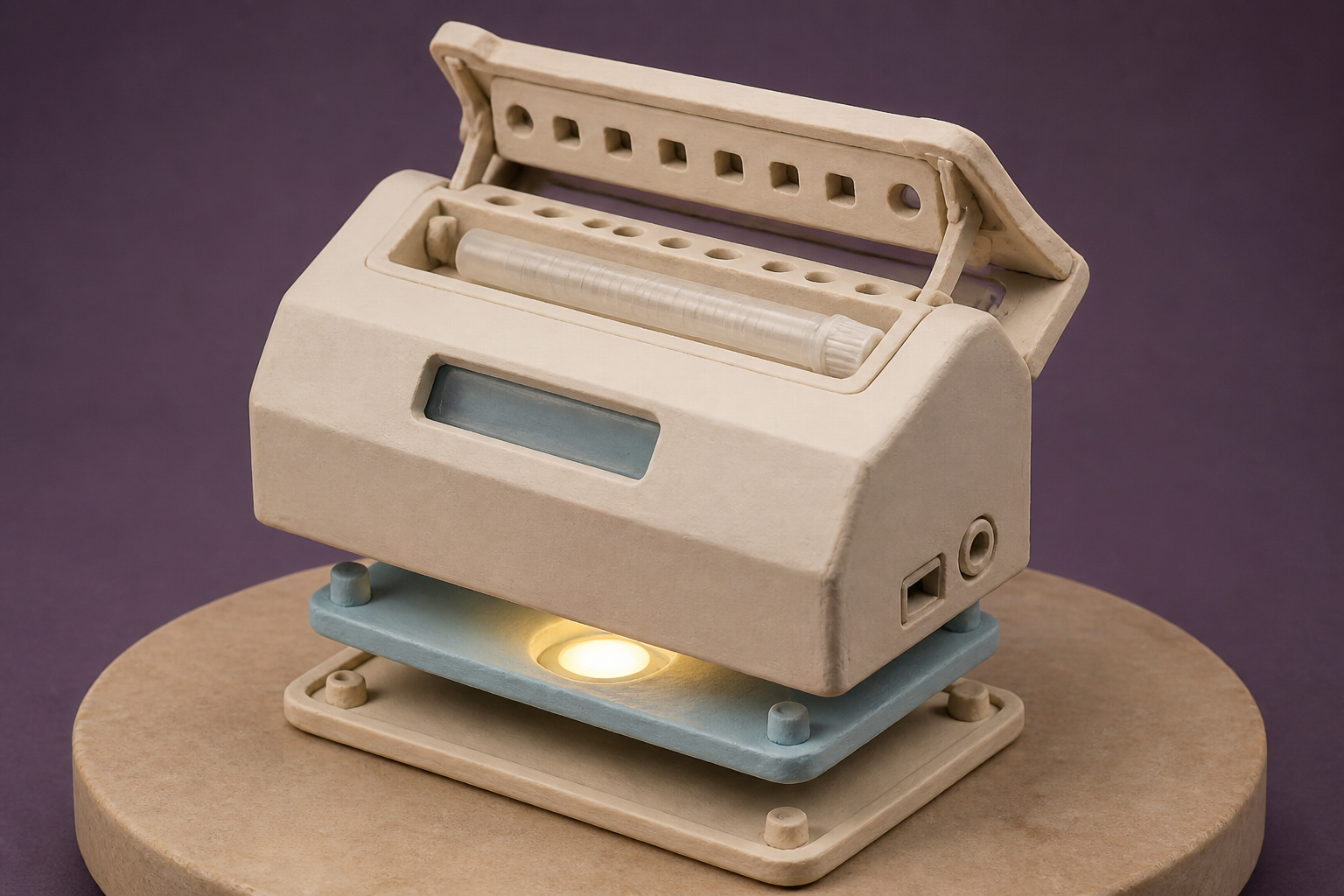
What changes in this design
A reader might otherwise picture a portable test device as a box that simply holds a reaction tube. How this kind of testing is ordinarily carried out is not stated.
Here, the tube sits in a mounting cavity while a heating module regulates temperature. A light-emitting module at the bottom sends light through a hole toward the tube for observation.
The physical setup is easier to picture: a portable unit combines a tube holder, temperature control, and lighting. What is observed, or what result the observation provides, is not stated.
December's empty booths
By early December 2022, compulsory testing booths were disappearing from Chinese cities and an enormous testing economy was losing its reason to exist. Beijing had been on track to spend an estimated $52 billion in one year on mass nucleic-acid testing, supporting roughly 3,000 companies. The date that stays in my mind is August 16, 2022: one month after a crackdown had suspended at least 40 testing businesses, ordered about 350 more to rectify operations, and coincided with test prices falling from 100 yuan to 10 yuan.
That day is the priority date for two Chinese applications behind a newly published US patent. The collapse did not make a portable molecular tester useless. It did make the old premise - ubiquitous, high-volume testing - a bad place to look for its future.
Light beneath the tube
US 2026/0257227 A1, published on September 3, is a compact piece of laboratory hardware. Hangzhou EZDX Technology filed it through the US national phase of a 2023 international application, with seven inventors led by Jinzhao Song. Its design centers on a reaction tube in a mounting cavity, a heating module to regulate temperature, and a light source below the tube, shining through an opening so its contents can be observed.
Those details sound modest because they are modest. They describe a way to hold, heat, and inspect a reaction, not a demonstrated diagnosis. One limit matters: I cannot tell from the filing which assay the device would run, how a user would interpret a signal, or how it would perform with real samples. Nearly four years passed between the first Chinese filing and US publication. In a market reshaped that quickly, the delay is part of the story.
The portable test problem
Portability has had a commercial benchmark for years. Cepheid shipped its 2.2-pound GeneXpert Omni in 2015, after building from an integrated system introduced in 2000 to cartridge-based GeneXpert instruments in 2005 and 2006. A small device is therefore not, by itself, a new testing model.
It also is not a proxy for accuracy. In May 2020, a US regulator warned about false-negative reports for a portable coronavirus test. One comparison found it missed a third of positive nasopharyngeal samples and 48% of dry nasal-swab positives against Cepheid's Xpert Xpress; another health system found a false-negative rate about 10 percentage points higher. The regulator required a postmarket study of more than 150 patients. For my purposes, that episode is a warning against treating a heated tube and a quick result as interchangeable with dependable diagnosis. It does not predict failure for EZDX's device.
Fifty grams for a lab
A later academic paper gives the filing a more interesting setting. Its authors thanked Hangzhou EZDX for supporting a portable device: a smartphone-linked reader measuring 40 x 30 x 55 mm and weighing 50 grams. They used it in a 45-minute assay called NAPTUNE, compared with 160 minutes for qRT-PCR, and reported 95.0% sensitivity, 100% specificity, and 97.5% accuracy in that study.
Those figures belong to that assay and its study conditions, not to the patent's reader alone. I don't treat the acknowledgement as proof that this is the same device, nor as proof of a commercial strategy. It does establish something narrower and more useful: the filer appears in ultra-sensitive academic diagnostics work as a portable-hardware supplier after the mass-testing bust.
A 2026 market-research estimate puts the global nucleic-acid amplification testing market at $11.13 billion, with PCR still holding 67.12% of the 2025 market while isothermal methods grow fastest. That is not evidence about this application. I think it does help explain why compact heating and optical-reading hardware may matter now as part of a particular assay, rather than as another mass-testing booth.
What would have to be true
The business risk is not theoretical. Lucira filed for bankruptcy on February 22, 2023, four days before receiving emergency authorization for a home flu and COVID molecular test. Its reported explanation included a prolonged regulatory review. A working product can arrive too late, even when the regulator eventually agrees it may be used.
For this filing to matter beyond its tidy physical arrangement, its temperature control and illumination would need to support repeatable, readable results in the intended setting. The assay paired with it would need to retain accuracy outside a specialist laboratory, and the full system would need a route through regulation that fits the life of the market. We should take the device seriously as evidence of a smaller, more targeted future for portable molecular testing, but not mistake the light beneath a tube for proof that future has arrived.
Sources
Reporting for this piece drew on the published filing and the references below.
- US 2026/0257227 A1 - Portable Nucleic Acid Detection Device, System and Method
- NAPTUNE: nucleic acids and protein biomarkers testing via ultra-sensitive nucleases escalation
- Mission & History of Delivering PCR Excellence
- Abbott on defense as FDA flags false negative reports with point-of-care coronavirus test
- Nucleic Acid Amplification Testing Market Size & Trends Report
- The COVID-testing profit party is over
- COVID-19 policy U-turn leaves workers in China's massive testing industry in the lurch
- The FDA has cleared the first home flu and Covid test - but its maker just declared bankruptcy
The record, briefly. US20260257227A1, “Portable Nucleic Acid Detection Device, System And Method” A portable nucleic acid detection device includes a main body with a mounting cavity for a reaction tube, a temperature-regulating heating module, and a bottom light-emitting module that illuminates the tube through a light-transmission hole for observation.
More angles on this
- CPC B01L: Chemical or physical laboratory apparatus for general useThe official classification family this record was filed into, published in the USPTO Cooperative Patent Classification scheme.
- At the Filter Inlet, Ordinary Order Shows Its ConsequenceAnother reading from the neighbouring B01D classification family, separation.
- A Lanyard System That Waits for EvidenceAnother reading from the wider B66F classification family, hoisting.
- The Handoff a Timing System DeclinesAnother reading in the same Machines category on this site.
Read around this one:Public patent recordUSPTO published figure