Field Notes
Timing the Molecular Handoff in Preeclampsia Detection
While clinics rely on blood protein ratios to predict preeclampsia, a new patent filing wagers that the true warning signs hide in sugar-coated peptides.

What changes in this design
Spotting pregnancy complications often relies on observing general physical signs or standard laboratory checks. Many people assume medical testing primarily depends on routine vital signs rather than tracking specific molecular signals in the body.
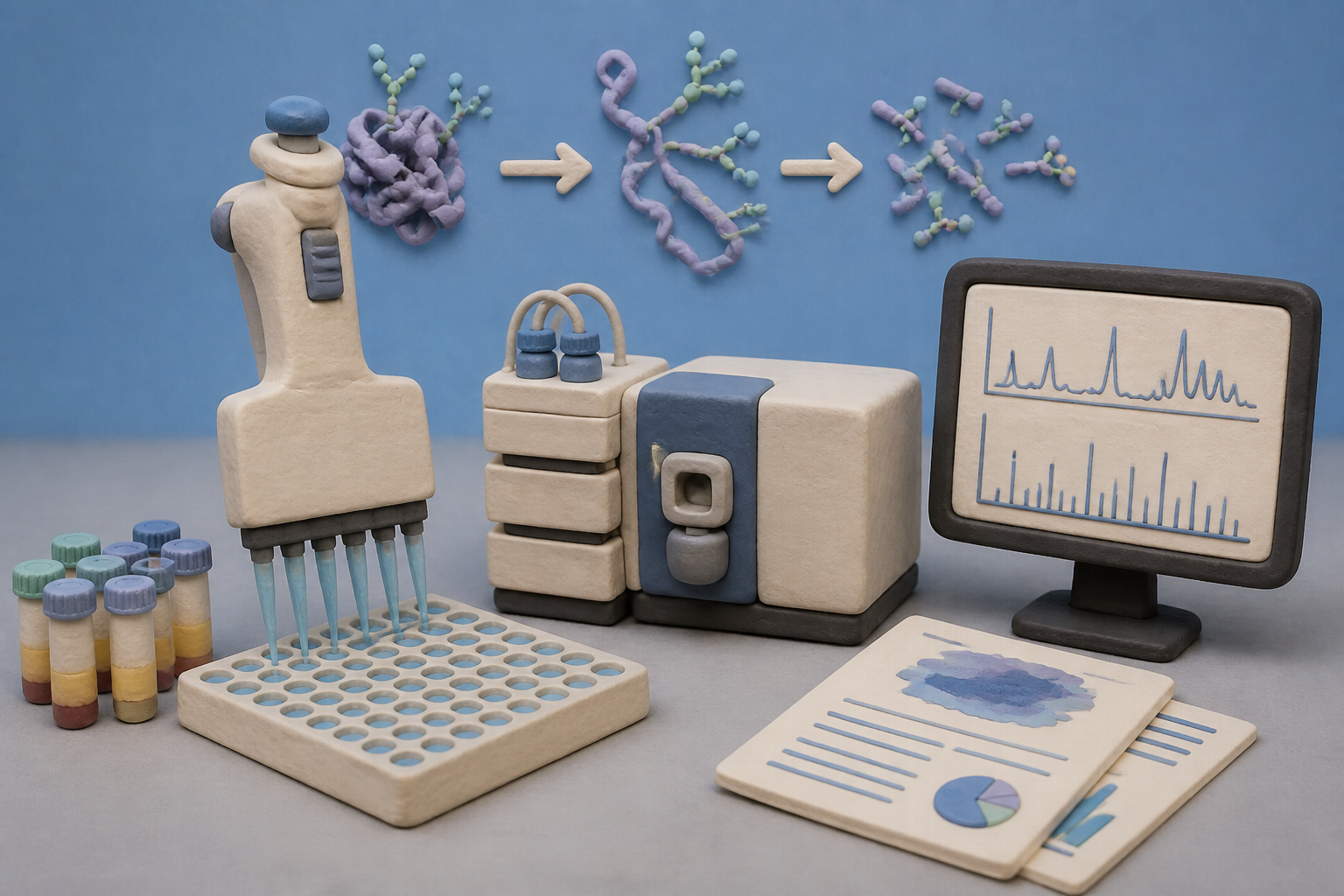
Here, the focus shifts to testing for the presence, absence, or quantity of glycopeptides in a patient. The record also covers specific chemical formulations built around one or more of these sugar-linked proteins to support diagnosis and treatment.
Tracking distinct biological markers offers a direct chemical route to evaluating preeclampsia. Understanding which molecules signal the condition helps connect laboratory testing directly to targeted treatments for expectant mothers.
Seven days of certainty
About 260,000 women died worldwide from complications of pregnancy and childbirth in 2023. On average, roughly 700 women die every day, according to the World Health Organization, with hypertensive disorders like preeclampsia ranking among the leading causes. CDC tracking in the United States recorded 817 maternal deaths in 2022, a rate of 22.3 per 100,000 live births. Disparities made the burden far worse for some: Black mothers died at a rate of 49.5 per 100,000, compared to 19.0 for White mothers. It happens fast. Blood pressure spikes and organs suffer before anyone realizes the placenta isn't coping.
For generations, clinicians had little more than a blood pressure cuff and a urine dipstick to guess who was slipping into crisis. Doctors needed better tools. Modern diagnostic testing shifted toward tracking proteins shed by an oxygen-starved placenta. During the 2016 multicenter PROGNOSIS trial, researchers followed 1,050 pregnant women across fourteen countries to test a blood ratio balancing soluble fms-like tyrosine kinase-1 against placental growth factor, known as sFlt-1 to PlGF. Below a cutoff of 38, that ratio yielded a 99.3 percent negative predictive value for ruling out preeclampsia over the subsequent week, though its positive predictive value for onset within four weeks stood at only 36.7 percent. When I look at those figures, what strikes me is how practical they were. Progress wasn't built on long-range prophecy, but on securing a dependable seven-day window of safety.
The thirty-minute threshold
Speed matters in obstetrics. In the British PARROT trial, which tracked 1,023 women across eleven maternity units, revealing placental growth factor results cut median diagnostic time from 4.1 days to 1.9 days. Prompt disclosure lowered severe maternal adverse outcomes from 5 percent to 4 percent. Following those findings, health authorities in the United Kingdom recommended four commercial testing platforms to evaluate suspected preterm preeclampsia between 20 weeks and 36 weeks plus 6 days.
Regulators in the United States took a parallel step in May 2023, when the FDA cleared automated immunoassays from Thermo Fisher Scientific under Breakthrough Device Designation. Built to assess hospitalized patients between 23 and 34 weeks plus 6 days, these tests evaluate who might progress to severe disease within two weeks. Running time is under thirty minutes. When a physician can rule out an immediate emergency in half an hour, they won't rush into unnecessary hospitalizations or premature deliveries. Even so, our current clinical arsenal remains largely reactive, flagging damage that's already underway.
Twenty-three studies and three survivors
Early detection requires catching molecular shifts before symptoms flare. Scientists pursuing that goal turned to maternal blood, analyzing cell-free RNA across 2,539 plasma samples from 1,840 pregnancies in a 2022 Nature study. Transcriptomic profiling caught 75 percent of mothers who later developed preeclampsia, yielding a 32.3 percent positive predictive value up to 14.5 weeks before delivery. That signal was real. Circulating blood clearly carries biological warnings months before blood pressure rises.
Translating candidate markers into dependable clinical tests isn't simple. Most markers vanish. Look at placental proteomics: across twenty-three studies published between 2004 and 2020, only three differentially expressed proteins replicated consistently in four or more papers. Hundreds of candidates showed up in initial discovery cohorts, but they didn't hold up under broader scrutiny. Pregnancy is messy, noisy biology, and we've watched dozens of candidate tests collapse when tested against diverse populations.
The sugar on the scaffold
Standard proteomics measures total protein abundance, assuming disease simply cranks protein production up or down. A 2023 mass spectrometry study examining 2,260 proteins and 789 intact glycopeptides across 159 glycoproteins pointed in a completely different direction. Alterations in ten key glycoproteins weren't driven by protein volume at all, but by glycosylation occupancy - the specific sugar chains branching from each molecular scaffold. Quantity wasn't the issue. What changed was the sugar coating.
I suspect this structural nuance explains why so many past biomarker hunts hit brick walls. Cells can maintain identical protein levels while altering the sugar attachments that dictate how those proteins signal and clear from circulation. Total counts look normal. Yet the molecules aren't behaving the same way, making raw abundance data misleading. It's like counting vehicles at an intersection without checking whether their tires are flat.
What the filing is really betting on
US20260260705A1 steps squarely into this biochemical gap. The wager is bold. Its claims cover methods for diagnosing and treating preeclampsia based on measuring specific intact glycopeptides, alongside compositions containing those targets. It doesn't rely on angiogenic ratios or raw protein tallies, betting instead that sugar-modified peptides carry the decisive signal.
I have my doubts. Moving glycoproteomics from research spectrometers to labor wards won't be simple. Clinical obstetrics spent two decades standardizing automated tests that run in thirty minutes on standard hospital analyzers. Preparing intact glycopeptides demands specialized mass spectrometry, and past failures with raw proteins have tested our patience. Bridging that gap between laboratory precision and emergency care is where my optimism cools. Still, targeting sugar modifications addresses an undeniable blind spot. If inventors can prove their glycopeptides replicate across diverse cohorts, they'll give clinicians a way to spot preeclampsia long before crisis hits.
Sources
Reporting for this piece drew on the published filing and the references below.
- RNA profiles reveal signatures of future health and disease in pregnancy
- Predictive Value of the sFlt-1:PlGF Ratio in Women with Suspected Preeclampsia
- Maternal Mortality Rates in the United States, 2022
- Maternal mortality
- Integrated Proteomic and N-Glycoproteomic Profiling of Placental Tissues of Patients with Preeclampsia
- FDA clears immunoassays to assess risk of preeclampsia
- Placental growth factor testing to assess women with suspected pre-eclampsia: a multicentre, pragmatic, stepped-wedge cluster-randomised controlled trial
- PLGF-based testing to help diagnose suspected preterm pre-eclampsia
The record, briefly. US20260260705A1, “Biomarkers For Diagnosing Preeclampsia” Disclosed are methods for diagnosing and treating preeclampsia based on the presence, absence, or amount of biomarkers such as glycopeptides, as well as compositions comprising one or more glycopeptide.
More angles on this
- Portable And Low-Cost Microscopic Imaging Device Makes a Small Case for Better TimingAnother reading from the same G01N classification family, investigating or analysing materials by determining their chemical or physical properties.
- Inside techniquesAnother reading from the same G01N classification family, investigating or analysing materials by determining their chemical or physical properties.
- CPC G16B: BioinformaticsThe official classification family this record was filed into, published in the USPTO Cooperative Patent Classification scheme.
- CPC G01N: Investigating or analysing materials by determining their chemical or physical propertiesThe official classification family this record was filed into, published in the USPTO Cooperative Patent Classification scheme.
- Separating Wind from Footsteps Across Two Parallel Lines of LightAnother reading from the neighbouring G01H classification family, measurement of mechanical vibrations or ultrasonic, sonic or infrasonic waves.
Read around this one:Public patent recordUSPTO published figure