Machines
Inside techniques
As oilfield giants race to verify deep carbon storage for regulators, a new Schlumberger patent highlights the tricky physics of reading rock.

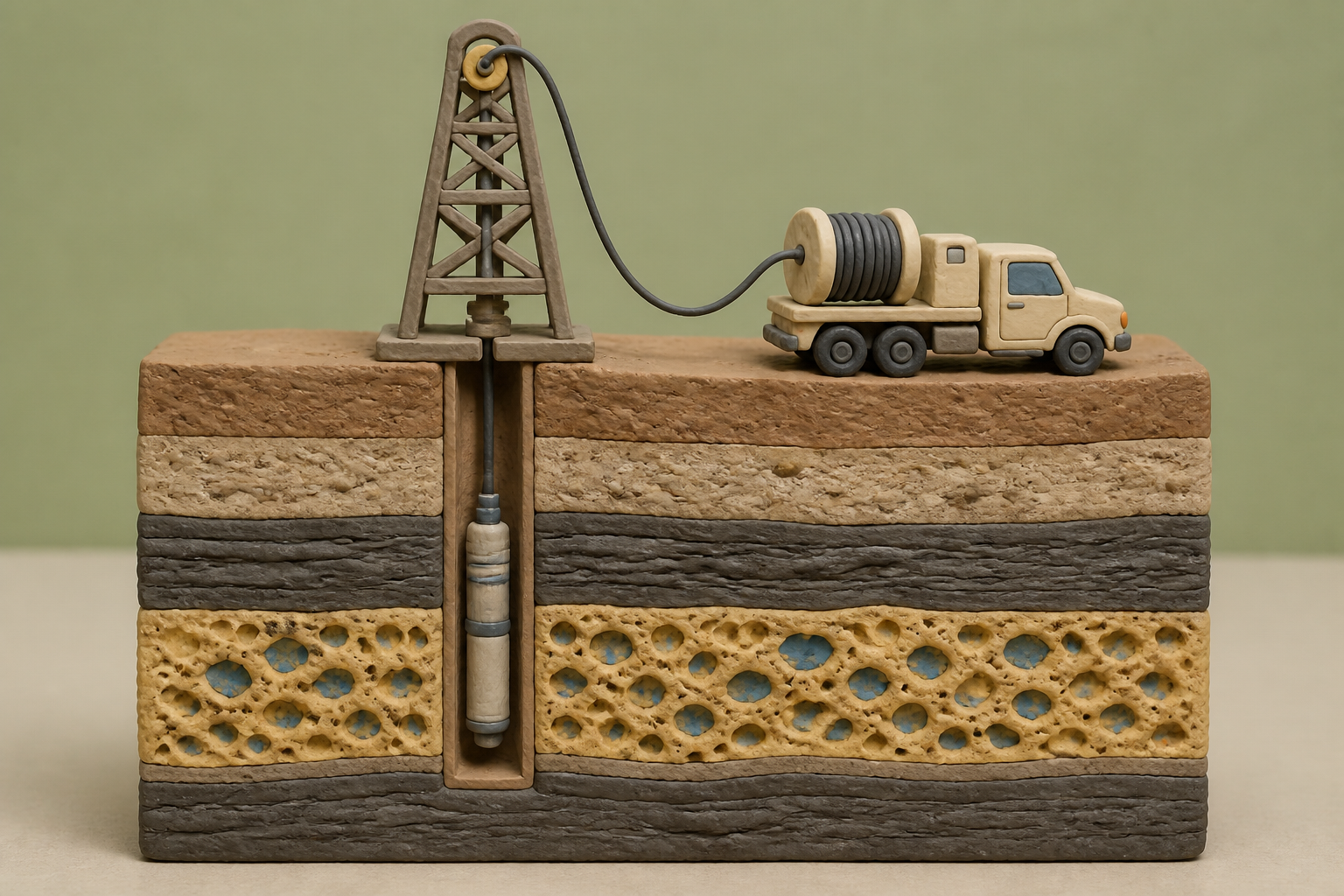
What changes in this design
A reader might expect underground fluid replacement to be measured by pulling physical fluid samples from the well. Alternatively, one might assume raw magnetic resonance readings directly display carbon dioxide saturation levels without needing extra mathematical transformations.
The record describes taking well Nuclear Magnetic Resonance data and applying a mathematical cutoff or a bell-shaped Gaussian distribution across T1, T2, or two-dimensional T1-T2 domains. This specific data processing step generates the prediction for how much fluid carbon dioxide has replaced.
Injecting carbon dioxide into underground reservoirs alters the fluid makeup inside rock pore networks. Understanding how well logs can model this displacement helps clarify how researchers monitor gases stored or used deep beneath the surface.
The legal burden of deep storage
Pumping millions of tonnes of compressed gas into deep saline aquifers is only half the battle. The harder half is proving where it went. Under the rules for Class VI injection wells run by the Environmental Protection Agency, an operator cannot simply cap a borehole and walk away. They must track the movement of the carbon dioxide plume and its pressure front throughout injection, monitor corrosion continuously, and maintain post-injection site care until regulators decide underground drinking water is completely safe. That obligation can stretch across decades.
If we look at the numbers, the commercial stakes behind that verification are enormous. Global capture capacity sat near 50 million tonnes a year in early 2025, while climate roadmaps call for roughly a gigatonne. Over 600 projects sit in the pipeline, backed by $6.4 billion in annual investment, with capture costs ranging from $40 to over $120 per tonne. Yet back in 2022, only two Class VI wells had ever received final permits against a growing stack of applications, even as nearly three-quarters of announced projects targeted deep saline formations. The backlog created a glaring bottleneck: project developers need cheap, rapid downhole verification, or their projects stall before breaking ground.
Reading rock with magnetic pulses
I spent several days tracing how logging companies propose to solve this monitoring mandate from inside an active wellbore. On September 3, 2026, Schlumberger published a patent application titled Techniques For Predicting Co2 Saturation In Formations Based On Nuclear Magnetic Resonance Data. The filing, originally submitted as a provisional application in February 2025, outlines a way to measure the exact fraction of pore fluid replaced by injected carbon dioxide using downhole nuclear magnetic resonance tools.
The tool works by pulsing magnetic fields into the rock to tip the magnetic moments of hydrogen nuclei in pore fluids, then recording how quickly that signal decays. In a water-saturated rock, hydrogen in the brine produces a characteristic relaxation signal spread across relaxation times known as T1 and T2. When supercritical carbon dioxide enters the pore space, it displaces the brine. The patent proposes applying a mathematical cutoff or a Gaussian distribution across the T1, T2, or two-dimensional T1-T2 domain. By isolating the signal shift before and after gas injection, an operator can calculate how much pore fluid has turned into stored carbon.
A thirteen-year paper trail
This is not a sudden breakthrough so much as the latest chapter in a long-running corporate campaign. In the published record, what caught my attention was how closely this new filing mirrors Schlumberger's earlier patent from 2014, where researchers used percolation theory on magnetic decay logs to estimate residual carbon saturation. The company has pursued this specific downhole physics since at least 2013, refining mathematical models as its core energy services business seeks new revenue legs in commercial carbon storage projects across the North Sea.
We are watching two oilfield heavyweights bet on competing physical phenomena to capture the exact same monitoring market. A rival service company, Weatherford, secured a patent in late 2024 for an entirely different downhole approach. Instead of magnetic resonance, Weatherford fires high-energy fourteen-megaelectronvolt pulsed neutrons into the formation to detect gamma-ray capture counts. Their patent claims an eightfold improvement in contrast against saltwater compared to older neutron methods.
The trouble with a single cutoff
The neatness of Schlumberger's mathematical cutoff hides a messy physical reality. Applying a single, fixed T2 cutoff assumes that rock pores behave with textbook regularity. But deep saline storage targets are rarely uniform slabs of clean quartz. Real formations are full of clay ribbons, micro-fractures, and erratic grain distributions that distort how fluid molecules interact with rock surfaces.
Looking at independent rock-physics studies, what I found was a clear warning about real geology. In heterogeneous sandstone formations, such as the Cooper Basin sandstone studied in petroleum literature, a single fixed T2 cutoff routinely produces inaccurate water saturation estimates. Researchers found that even elaborate empirical corrections often fell short, and simple averaging across varying core samples proved more dependable than relying on a rigid threshold. What troubles my reading of the patent's clean equations is that downhole rocks rarely conform to fixed boundaries.
Where this leaves things
The patent race reveals the growing friction between corporate targets and geological reality. Large service companies need carbon storage to deliver billions in revenue growth over the coming years, while regulators need rock-solid verification before approving permits or closing injection sites. Patents like this one offer clean mathematical workflows that look persuasive on paper.
My sense is that downhole monitoring will not be solved by a single clever algorithm or a fixed mathematical cutoff. Until logging tools can reliably handle the erratic clay layers and pore variations of real storage formations, operators will likely have to combine multiple physical methods, from pulsed neutrons to acoustic logs. The filings show that the industry knows what regulators demand. Proving that the gas stays put in messy, unpredictable rock remains an open contest.
Sources
Reporting for this piece drew on the published filing and the references below.
- US8862407B2 — Method and apparatus utilizing nuclear magnetic resonance measurements for estimating residual carbon dioxide saturation in aquifers
- US12181626B2 — Pulsed neutron monitoring of carbon dioxide in reservoirs
- Class VI — Wells used for Geologic Sequestration of Carbon Dioxide
- EPA's Class VI Well Program Key to Deploying CO2 Geologic Storage
- NMR T2 Cut Off: Which One Is to Be Used for Application?
- Does SLB's Carbon Storage Push Reframe Its Core Energy Services Investment Story?
- What's Next For Carbon Capture, Utilization & Storage (CCUS) In 2026?
The record, briefly. US20260259344A1, “Techniques For Predicting Co2 Saturation In Formations Based On Nuclear Magnetic Resonance Data” Systems and methods apply a cutoff or Gaussian distribution in the T1, T2, or two-dimensional T1-T2 domain to a well Nuclear Magnetic Resonance (NMR) log to predict the fraction of fluid replaced by carbon dioxide introduced into a reservoir pore system.
More angles on this
- Induced Seismic Monitoring Augmented With Various Multi-Type Sensors Questions the Default ArrangementAnother reading from the same G01V classification family, geophysics; gravitational measurements; detecting masses or objects; tags.
- Inside covid-19Another reading from the same G01N classification family, investigating or analysing materials by determining their chemical or physical properties.
- CPC G01V: Geophysics; gravitational measurements; detecting masses or objects; tagsThe official classification family this record was filed into, published in the USPTO Cooperative Patent Classification scheme.
- CPC E21B: Earth or rock drilling; obtaining oil, gas, water, soluble or meltable materials or a slurry of minerals from wellsThe official classification family this record was filed into, published in the USPTO Cooperative Patent Classification scheme.
- Photon Detection Marks a Pause Worth NoticingAnother reading from the neighbouring G01J classification family, measurement of intensity.
Read around this one:Public patent recordUSPTO published figure