Field Notes
Separating Wind from Footsteps Across Two Parallel Lines of Light
NEC's patent doubles up perimeter cables to catch false alarms, but advances in optical AI suggest software might soon do the job with a single strand.

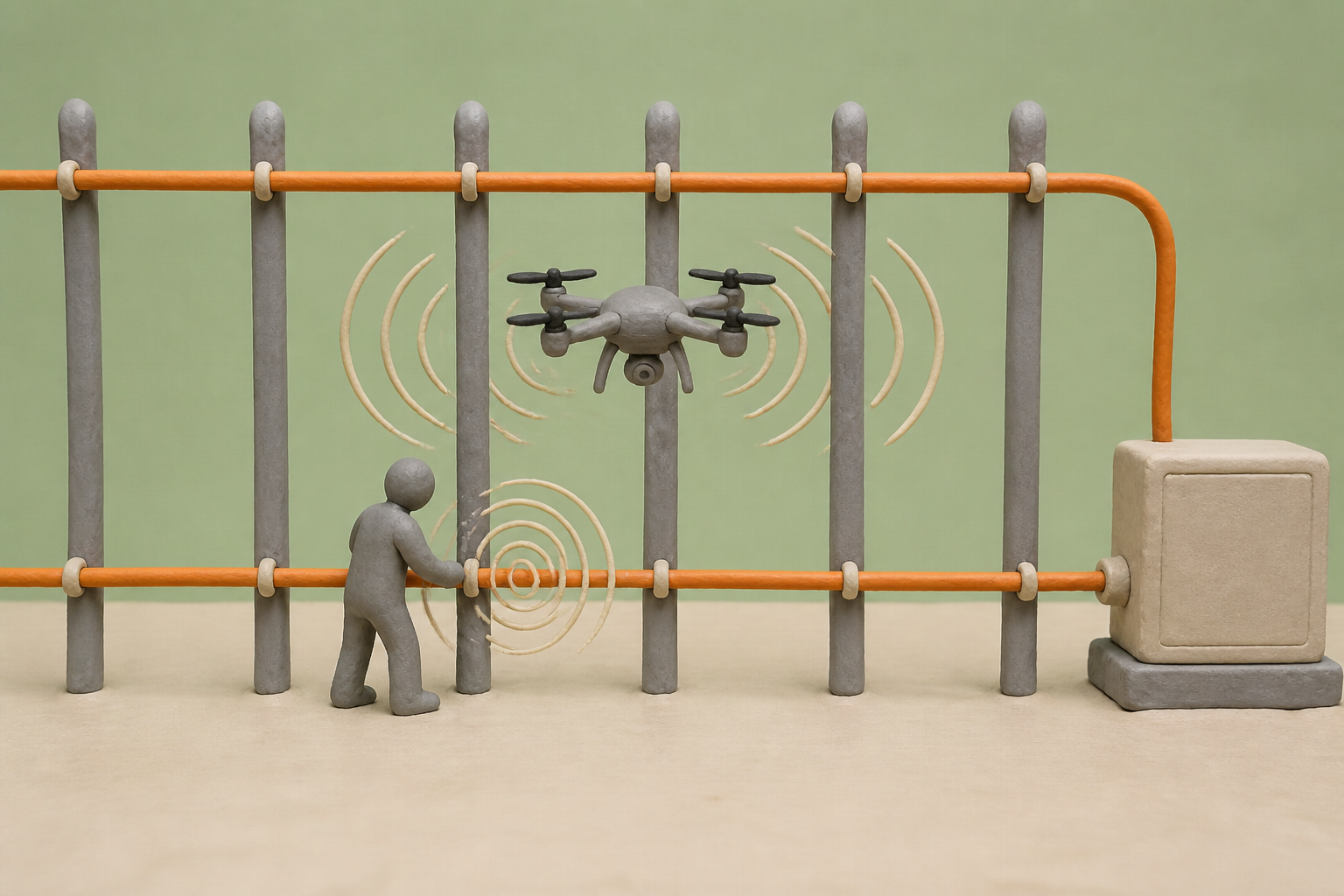
What changes in this design
A typical perimeter detector might trigger an alert whenever any single vibration sensor picks up movement, which makes it easy for accidental disturbances to trigger false warnings.
Instead of relying on one line, this approach places two vibration-detecting optical fibers at different heights and evaluates whether an event is false based on how many fibers pick up the shake.
Knowing how many lines caught the vibration helps distinguish genuine intruders from mistaken alarms, keeping monitoring systems more dependable.
The eighty-kilometer tripwire
A glass core no thicker than a human hair can turn a chain-link fence into an eighty-kilometer listening device. I spent time reviewing field reliability data from perimeter fiber installations, and the numbers reveal a clear mechanical ceiling. Commercial perimeter processors from Senstar run optical lines along fences or underground, pinpointing disturbances to within four meters across fifty miles of cable. The glass itself lasts more than twenty-five years, and centralized optical processors log a Mean Time Between Failures of 251,691 hours across seven years of deployment. On paper, it sounds like an unblinking tripwire.
The trouble starts when the weather turns. Single fiber lines along high-speed rail corridors and remote boundaries struggle during heavy rain, dense fog, and gusting wind. The low-frequency rumble of a storm overlaps with the acoustic signature of a person climbing a fence. For high-stakes infrastructure, every spike is expensive. Under U.S. Nuclear Regulatory Commission rules, perimeter isolation zones at nuclear reactors must detect penetration attempts before completion, route signals through tamper-indicating transmission lines, and feed concurrent real-time assessment into two continuously staffed alarm stations. When a squall triggers alarms across fifty miles of fence, guards spend the night chasing ghosts.
Two heights on a fence
When I read patent application US20260260552A1 from NEC, the engineering instinct felt remarkably tangible. Rather than asking a single optical line to distinguish between a gust of wind and an intruder, the published record introduces a physical division of labor: a first vibration-detecting optical fiber and a second vibration-detecting optical fiber mounted at different heights along the barrier.
An intruding object detection unit evaluates incoming acoustic pulses based on the number of fibers registering activity. If a heavy crosswind shakes the entire fence structure, vibrations register across both cables at once. If an animal brushes the ground or someone cuts into a specific section, the vibration profile hits only one fiber height. By using spatial separation to evaluate whether an event is a false alarm, the hardware sidesteps the need for a solitary strand of glass to solve the problem in isolation.
Teaching a single strand to see
We often assume that physical mechanical fixes are clumsy relics waiting to be replaced by smarter software. Over the last few years, academic researchers have pushed distributed acoustic sensing to extraordinary lengths. Modern systems monitor up to 101 kilometers of continuous fiber, with deep-learning classifiers reaching threat detection accuracies between 95.4% and 98.4% even in noisy environments at minus ten decibels signal-to-noise ratio.
Other teams have turned to computer vision models like YOLO-A30, converting phase-sensitive optical time-domain reflectometry signals into spatial-temporal images. By treating vibrations along the fence as visual frames, these vision models hit 99.2% precision, 100% recall on fence-climbing, and a 99.2% F1 score, filtering out turbulent airflow and wind without needing a second cable on the fence. Industry analysis confirms that standalone physical perimeter sensors have hit their mechanical limits, driving a broader shift toward multi-sensor fusion and machine learning to suppress costly nuisance alarms.
The trap of open-world noise
What I could not easily reconcile while looking over the benchmark numbers is how quickly pure algorithmic confidence collapses in an unpredictable outdoor environment. In controlled tests, deep learning looks flawless. But a study on open-world optical fiber sensing found that baseline classifiers confronted with novel environmental noise produce false alarm rates between 42% and 64%, climbing as high as 88.2% in challenging conditions.
When engineers try to patch this by adding physical and geometric consistency rules, novel disturbances like rattling gates or rumbling vehicles still slip through the software gates. If operators dial up the filtering aggression to silence the alarms, missed threat rates jump from zero percent to anywhere between 9% and 34%. In high-consequence facilities, missing one in three intruders to avoid nuisance calls is an unacceptable trade-off.
The open question
Looking at the filing alongside NEC's newer research, our central puzzle comes into focus. In September 2026, NEC established a dedicated Optical Sensing & Solutions department at NEC Labs America, moving away from basic dual-fiber hardware toward physics-informed AI and multimodal distributed acoustic sensing that turns standard commercial telecom fiber into real-time monitoring grids.
I wonder whether mechanical spatial redundancy like dual-height cabling is a temporary crutch or an enduring necessity. Software models continue to promise that a single strand of telecom glass can do it all, but until algorithms can handle open-world noise without missing real threats, running two cables at two different heights remains a remarkably honest piece of engineering.
Sources
Reporting for this piece drew on the published filing and the references below.
- Object Intrusion Detection System, Detection Method Therefor, And Program
- Optical Sensing & Solutions | Research | NEC Labs America
- FiberPatrol FP1150 - Fiber Optic Sensor Detection - Senstar
- FiberPatrol FP1150: Perimeter Security For the Long Haul - Senstar
- Sensor Fusion: The Next Generation of Perimeter Security - Senstar
- 10 CFR 73.55 -- Requirements for Physical Protection of Licensed Activities in Nuclear Power Reactors Against Radiological Sabotage
- A Survey on Multi-Sensor Fusion Perimeter Intrusion Detection in High-Speed Railways
- Research Progress of Event Intelligent Perception Based on DAS
- Real-Time Φ-OTDR Vibration Event Recognition Based on Image Target Detection
- Physically Consistent Risk Calibration for Open-World Alarm Filtering in Distributed Optical Fiber Sensing
The record, briefly. US20260260552A1, “Object Intrusion Detection System, Detection Method Therefor, And Program” An object intrusion detection system minimizes false intruder detections using a first vibration-detecting optical fiber and a second vibration-detecting optical fiber positioned at a different height. An intruding object detection unit evaluates whether a detected event is a false detection based on the number of optical fibers detecting vibration.
More angles on this
- Thermal Imaging Camera Device Makes the Next Move Easier to SeeAnother reading from the same G08B classification family, signalling systems, e.g. personal calling systems; order telegraphs; alarm systems.
- Audio-Based Modal Estimation Treats the Relationship as the PointAnother reading from the same G01H classification family, measurement of mechanical vibrations or ultrasonic, sonic or infrasonic waves.
- CPC G08B: Signalling systems, e.g. personal calling systems; order telegraphs; alarm systemsThe official classification family this record was filed into, published in the USPTO Cooperative Patent Classification scheme.
- CPC G01H: Measurement of mechanical vibrations or ultrasonic, sonic or infrasonic wavesThe official classification family this record was filed into, published in the USPTO Cooperative Patent Classification scheme.
- Borrowed Warning Lights and the Shift of Visual ResponsibilityAnother reading from the neighbouring G08G classification family, traffic control systems.
Read around this one:Public patent recordUSPTO published figure