Machines
Blanket For Fusion Reactor Makes the Next Move Easier to See
Fusion's hard fuel problem is moving engineers from the plasma to the blanket that must make tomorrow's tritium.

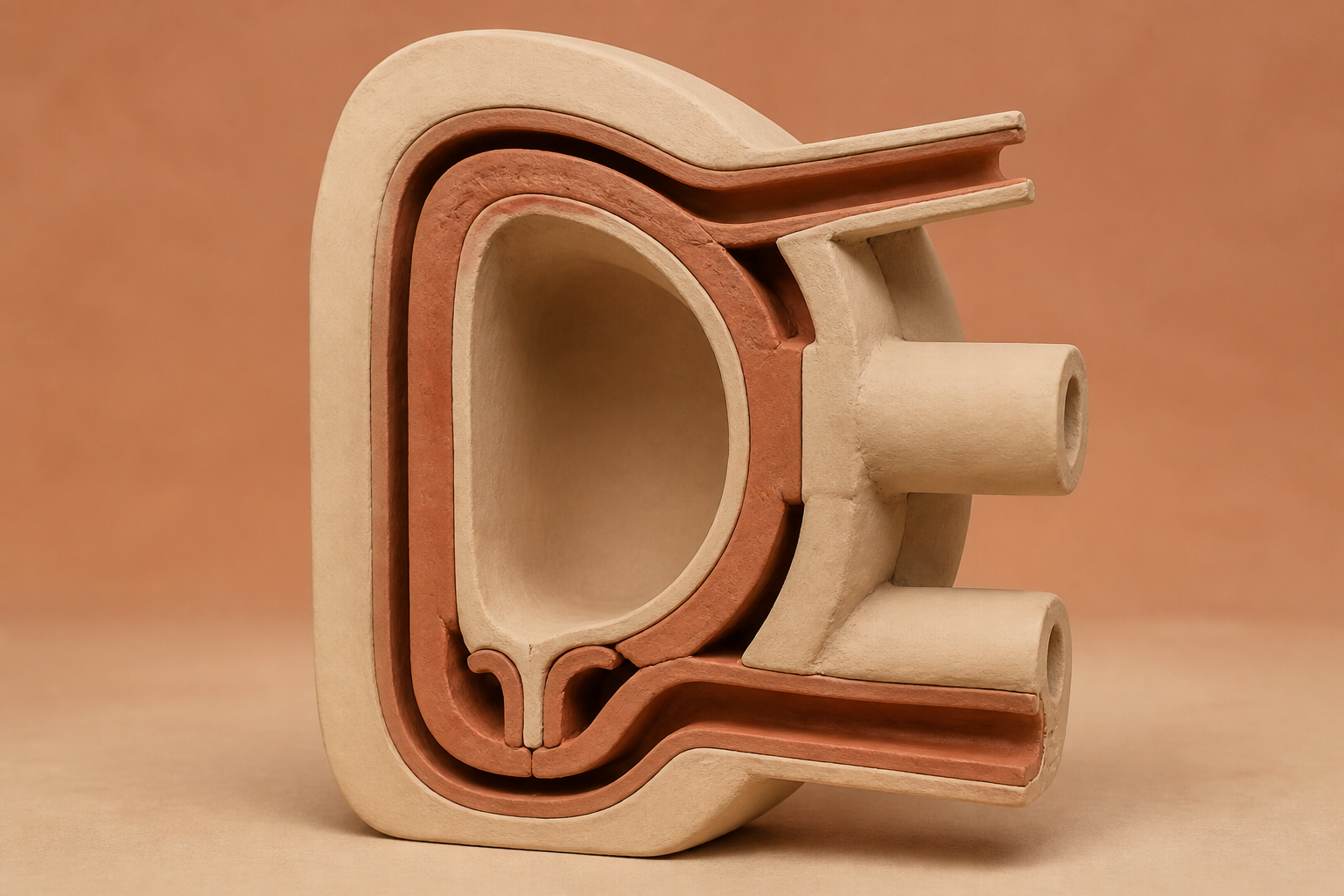
What changes in this design
Without more detail, someone might picture this kind of component as one simple layer with a single passage for fluid. That is a reader's starting assumption, not a fact about other fusion reactors.
Here, the blanket has outer and inner walls. Their front walls face different sides: one faces the fusion plasma and the other faces the opposite side. It also has separate outer and inner paths carrying identical fluid.
This gives a reader a concrete way to recognize the component: two walls and two fluid paths, rather than one undivided block. What effect this layout has during operation is not stated.
Twenty kilograms
Twenty kilograms is the number I kept coming back to. That is the estimated global tritium inventory, according to a recent industry account, and it shrinks by 5.5 percent each year as the isotope decays. The same account put the quoted price at $30,000 to $40,000 a gram. Fusion is often presented as an argument about getting a plasma hot enough. The quieter argument, I think, is harsher: where does tomorrow's fuel come from when today's supply is counted in tens of kilograms?
Tritium is the fuel problem behind the plasma headlines. A future plant is expected to replenish it by turning lithium into fresh tritium in material around the reactor. ITER, the international experiment testing blankets, says a future plant will have to breed all its own tritium. It also says large-scale production has not yet been demonstrated. That gap is why I read a newly published patent for pipes and walls with unusual care.
A blanket behind the plasma
On August 27, Kyoto Fusioneering's US application, US20260253751A1, appeared as Blanket For Fusion Reactor. Filed April 14, 2026, it traces back to a Japanese priority application from October 2023. Its target is not the plasma itself. It is the blanket, where the filing puts walls on the plasma-facing and opposite sides. That is where a future plant would need part of its fuel cycle. The filing doesn't strike me as proof this job has been solved. The filing is evidence, to me, of where engineering pressure has moved.
The application, to me, describes a component with an unforgiving task. It sits at the plasma-facing boundary while a fluid circulates through it. In a broader reactor design, such a component is meant to help make fuel, not merely contain hardware. ITER says full-scale tritium production has not yet been shown. A patent defines a component; testing must show whether a system can replenish what a working plant uses.
Two passages, one fluid
Here is the particular design I found. The patent claims outer and inner walls, each with a front wall, and two flow paths. A first fluid moves through the outer path; an identical second fluid moves through the inner path. It also claims a double discharge pipe in which the inner passage runs hotter. The document names silicon carbide for the walls and lithium liquid metal for the fluid.
That sounds modest. Still, it is a design for part of a fuel-making component, moving the same fluid through two routes and bringing it out at different temperatures. The description gives an inlet range of roughly 300-400 C and an inner-discharge range of roughly 900-1000 C. Those are proposed patent details, not measurements from a working fusion reactor. That distinction is one I hold firmly.
Three test sites
If the patent is a sketch of a passageway, I think the consequential story is whether anyone can run the whole circuit. Kyoto Fusioneering says UNITY-1 in Kyoto operates a liquid-metal loop validating heat-to-electricity hardware, but produces neither fusion reactions nor tritium. UNITY-2, in Chalk River, Canada, is intended to test an integrated fuel cycle in a tritium-licensed building. UNITY-3, planned with a US national laboratory in Oak Ridge, is designed to irradiate blanket designs with a fusion-relevant neutron source.
That sequencing makes sense to me. A patent can define a flow path; it cannot show that a blanket breeds enough tritium to keep a plant supplied. The industry account makes another constraint plain: breeding works at steady state, not for start-up. A machine needs an initial tritium supply before it can make more. There is no sensible way to wave that dependency away.
Where this leaves things
The mismatch I found between capital and proof was sharp. A trade group counted $9.766 billion in cumulative investment across 53 fusion companies by July 2025. Its members said they needed a median $700 million more each to reach a first pilot. Kyoto Fusioneering has raised substantial financing too. A 2024 extension included In-Q-Tel, the US intelligence community's investment arm, alongside a trading company and an electronics maker. Later funds are going toward test plants and a Canadian fuel-cycle venture. This is real industrial effort, not yet a self-sustaining tritium system.
The United States has chosen a byproduct-materials framework for fusion rather than fission-reactor rules. That lowers one uncertainty, not the physical one. US20260253751A1 is not evidence, in my reading, that fusion's fuel problem is near a solution. The application signals, to me, that the part most in need of proof may be behind the plasma: making tomorrow's fuel while a plant runs.
Sources
Reporting for this piece drew on the published filing and the references below.
- Blanket For Fusion Reactor - US20260253751A1
- ITER - Tritium Breeding
- Answering the big tritium question
- Kyoto Fusioneering - UNITY Program
- Kyoto Fusioneering Closes 2nd Round of 1.1 Billion Yen Series C Extension Led by In-Q-Tel
- Kyoto Fusioneering Raises 9.3 Billion Yen in Series C Extension and Debt Financing
- Over $2.5 Billion Invested in Fusion Industry in Past Year
- NRC Decision Separates Fusion Energy Regulation from Nuclear Fission
The record, briefly. US20260253751A1, “Blanket For Fusion Reactor” A blanket includes outer and inner walls with respective front walls facing a fusion plasma and the opposite side, plus outer and inner flow paths carrying a first fluid and an identical second fluid.
More angles on this
- CPC G21B: Fusion reactorsThe official classification family this record was filed into, published in the USPTO Cooperative Patent Classification scheme.
- A Reading Taken in the Ear, and the File It Has to ReachAnother reading from the wider G16H classification family, healthcare informatics.
- A Setting Is Not a Promise: Inspecting the HingeAnother reading in the same Machines category on this site.
Read around this one:Public patent recordUSPTO published figure