Objects
Coordinating Dual-Axis Alignment in Nuclear Fuel Grid Welding
South Korea's fuel fabricator is refining mechanical jigs for nuclear spacer grids, even as additive manufacturing and in-reactor wear challenge old assumptions.

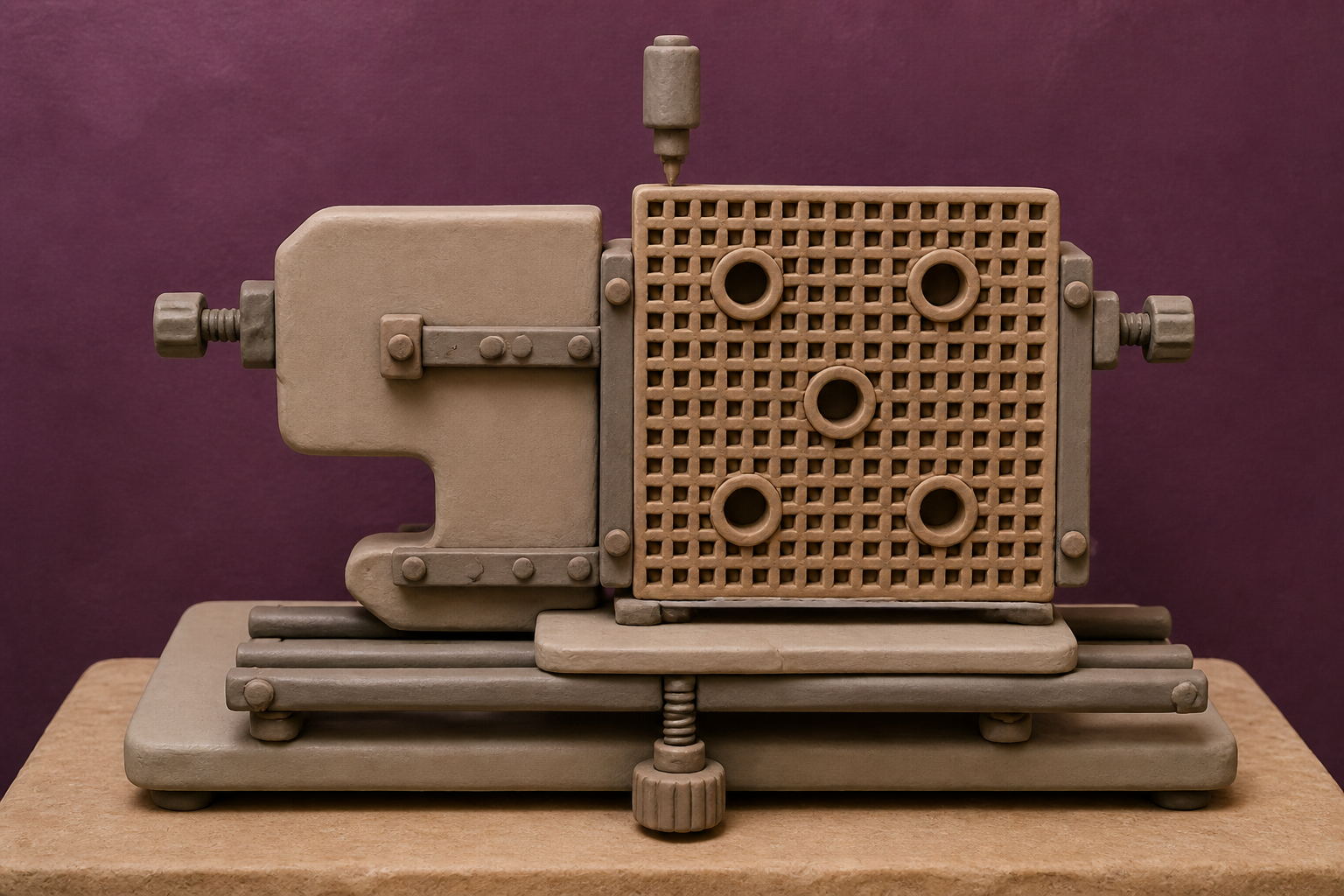
What changes in this design
A reader might expect a welding jig to lock a piece firmly in a single, unmoving position. Standard holders often require someone to unclamp, reposition, and reclamp a fragile part by hand whenever welding points shift.
The setup mounts the grid on a sliding platform flanked by end supports. Instead of taking the piece out to change alignment, built-in horizontal controls glide the platform left and right along parallel tracks, while a vertical control shifts the grid up and down.
Nuclear fuel components demand tight tolerances where even tiny misalignments can cause defects. Providing controlled dual-axis adjustment directly on the support frame makes it easier to line up delicate metal intersections accurately before applying each weld.
Fuel for Dukovany
In June 2025, South Korea finalized an $18.6 billion agreement to build two nuclear reactors in the Czech Republic, securing a ten-year fuel supply role for the new APR-1000 units at Dukovany. That export milestone followed a January 2025 intellectual property settlement with Westinghouse, clearing commercial boundaries that had constrained foreign bids. At home, commercial reactors have generated roughly one-third of the country's electricity since operations began at Kori 1 in 1978. Supplying those 26 domestic reactors takes an annual fabrication capacity of 700 tonnes of pressurized water reactor fuel and 400 tonnes of heavy water fuel. The work falls entirely to KEPCO Nuclear Fuel, a dedicated subsidiary founded in 1982 to localize fuel components for OPR-1000 and APR-1400 reactors.
Inside any light-water reactor core, the basic unit of order is the spacer grid. These grids are egg-crate structures built from thin, interlocking straps of zirconium alloy or Inconel. They provide lateral positioning for hundreds of fuel rods, maintaining precise coolant channels under high-pressure, turbulent flow. When our team looked through the manufacturing records, the surprise was how mechanical the assembly remains. Every single intersection of those thin metal straps must be aligned, held rigid, and spot-welded without distorting the surrounding channels.
A sliding plate on the bench
A recent patent application, published under US20260260771A1, shows how KEPCO Nuclear Fuel handles that alignment on the shop floor. The filing describes a specialized spot-welding fixture designed to hold a spacer grid steady while an automated or manual welding head joins the straps. The apparatus rests on a base plate fitted with a parallel guide member. A movable plate travels left and right along this guide, while a pair of fixing parts clamps the outer ends of the grid.
What we see in the filing is an attempt to squeeze out error with mechanical adjustments. Horizontal adjustment parts set the exact x-axis position of the sliding plate, while a vertical adjustment part dials in the y-axis height of the seated grid. I find it striking that assembling a component for an advanced nuclear reactor still depends on physical screws, sliding guide rails, and manual reference planes. Even a millimeter of warp across an assembly can pinch coolant channels or make fuel rods difficult to slide into place during bundle assembly.
Printing past the fixture
This focus on tighter clamping stands in sharp contrast to where core manufacturing research is heading elsewhere. In a 2019 report on additive manufacturing, researchers at a federal laboratory in Tennessee demonstrated how Laser Powder Bed Fusion could build complex core components and grids in one continuous run. By melting metal powder layer by layer, 3D printing bypasses sheet-metal stamping, multi-step mechanical fixturing, and strap-by-strap resistance welding entirely.
If we look past the factory floor, the environment inside the vessel tells a harsher story. Fluid dynamic studies published in 2021 and 2022 show that coolant racing past spacer grids generates intense secondary flows and turbulence at Reynolds numbers of 12,000. These vortexes create constant hydrodynamic vibration against every welded seam. The appeal of 3D printing is that it eliminates those seams altogether. Yet for high-volume commercial production lines, retooling an entire supply chain around powder-bed machines is enormously expensive, which explains why fabricators continue to refine their physical welding jigs instead.
Where the risk actually sits
The deeper question is whether pristine factory welds are enough to guarantee safety when things go wrong. Regulators at the Nuclear Regulatory Commission set strict design rules under NUREG-0800: allowable spacer grid crushing loads must be proven at the 95% confidence level to ensure a coolable core geometry and allow control rod insertion during combined earthquake and pipe-break accidents. For decades, safety cases relied on testing brand-new, unirradiated production grids at operating temperatures, operating on the assumption that beginning-of-life strength represents the true structural baseline.
That assumption began unraveling when the agency issued Information Notice 2012-09. The notice alerted plant operators that intense neutron fluence, grid spring relaxation, and metal corrosion degrade spacer grid crush strength across an assembly's operating life. My impression from the engineering data is that factory precision only protects the fuel during its first months in the vessel. Even the most flawless spot-welding fixture cannot prevent what in-reactor wear takes away, leaving the true structural risk far beyond the reach of our shop tools.
Sources
Reporting for this piece drew on the published filing and the references below.
- Spot-Welding Fixture For Spacer Grid Of Nuclear Fuel Assembly (US20260260771A1)
- NRC Information Notice 2012-09: Irradiation Effects on Fuel Assembly Spacer Grid Crush Strength
- NUREG-0800 Standard Review Plan Section 4.2: Fuel System Design (Revision 3)
- Nuclear Power in South Korea (World Nuclear Association)
- Korea Electric Power Corporation
- Nuclear Power in South Korea
- Nuclear Fuel
- Application of Laser Powder Bed Fusion for Transformational Challenge Reactor Core (ORNL/TM-2019/1323)
- Feasibility of full-core pin resolved CFD simulations of small modular reactor with momentum sources
- Experimental measurements of fluid flow in an 84-pin hexagonal rod bundle with spacer grid for a gas-cooled fast modular reactor
The record, briefly. US20260260771A1, “Spot-Welding Fixture For Spacer Grid Of Nuclear Fuel Assembly” A spot-welding fixture for a nuclear fuel assembly spacer grid includes a base plate, a parallel guide member, a movable plate that moves left and right along the guide member, and a pair of spacer grid fixing parts supporting the ends of the spacer grid. Horizontal adjustment parts adjust the x-axis position of the movable plate, and a vertical adjustment part adjusts the y-axis position of the spacer grid seated on the movable plate.
More angles on this
- Welding-Type Systems Using Fluid Sensors With Bond Resisting Substances Makes the Next Move Easier to SeeAnother reading from the same B23K classification family, soldering or unsoldering.
- CPC G21C: Nuclear reactorsThe official classification family this record was filed into, published in the USPTO Cooperative Patent Classification scheme.
- CPC B23K: Soldering or unsolderingThe official classification family this record was filed into, published in the USPTO Cooperative Patent Classification scheme.
- Audio-Based Modal Estimation Treats the Relationship as the PointAnother reading from the neighbouring B23Q classification family, details, components, or accessories for machine tools, e.g. arrangements for copying or controlling.
- When the Infusion Pump Audits Its Own MechanicAnother reading from the wider G16H classification family, healthcare informatics.
Read around this one:Public patent recordUSPTO published figure