Objects
Device And Method Of Virtual Reality Interaction Based On Bimanual Treats the Relationship as the Point
A KAIST patent turns bare-hand VR sketches into protein-design constraints, asking whether human intent is the scarce input.

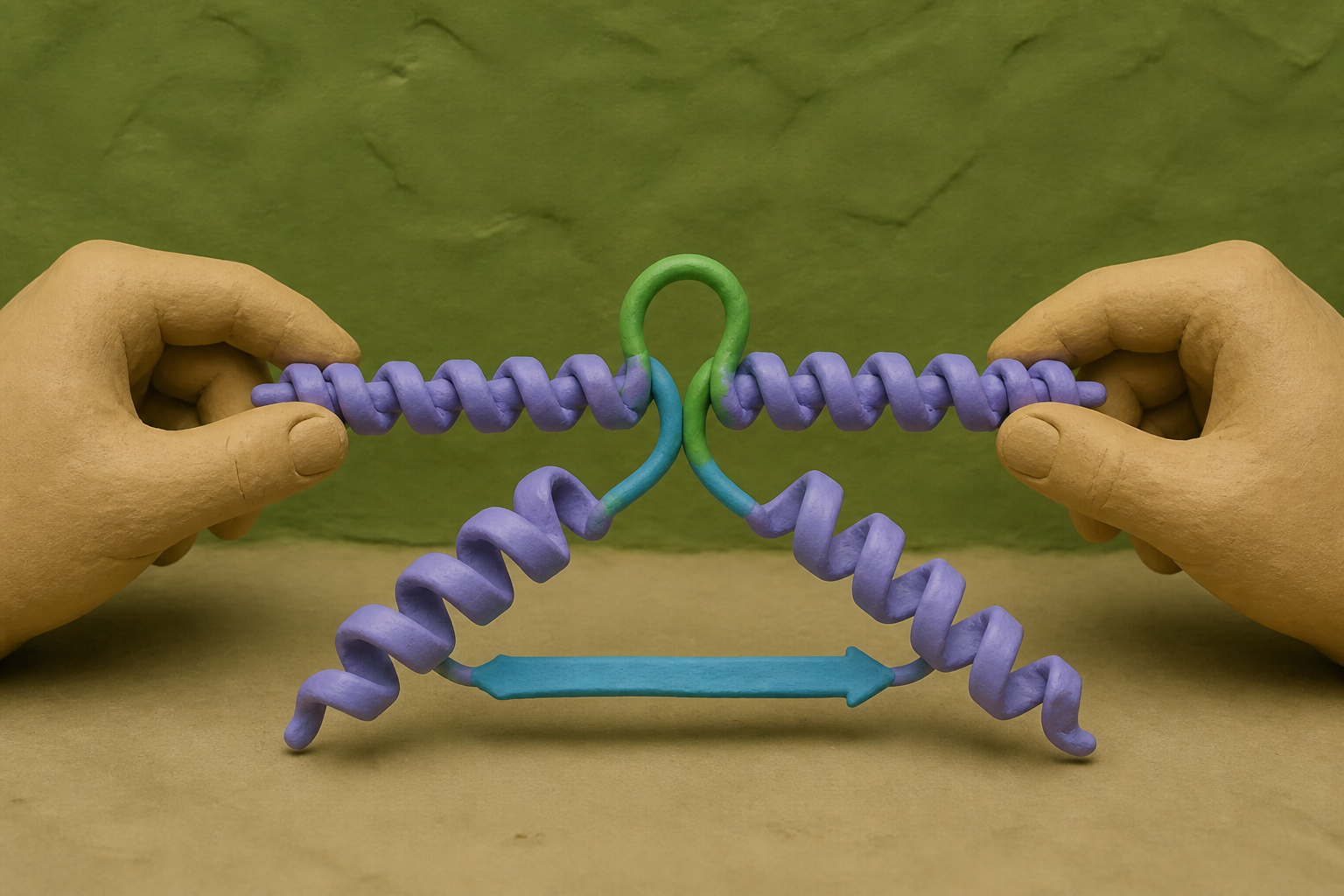
What changes in this design
Without this approach, a reader may simply think of a protein shape appearing in virtual space, without considering the person's two hands or an invisible guide line. How other systems handle the task is not stated.
Here, the person grips an invisible guide line with both hands in virtual reality. The device generates a protein shape along that line; grab, thumb-grab, and pinch are the gestures mentioned.
It gives a concrete picture of the interaction: hands hold a guide in virtual space, and a protein form is made along it. What it measures or how well it performs is not stated.
One crooked measurement
A crooked line on a flat molecular image was where I began. In a 2025 account, a biochemist described a 30-minute argument among PhDs because one measured distance looked longer than another but was shorter. Before virtual reality, getting a computational distance check could take a week. Inside a headset, the group measured it together.
That scene keeps drawing me back because it narrows the case for immersive molecular work. The virtue was not spectacle. It was the ability to settle one spatial fact while everyone could see the same object. That is a much smaller promise than remaking drug discovery, and a more useful one.
Ten thousand backbones
When I looked at the protein-design software behind this story, the scale changed my reading of the headset. RFdiffusion's published binder workflow generates about 10,000 backbones for a target, then screens roughly 20,000 designs with AlphaFold2. Its setup guide says a desktop installation can be done in under 30 minutes.
A shift in scarcity, not a verdict on quality, is what I read in those numbers. Generating candidate shapes is abundant enough to make a person's desired arrangement of helices, strands, and loops newly valuable. Another way to make limitless possibilities is not what we need. A way to state a particular idea clearly enough for the software to preserve it is what we need.
Three hand gestures
That is where I place US20260253678A1 in this story. Published on August 27, 2026, and assigned to the Korea Advanced Institute of Science and Technology, it describes a device that recognizes two hands gripping a virtual central axis and lays secondary protein structure along that axis. The options include an alpha-helix, beta strand, or loop.
The important detail is in the gesture vocabulary, I think. In the team's related ProteinSketch preprint, a cylinder grab is used for an alpha-helix, a thumb-grip for a beta-strand, and a pinch for a loop; those hand-made forms are passed to RFdiffusion as constraints. The filing is centered on that act of specification, rather than merely a headset view of an existing molecule.
KAIST's setting makes that focus less surprising to me. The lab behind the work sits in an industrial design department, where it describes sketching as a bridge between designer creativity and computational productivity, with synthetic protein among its target uses. The earliest Korean priority date is October 19, 2023; the same group presented bare-hand protein sketching at a human-computer interaction conference that month. These materials do not let me establish the order of those October events.
Soluble proteins
The hand motions are not where I would stop. The strongest support I found is the team's July 2026 preprint, which reports that 75 to 90 percent of its designed variants expressed as soluble, monodispersed proteins in E. coli. It also reports cryo-EM structures matching the intended designs at 0.7 to 2.4 angstrom RMSD.
That is a serious result to me, especially because the preprint reports a designed MD2 binder with a dissociation constant of 52.2 nM. But it is still a preprint from the same team that made the interface. It is, to me, an encouraging demonstration, not independent confirmation that this interface improves protein design for ordinary users.
The room with ten chemists
The useful contrast for me came from a LifeArc case study. It says chemists became comfortable building molecules in virtual reality after about 20 minutes, and that five to ten people joined real-time sessions from London to Lithuania. The work spanned at least five projects, including protein degradation, antimicrobial resistance, and cancer.
Yet I read that evidence as a story about viewing, measuring, and discussing molecules together, not authoring new protein backbones. That distinction is the heart of this filing. It asks a researcher to use their hands not just to inspect a structure, but to declare a structural wish that, in the reported implementation, downstream software turns into candidates.
Where the risk actually sits
A third dimension does not, I think, automatically make people better at molecular design. A controlled six-degree-of-freedom spacecraft-docking study found stereoscopic presentation improved learning efficiency briefly but produced no durable performance advantage. It was not a protein experiment, so I would not use it to dismiss this work. It is what I use to resist an easy conclusion.
For me, the risk sits in mistaking a fluent gesture for a validated molecule. A hand can express an intent; expression, structural agreement, and binding have to test it. That is why this filing interests me less as a headset patent than as a claim about where human judgment belongs after high-throughput design. The early results make that claim plausible. They do not settle it.
Sources
Reporting for this piece drew on the published filing and the references below.
- Device And Method Of Virtual Reality Interaction Based On Bimanual Gestures For Artificial Protein Backbone Design
- US Patent Application 2026/0253678 A1 - FreePatentsOnline record
- ProteinSketch translates spatial intuition into protein design with bimanual interaction in VR
- RFdiffusion
- Nanome V2.2 XR Measurement Tools case study
- Case Study: LifeArc and VR - How Medical Researchers Are Supercharging Drug Design with Meta Quest
- SketchLab, KAIST Department of Industrial Design
- Sketching Proteins with Bare Hands in VR
- Simulated manual spacecraft docking as a measure of operational performance
The record, briefly. US20260253678A1, “Device And Method Of Virtual Reality Interaction Based On Bimanual Gestures For Artificial Protein Backbone Design” A device detects a user's bimanual gesture gripping a virtual central axis and generates a corresponding protein secondary structure along that axis. The structure may include an alpha-helix, beta strand, or loop, using grab, thumb-grab, or pinch gestures.
More angles on this
- A Handoff Worth Watching: Fragment-Based Drug Design With an Assistant at the BenchAnother reading from the same G16B classification family, bioinformatics.
- Measurement And Analysis Method For Detecting And Quantifying Makes a Small Case for Better TimingAnother reading from the same G16B classification family, bioinformatics.
- CPC G16B: BioinformaticsThe official classification family this record was filed into, published in the USPTO Cooperative Patent Classification scheme.
- CPC G06F: Electric digital data processingThe official classification family this record was filed into, published in the USPTO Cooperative Patent Classification scheme.
- Methods For Treatment Of Thyroid Cancer Treats the Relationship as the PointAnother reading from the neighbouring G16H classification family, healthcare informatics.
Read around this one:Public patent recordUSPTO published figure