Field Notes
Directional Control Valve Treats the Relationship as the Point
Instead of replacing heavy excavator hydraulics with pricey digital systems, an engineered dip in a metal valve spool offers a cheaper way to satisfy clean air rules.

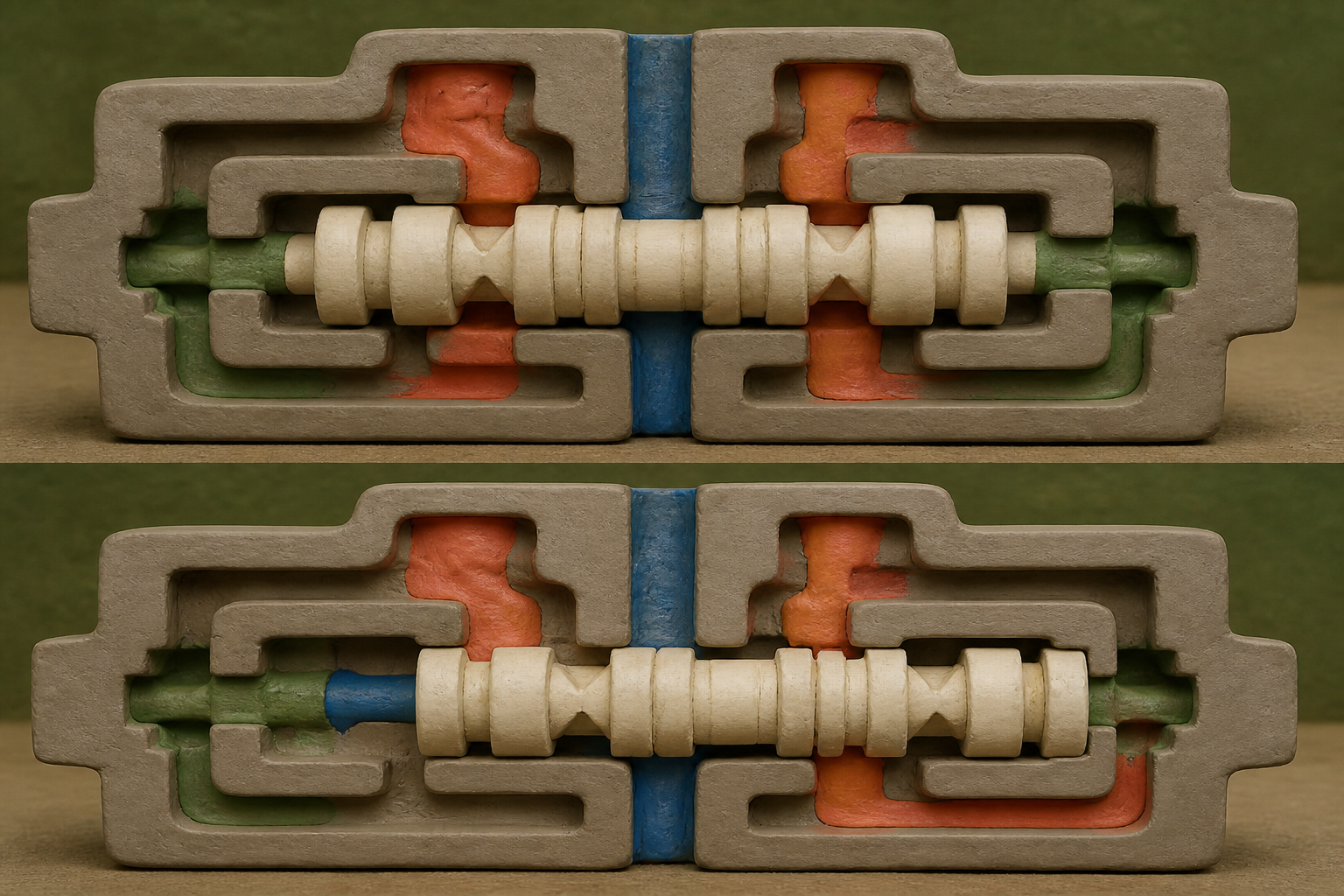
What changes in this design
When you shift a mechanical valve further along its path, you normally expect the fluid passageway to keep opening wider or remain at its maximum size.
Here, the sliding spool links one working line to the pump and another to the tank, but the opening leading to the pump hits its peak at a specific travel distance and then drops below that peak as the spool travels onward.
Such behavior reveals how physical movement can directly vary a pathway's size in both directions during a single stroke, rather than following a simple all-or-nothing flow.
The heat inside a twenty-ton arm
A twenty-four-ton excavator looks like pure mechanical muscle as it bites into hard earth, but more than half the energy supplied to its hydraulic fluid never reaches the bucket. When I look at a heavy excavator working a trench, the machine seems all brute force, but fluid friction tells a different story. Oil pressurized up to 34.3 megapascals rushes through valve channels, squeezing past narrow metal gaps that turn expensive diesel fuel straight into waste heat.
Most construction machinery relies on directional control valves to split flow between the boom, arm, bucket, and swing motors. In open-circuit systems using negative or positive flow control, or closed-center systems running at 40 megapascals, steel spools slide inside cast housings to open and close fluid passages. When an operator lowers a heavy boom, gravity drives the oil, but conventional throttling cannot capture that falling weight. It simply throttles the fluid, burning power and warming the hydraulic tank.
The squeeze from clean air mandates
Regulators have made that wasted heat an urgent problem. Under European Union Stage V rules set by Regulation (EU) 2016/1628, nonroad machinery faces strict caps on particulate matter and nitrogen oxides. Across the Atlantic, US EPA Tier 4 standards under the Clean Air Act apply similar pressure. Heavy equipment builders can no longer afford hydraulic systems that turn fifty percent of their engine output into hot oil.
Academic researchers and component makers have responded with high-tech overhauls. Test data on a 24-ton excavator duty cycle shows that switching to a digital multi-pressure rail architecture cuts fuel consumption by 52 percent. Other developers, collaborating with Bosch Rexroth, have tested throttle-less electric actuators that vary motor speed directly to control hydraulic cylinders. Our reading of the research papers shows why: replacing throttling valves with digital switching eliminates parasitic losses and lets machines recapture energy from over-running loads.
A carved notch in the steel
Those digital architectures require banks of high-speed switching valves, electric motors, and complex control software. For a global manufacturer like Kawasaki Heavy Industries, Ltd., which coordinates hydraulic production across roughly one hundred group companies, replacing every mechanical valve block is a massive industrial disruption. Their existing KMX series valves handle up to 550 liters of oil per minute, while their load-sensing KLSV line shares flow across nine sections with tight 1.5 megapascal margins. These cast-iron blocks are durable, well-understood, and comparatively cheap to build.
In patent application US20260258822A1, titled "Directional Control Valve," Kawasaki proposes an elegant mechanical compromise. The filing details a valve housing containing a pump passage, tank passage, supply and discharge passages, and an internal spool. When shifted away from neutral, the spool connects one port to the pump and another to the tank. But the geometry of the spool contains a deliberate twist. As the spool moves, the opening area connecting the pump to the work port expands to a maximum at a specific stroke distance - and then contracts below that maximum as the operator pushes the stroke further.
Letting metal geometry do the math
Standard directional valves open wider the further the spool shifts. That linear progression works well for single motions, but excavators frequently combine actions, such as swinging the cab while curling the arm. If one spool opens completely, it can starve another circuit of pressure or dump excess flow into the tank. Builders often add separate priority valves, confluence circuits, or electronic pilot controls to hold back that flow.
Kawasaki's design builds flow restriction directly into the spool's shape. At mid-stroke, the valve delivers peak flow for fast movement. At full stroke, the passage narrows slightly, raising backpressure or redirecting pump flow to secondary functions without needing an electronic command. What we see in the published record is a deliberate choice to let steel geometry do the math instead of software. I find this mechanical restraint striking because it balances fluid distribution without adding failure points.
Where the risk actually sits
My doubt is whether mechanical geometry can hold off electric actuation indefinitely. Carving a non-monotonic opening curve into a steel rod is brilliant manufacturing, but it remains a throttling valve. It manages flow by restricting it, meaning some portion of fluid power will always convert into wasted thermal energy. As hydrogen combustion engines and large battery packs enter construction sites, eliminating that parasitic drag becomes essential to preserving battery range and fuel storage.
Yet for excavators built right now, we can see why an equipment maker would choose this path. Redesigning an excavator around multi-rail hydraulics or individual electric motor drives demands new supply chains, higher bill-of-materials costs, and extensive software validation. A modified spool, by contrast, drops straight into existing machining lines and field-proven valve blocks. It buys time for the industry, squeezing another fraction of efficiency out of oil and steel before the digital electric era takes over completely.
Sources
Reporting for this piece drew on the published filing and the references below.
- Directional Control Valve
- Corporate Profile | Kawasaki Heavy Industries, Ltd.
- KMX series | Kawasaki Heavy Industries, Ltd.
- KLSV series | Kawasaki Heavy Industries, Ltd.
- Development of Hydrogen-Fueled, Highly Energy-Efficient, Electro-Hydraulic Excavator
- Precise Motion Control of Hybrid Hydraulic Electric Architecture (HHEA)
- Pressure feedback control of electro-hydraulic actuators using fixed displacement hydraulic machines
- Emission Standards: Europe: Nonroad Engines
- Emission Standards: USA: Nonroad Diesel Engines
- Regulations for Emissions from Nonroad Vehicles and Engines
The record, briefly. US20260258822A1, “Directional Control Valve” A directional control valve includes a housing with a spool hole, pump passage, tank passage, and supply/discharge passages, plus a spool in the spool hole. When shifted from neutral, the spool connects one supply/discharge passage to the pump and the other to the tank. Opening area to the pump reaches a maximum at a predetermined stroke and then falls below that maximum as stroke increases further.
More angles on this
- Fluid Pressure Circuit Treats the Relationship as the PointAnother reading from the same F15B classification family, systems acting by means of fluids in general.
- CPC F15B: Systems acting by means of fluids in generalThe official classification family this record was filed into, published in the USPTO Cooperative Patent Classification scheme.
- Inside systemAnother reading from the wider F26B classification family, drying solid materials or objects by removing liquid therefrom.
- Strut Channel Ratchet And Method Therefor Marks a Pause Worth NoticingAnother reading in the same Field Notes category on this site.
Read around this one:Public patent recordUSPTO published figure