Field Notes
Strut Channel Ratchet And Method Therefor Marks a Pause Worth Noticing
Tightening a bolt inside a steel strut channel has annoyed electricians for a century, and shaving two sides off a socket wrench might finally solve it.

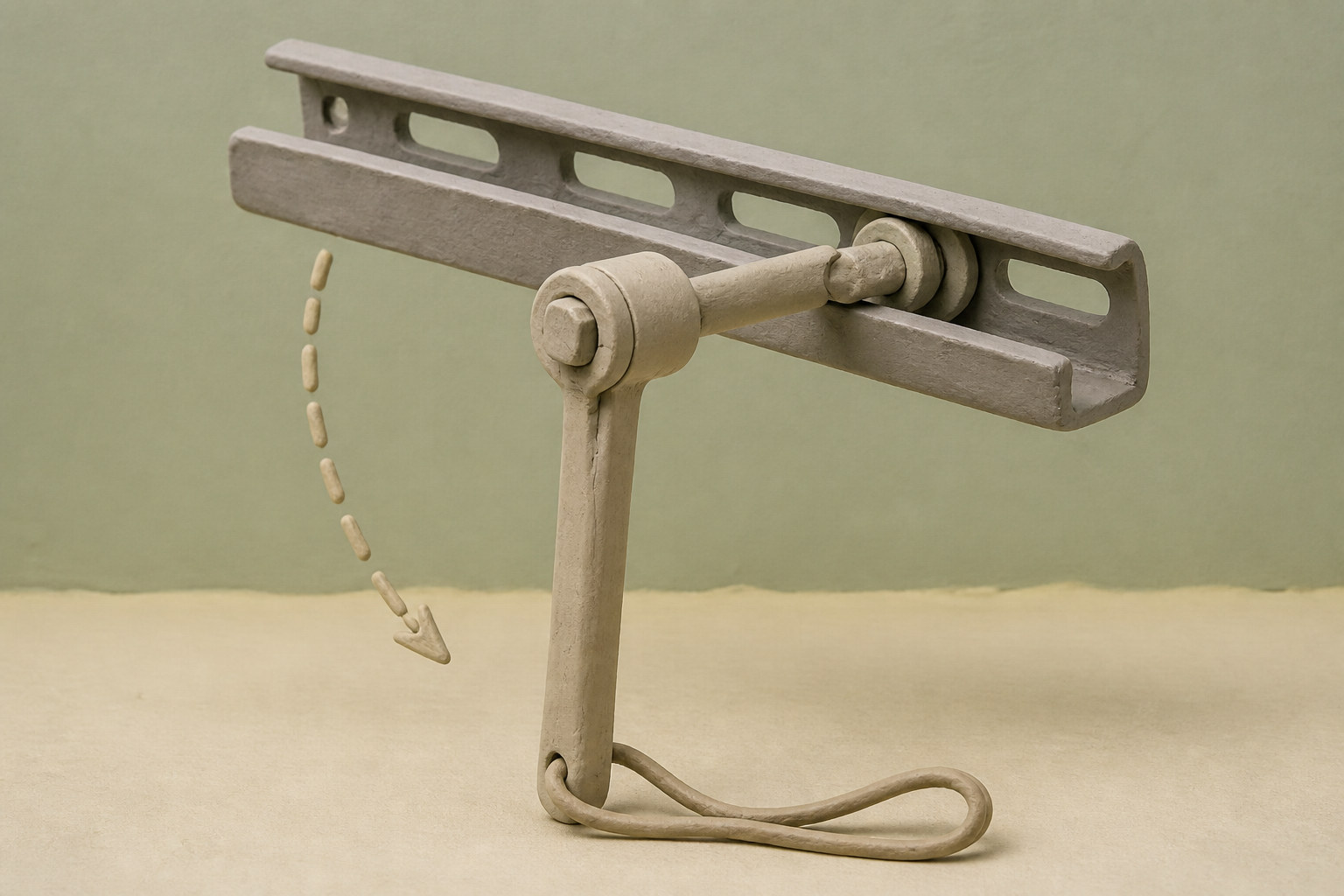
What changes in this design
Without the shape detail, a reader might picture a socket head that is simply round.
The socket head has two rounded sides and two flat sides. It is shaped for insertion into a strut-channel slot, while the socket engages a part that rotates.
That shape detail explains the point of the tool: it concerns both turning a fastening part and getting the socket head into a slot.
The seven-eighths inch gap
In 1924, Charles Attwood designed a simple steel channel with inward-curving lips, giving builders a modular track that could support pipes, wiring, and ductwork without field welding. A century later, standard channel profiles governed by the Metal Framing Manufacturers Association still measure 1-5/8 inches wide with a continuous slot opening of exactly 7/8 inch (22.2 mm). That opening is brilliant for sliding spring nuts into position. It is also an unrelenting nuisance for anyone trying to tighten them.
The number that caught my eye was seven-eighths of an inch. That narrow corridor leaves virtually no room for conventional tools to rotate. Under NFPA 70 guidelines, overhead electrical conduit runs require trapeze supports every 8 to 10 feet. In an industrial facility, an electrical crew hangs hundreds of these channel assemblies, each suspended from continuous threaded rods. Standard socket wrenches quickly bottom out against the long protruding studs, forcing workers to reach for slow open-end wrenches or specialized pass-through ratchets.
Richardson's square drive meets a modern track
I spent an afternoon looking at the history of socket drives to understand how we got stuck here. The basic interchangeable socket mechanism dates back to J.J. Richardson's 1863 patent. For over a century, standardized square drive sizes have anchored mechanical assembly. A standard cylindrical socket head works well on an open flange, but drop it into a metal framing channel and its circular outer wall immediately collides with the channel's inward lips.
When we look at overhead assemblies, the spatial clearance is brutally unforgiving. A solid-body ratchet cannot slip into the channel slot without jamming against the sides before it engages the nut. Pass-through ratchets helped solve the protruding stud issue, but their outer drive heads remain too bulky to turn cleanly inside the 7/8-inch slot. Electricians and mechanical installers end up trading proper torque for speed, using whatever narrow tool can squeeze into the gap.
Flattening two sides of the cylinder
This brings us to a recent patent application from Francisco Rangel, published under US20260257320A1. His proposed strut channel ratchet introduces a socket with a distinct profile: a shaft and head configured with two rounded sides and two flattened sides.
The geometry is straightforward. By shaving down opposing sides of the outer socket wall, the tool slips into the 7/8-inch slot with its flattened profile parallel to the channel lips. Once seated over the fastener, the ratchet mechanism drives the nut without the socket's outer body colliding with the steel framing track. It is a neat mechanical answer to a hundred-year-old clearance headache, aiming to turn an awkward hand-tightening job into a fluid ratcheting motion.
The ninety percent friction trap
Turning a fastener inside a steel track is not just about clearance, though. It is about friction. What puzzles our mechanical intuition is that roughly 90 percent of all applied tightening torque is swallowed by friction alone: 50 percent under the bolt head or nut face, and 40 percent in the thread mating surfaces. Dry assembly conditions introduce a preload variance of up to 35 percent.
If a modified socket does not sit perfectly perpendicular to the fastener, non-standard flattened walls risk galling and binding against the channel interior before the bolt achieves its required clamp load. Standard framing hardware demands real force: tightening specs call for 19 foot-pounds on 3/8-16 hardware and 50 foot-pounds on 1/2-13 bolts. Under ASME and ISO standards, torque tools maintain a tight 4 percent accuracy window. If a flattened socket head deforms or binds under that load, the fastener may feel tight to the worker while remaining dangerously loose beneath the surface. Federal OSHA standards under 29 CFR 1926.300 and 1910.242 hold employers liable for defective hand tools that slip or fail under load, making socket integrity a serious safety issue.
What would have to be true
For Rangel's dual-flat socket to earn a permanent spot in a commercial tool bag, several tough engineering conditions must line up.
We cannot simply take standard socket geometry, flatten its profile, and expect it to survive daily abuse on an MEP job site. Standard impact tools use ductile chrome molybdenum steel precisely because high-stress percussive loads cause brittle fractures in thinned metal walls. A flattened socket head has asymmetrical wall thickness, creating uneven stress concentrations that could crack under repeated impact driving. To succeed, the socket must maintain structural rigidity under high torque without widening its profile.
It would also need to satisfy electrical code demands. Under NEC Article 384, strut-type channel raceways carry circuits up to 600 volts, where structural fastening and grounding integrity are mandatory. In my view, if a custom socket profile cannot guarantee consistent clamping torque across thousands of joints without binding against the channel lips, contractors will keep their standard ratchets and leave the channel slots to open-end wrenches.
Sources
Reporting for this piece drew on the published filing and the references below.
- Strut Channel Ratchet And Method Therefor - Justia Patents
- Strut channel - Wikipedia
- Socket wrench - Wikipedia
- Bolted joint - Wikipedia
- Torque wrench - Wikipedia
- Impact wrench - Wikipedia
- Threaded rod - Wikipedia
- National Electrical Code - Wikipedia
- Electrical conduit - Wikipedia
- 29 CFR 1926.300 - General requirements for tools - OSHA
- 29 CFR 1910.242 - Hand and portable powered tools and equipment, general - OSHA
The record, briefly. US20260257320A1, “Strut Channel Ratchet And Method Therefor” A strut channel ratchet has a handle with a ratchet head and a socket configured to engage a rotatable fastening structure. The socket has a shaft and a head with two rounded and two flattened sides for insertion into a strut-channel slot.
More angles on this
- The Decision Inside a Pivoting Tool HeadAnother reading from the same B25B classification family, tools or bench devices not otherwise provided for, for fastening, connecting, disengaging, or holding.
- CPC B25B: Tools or bench devices not otherwise provided for, for fastening, connecting, disengaging, or holdingThe official classification family this record was filed into, published in the USPTO Cooperative Patent Classification scheme.
- CPC B25G: Handles for hand implementsThe official classification family this record was filed into, published in the USPTO Cooperative Patent Classification scheme.
- Audio-Based Modal Estimation Treats the Relationship as the PointAnother reading from the wider B23Q classification family, details, components, or accessories for machine tools, e.g. arrangements for copying or controlling.
- Inside electrode, capacitive element, capacitor, precursor material,Another reading in the same Field Notes category on this site.
Read around this one:Public patent recordUSPTO published figure