Field Notes
The Decision Inside a Pivoting Tool Head
Pivoting Head is the tool’s end section that can turn in relation to the handle instead of staying permanently aligned with it.

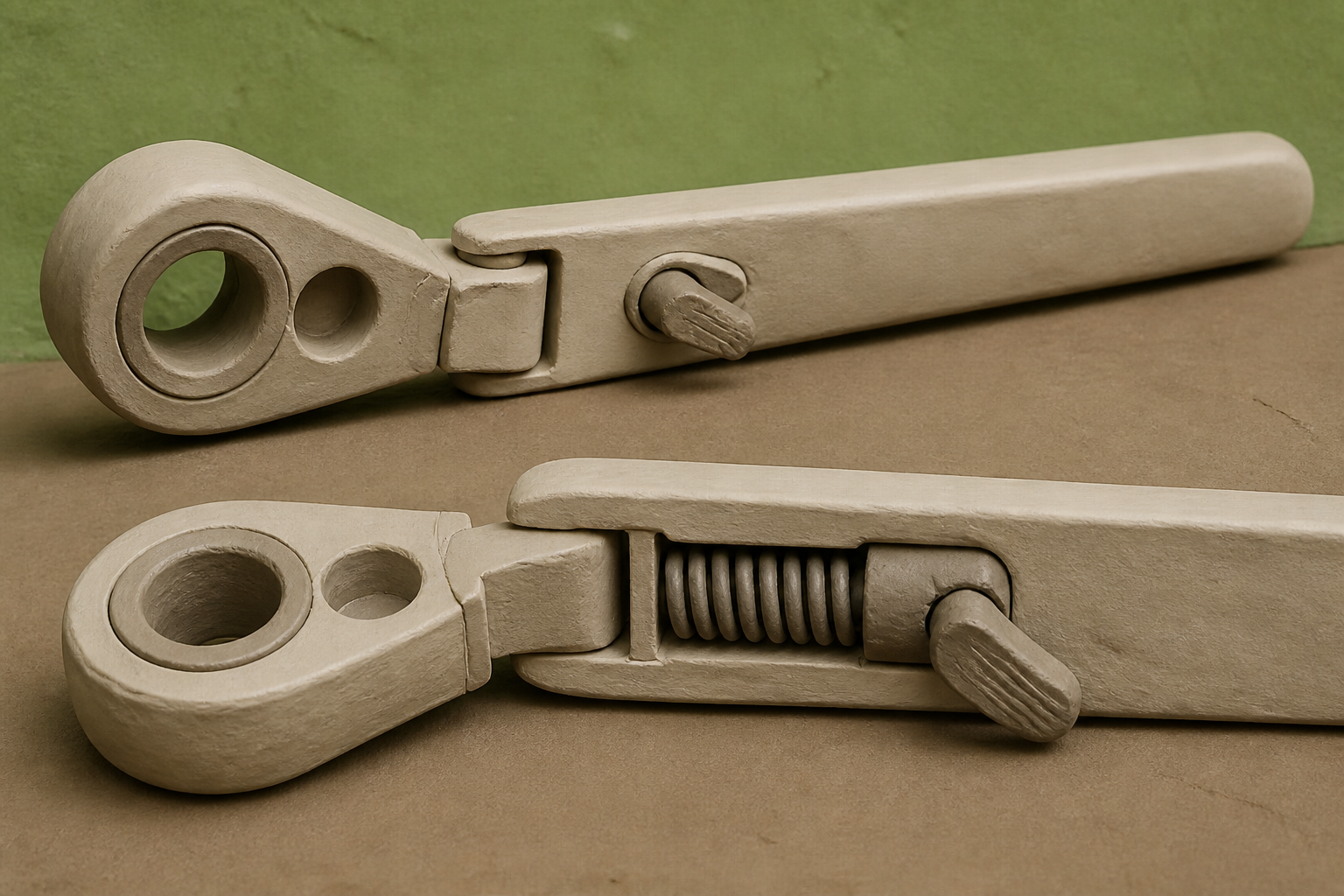
First, the setting
Many repair tasks happen in tight, awkward spaces: under a sink, beside an engine, or behind a machine. A person needs to turn a fastener, but a straight-handled tool can bump into nearby parts or leave too little room for a comfortable grip. Adjustable tools exist because real work rarely offers a clear path.
In a garage, workshop, or home repair corner, someone grips a handled tool and works around hoses, brackets, or cabinet walls. The working end is angled toward a nut or bolt while the handle sits where the person's hand can move. Small shifts of the head change how the tool fits among surrounding parts.
What changes in this design
Without a pivoting end, a reader would expect a tool's head and handle to stay in one fixed relationship.
Here, the head can be repositioned relative to the handle, then securely locked at a chosen angle.
That matters because the chosen angle can be held in place. What work setting or task it serves is not stated.
A Head That Holds Its Angle
A ratchet wrench head settles at a chosen angle, and a locking mechanism holds it there for the next turn. That is the practical picture behind US20260257318A1, Tool With Pivoting Portion And Locking Mechanism, published September 3, 2026: a tool with a head that can pivot, or move relative to its handle, and a lock that lets a user securely hold that head at a selected angular position. Angular position simply means the chosen angle of the head relative to the handle. The purpose is not movement for its own sake; the filing describes repositioning the head relative to the handle and then making that choice secure. I noticed how much of the idea lives in the word then. The head's change of position makes a possibility, while the lock gives that possibility a decided place. That sequence makes the opening picture feel less like a moving part seeking attention and more like an ordinary task waiting for a clear instruction.
How the Lock Marks a Choice
That order leads to the mechanism worth dwelling on. A pivoting portion is the part that changes its angle, while the locking mechanism is the part that allows a user to secure the selected angle. In everyday language, one component creates a range of possible positions and the other records the moment one of them becomes the position to keep. The stated relationship is not adjustment treated as an isolated trick. It is adjustment coupled with a decision. The locking mechanism behaves as if a restrained committee had finally agreed where the head should wait. That small distinction turned me from the image of a moving joint to the signal inside the arrangement: the user selects, and the mechanism makes the selection hold.
Once that signal is visible, the contrast becomes clearer. A vague handoff would describe a head that can be repositioned, then leave the decisive next step somewhere between the moving part and the user's intention. Here, the described arrangement instead joins the pivoting head to a mechanism for securely locking a selected angular position. The arrangement is less like a vague handoff and more like a stage manager marking the next position. That comparison is intentionally modest. No claim about feel, results, or superiority is needed to see why movement followed by locking deserves attention. The decision is not an afterthought pasted onto the pivot. It is the point where uncertainty about position receives a named, physical answer.
From that contrast come two observations you can transfer outside a tool. First, an adjustable system becomes easier to understand when it separates the act of changing from the act of choosing; a dial, a layout, or a plan can offer many states without making every state equally settled. Second, a useful signal tells you not merely that something moved, but that a chosen condition is now the one the system will keep. A selected angle has the air of a label-maker's neat decision, rather than a shrug left on the workbench. The filing stays close to the tool, yet its arrangement points toward a broader systems question: where does variation end and commitment begin? I think that question is worth carrying forward because it asks you to notice the precise step at which flexibility becomes an instruction.
Questions for Comparable Arrangements
That broader question also gives you a calm way to approach a comparable published record. Look first for the relationship of parts and steps: what changes, who selects, and what, if anything, makes the selected condition hold. Then ask whether the description provides a signal as clear as the one here, rather than merely presenting adjustability as a loose possibility. This is not a verdict about comparative results or an invitation to infer them. It is a reading habit: identify the moment at which an open set of positions turns into a condition the arrangement is meant to retain. In this filing, that moment is the locking of the pivoting head at the selected angular position.
The payoff is mainly clarity. A pivoting head can sound like a general invitation to movement until the locking mechanism puts a boundary around a particular angle, and that boundary makes the purpose legible without asking you to infer more than the published record states. What made me look twice was the quiet discipline of that sequence: reposition, select, secure. It is a small lantern on a short signal trail, enough to show what to inspect next without pretending the whole workshop has been mapped. When you meet another adjustable design, can you point to the moment when a possible position becomes the chosen one?
The record, briefly. US20260257318A1, “Tool With Pivoting Portion And Locking Mechanism” A tool with a pivoting head includes a locking mechanism that lets a user securely lock the head at a selected angular position and may be used with tools such as ratchet wrenches to reposition the head relative to the handle.
More angles on this
- CPC B25B: Tools or bench devices not otherwise provided for, for fastening, connecting, disengaging, or holdingThe official classification family this record was filed into, published in the USPTO Cooperative Patent Classification scheme.
- CPC B25G: Handles for hand implementsThe official classification family this record was filed into, published in the USPTO Cooperative Patent Classification scheme.
- Inside electrode, capacitive element, capacitor, precursor material,Another reading from the wider B22F classification family, working metallic powder.
- Method For Producing Microparticles And Colloidal Solution Makes a Small Case for Better TimingAnother reading in the same Field Notes category on this site.
Read around this one:Public patent recordUSPTO published figure