Field Notes
Inside electrode, capacitive element, capacitor, precursor material,
A new capacitor-electrode patent lands as AI data centers strain the old foil supply, reopening a costly argument about capacitance, strength and voltage.

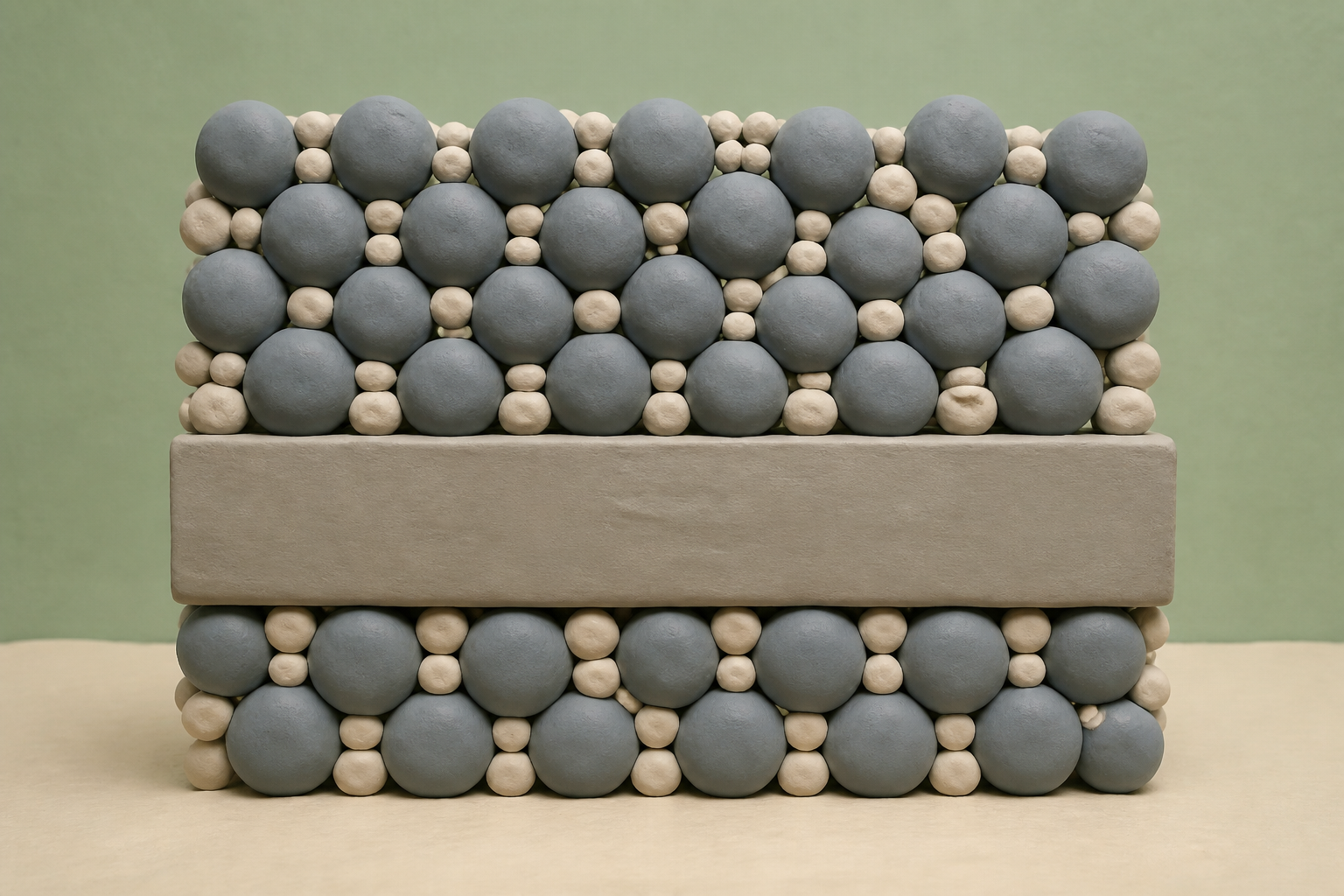
What changes in this design
The record does not say how electrodes are ordinarily made or what particle mix a reader should otherwise expect. It identifies an electrode with a sintered portion.
Its sintered portion is made by mixing a first and second group of particles made from a valve metal or a boron-group metal. The first group has a smaller average particle size.
This gives the reader a concrete way to picture the electrode’s construction: it combines two particle groups rather than referring to particles as one undifferentiated mass. Any resulting advantage is not stated.
The $420 million failure
In 2005, a large computer maker spent roughly $420 million replacing and shipping failed components after a notorious run of bad aluminum electrolytic capacitors. That 1999-2007 episode was tied to a defective electrolyte formula, which could generate gas and leave capacitors ruptured or dead far earlier than expected. Such a small cylinder on a circuit board had become an expensive systems problem.
Reliability is why I started here. These components may be cheap, but their failure can take down a power supply, a motherboard, or an entire batch of machines. Materials choices inside these components deserve more attention than they usually get.
Sixty tons of foil
Aluminum electrolytics are still in the contest. One capacitor maker notes that one part can cover from 1 microfarad to 10,000 microfarads, while ceramic multilayer capacitors can lose capacitance under DC bias. That remains a practical reason to keep electrolytics close to power-hungry equipment.
In return, the technology asks a great deal of aluminum foil. One industry analysis puts anode foil at 99.95% to 99.9998% purity and says that 100 metric tons of electronic foil may yield only about 60 metric tons of usable etched foil. Losing material before a capacitor is even made changed my sense of this patent. Another market analysis identifies fewer than 10 etched-foil suppliers, mainly in Japan and China, as a supply risk. Reported 2026 price rises of 10% to 15% on some aluminum-electrolytic lines, amid AI-server demand, make that constraint feel immediate. Market reports aren't forecasts, so I don't treat them as such, but the bottleneck is hard to dismiss.
Two sizes of powder
Against that pressure, TDK Electronics AG filed US20260257272A1 on January 28, 2026, claiming German priority from January 29, 2025. Published on September 3, the application describes a sintered electrode portion made from two groups of particles. Both groups comprise a valve metal or a boron-group metal, but the first group's average particle size is smaller than the second's.
Its background returns to a very physical production problem: winding capacitor coils. Rigid foil can crack under bending, local gas generation, or micro sparks; the exposed aluminum can then increase leakage current. Manufacturers respond with lower winding tension and slower winding speeds. Factory-floor detail is, I find, more persuasive than any broad promise of better components. This application sits in a sintered, etch-free aluminum-electrode approach that could reduce dependence on the acid-etched foil supply chain, though its public record does not show factory-scale results for this particular particle mix.
A 2008 porous sheet
This route isn't new. Toyo Aluminum's 2008 application, later granted as US9142359B2, claimed a porous sintered aluminum or aluminum-alloy electrode that could match or exceed etched-foil capacitance for medium- and high-voltage capacitors while eliminating hydrochloric-acid etching.
History matters because a granted patent is not proof that a manufacturing problem has disappeared. In my view, the earlier claim is not evidence of broad commercial success, and the published sources do not supply production volumes for either approach. TDK's particle-size arrangement may prove legally or technically distinct, but it enters an eighteen-year effort to make sintered foil work where etched foil has remained entrenched.
Voltage at the edge
Peer-reviewed comparison of sintered and etched aluminum foils supplies the caution missing from any simple progress story. Sintered foil achieved significantly higher specific capacitance because of its loose, high-surface-area oxide structure. Yet it also showed weaker voltage-withstand behavior than etched foil, whose denser crystalline oxide layer spreads electric fields more effectively at high voltage.
This isn't a minor footnote. TDK is addressing brittleness and winding speed, while the research shows that capacitance and mechanical handling do not settle the whole engineering question. Calling sintering a replacement before voltage endurance is measured would make me wary. Nothing supplied establishes whether the two-particle formulation changes that weakness.
Where this leaves things
This is a timely patent because it addresses a real production choke point at a moment when demand is pressing on capacitor materials and pricing. Its importance lies less in a claim that sintering has suddenly won than in the insistence that etched foil is still expensive, wasteful, and difficult to handle.
To my mind, the better way to read the filing is as a serious move in an unfinished trade-off. Higher capacitance and less fragile winding material would be valuable, but not if the cost is unacceptable voltage behavior. We should judge this one by the measurements that are still absent from the published application: endurance at voltage, leakage after winding, manufacturing yield, and whether the finer-and-coarser particle mix changes the balance rather than merely moving it.
Sources
Reporting for this piece drew on the published filing and the references below.
- TDK Electronics
- Capacitor plague
- Electrolytic Capacitors Replacing MLCC's
- Aluminum Electrolytic Capacitors Market
- AI Data Centers Push Aluminium Capacitor Prices Higher
- Brief Analysis of High-Purity Aluminum Standards and the Electrode Foil Industry Chain
- Mechanistic Study on Electrical Performance Differences Between Sintered and Etched Foils in Aluminum Electrolytic Capacitors
- US9142359B2 - Electrode material for aluminum electrolytic capacitor and process for producing the electrode material
The record, briefly. US20260257272A1, “Electrode, Capacitive Element, Capacitor, Precursor Material, Process Of Producing A Precursor Material, Process Of Producing An Electrode” An electrode includes a sintered portion made from mixed first and second particle groups comprising a valve metal or a boron-group metal. The first group's average particle size is smaller than the second group's.
More angles on this
- CPC B22F: Working metallic powderThe official classification family this record was filed into, published in the USPTO Cooperative Patent Classification scheme.
- CPC H01G: CapacitorsThe official classification family this record was filed into, published in the USPTO Cooperative Patent Classification scheme.
- What a Steelmaking Sequence Leaves for JudgmentAnother reading from the neighbouring B22D classification family, casting of metals; casting of other substances by the same processes or devices.
- The Moment a Remediation System Hands OffAnother reading from the wider B09C classification family, reclamation of contaminated soil.
- When a Bottle Stops Leaving Thick Liquid to LuckAnother reading in the same Field Notes category on this site.
Read around this one:Public patent recordUSPTO published figure