Field Notes
When a Bottle Stops Leaving Thick Liquid to Luck
A solo inventor's bottle filing joins a long effort to get the last product out, where good ideas often fail to become products.

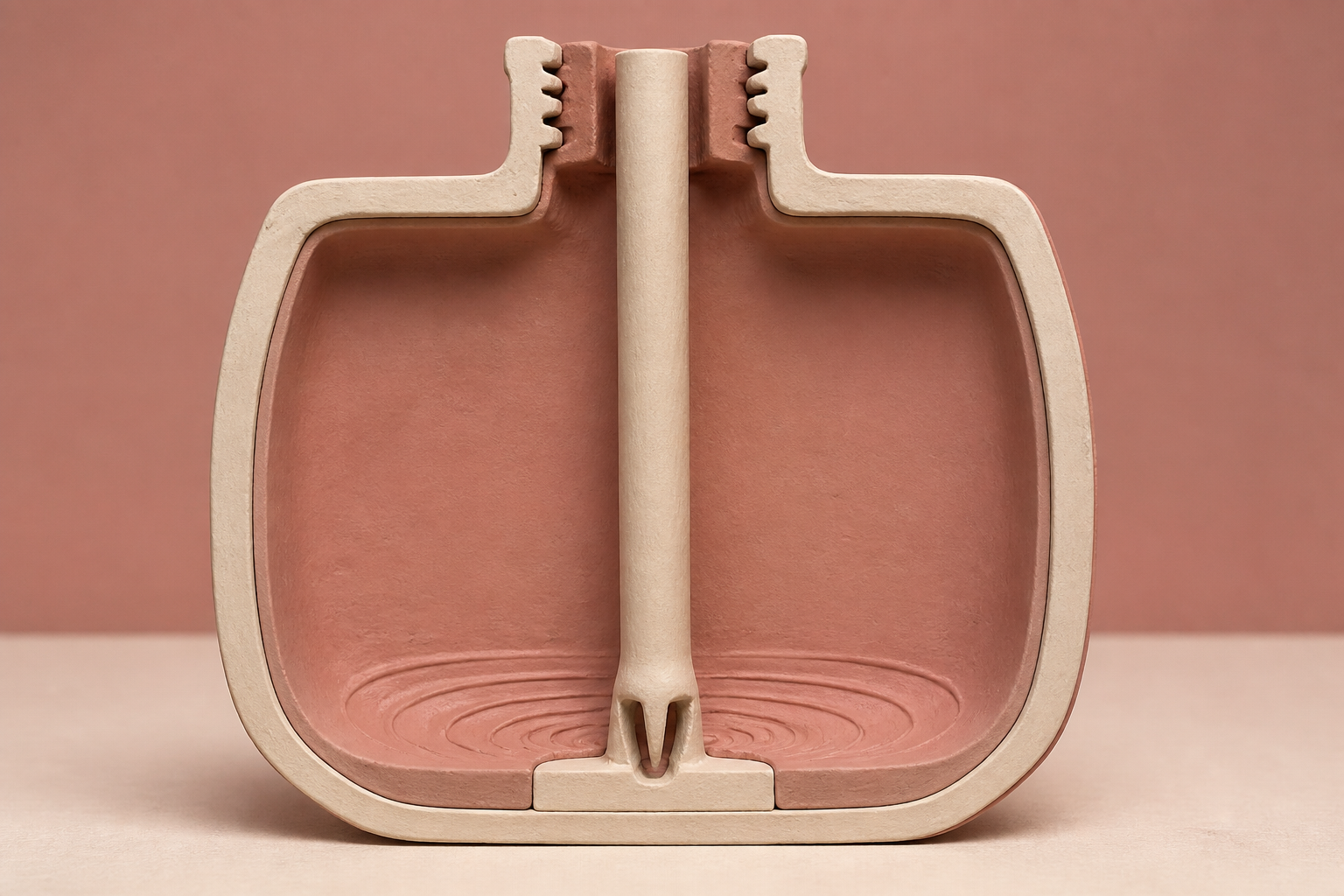
What changes in this design
A reader might expect a bottle to rely on a standard pickup path, with thick lotion or shampoo reaching it only from the direction where the liquid happens to sit.
Here, the bottle includes an outer wall, a fluorosilicone-coated inner wall, a semicircular bottom, and a rigid straw with V-shaped openings. Those openings allow liquid to enter from more than one direction.
Thick lotions and shampoos can be difficult to extract from a bottle. This page shows that the inner wall, bottom shape, and straw openings are all included in addressing that everyday problem.
An upside-down bottle
Eighty-four percent of more than 1,000 consumers in a 2014 survey said they had stored a bottle upside-down to chase the last bit of product. That is a lot of bathroom cabinets organized around a small annoyance. Seventy-four percent said they would switch body-lotion brands for packaging that wasted less. The survey responses suggest that the irritation is not limited to thrift. When people invert a bottle, they are adapting their routines to packaging that has stopped working before its contents are gone.
A product designer quoted in a local news report put the residue in pump bottles as high as 25%, compared with 2% to 10% in tubes, jars, and squeeze bottles. Whether those estimates hold for every lotion, pump, climate, and user, I do not know. They do establish that a stubborn film of product is not a trivial complaint. The comparison also helps explain why the issue persists: a pump offers convenience while it works, but its form can make the remaining product harder to reach than it is in simpler containers.
Shiro Ando's three fixes
On September 3, a published U.S. patent application arrived from Shiro Ando of Reading, Massachusetts. Ando is listed as both applicant and sole inventor; the cover sheet lists no assignee and no attorney or agent. Filed February 28, 2025, it is an application, not a granted patent. Its publication shows that the proposal has entered the patent record, but it does not show that it has been examined favorably, manufactured, or tested with consumers.
Ando's proposed bottle combines an outer wall with a fluorosilicone-coated inner wall described as FDA-approved, a semicircular bottom, and a rigid straw with V-shaped openings for multidirectional liquid entry. Together, shape and straw address how thick material reaches the pickup point. The semicircular bottom is part of the same practical problem as the straw: product needs somewhere to gather before the straw can draw it up. What I find telling is that the coating is only one part of the proposed answer. Ando appears to treat residue as a problem of both surface adhesion and bottle geometry, rather than assuming one slippery material will solve every part of it.
The FDA wording deserves caution. FDA says it has no legal authority to approve cosmetics before they reach the market, except for color additives. That does not settle the regulatory status of a bottle coating, but it means I would not repeat "FDA-approved" as an independently established fact. The application may accurately describe a particular material or regulatory basis, but the phrase alone does not explain what FDA action, if any, applies to the coating in this use.
The slipperier rival
In 2012, researchers at MIT introduced LiquiGlide, a food-safe slippery coating intended to make viscous foods such as ketchup and mayonnaise leave their containers more completely. Its answer to trapped product was to change the surface the product touched, not the bottle's bottom or its pickup tube. That difference matters because it frames Ando's filing as a combined approach, with the coating working alongside a design meant to collect and access what remains.
By 2017, LiquiGlide had reported $25 million in total equity financing and commercial partners. Coating technology can attract money and customers, but the relevant question for this bottle is whether its particular combination removes more product in ordinary use than a good coating alone. The comparison is useful precisely because both approaches begin with the same visible frustration, while proposing different places to intervene: at the container surface, at the bottom of the bottle, or at the point where a pump draws material in.
Two lapsed predecessors
Individual inventors have been filing variations on this problem for decades. Keith Vogrin filed for a pyramidal viscous-liquid bottle with a bottom-corner valve in 1994; the patent was granted in 1997 and lapsed in 2001 after maintenance fees went unpaid. Elizabeth Train filed in 2000 for a conical insert that separated thick condiment material from thinner liquid near a bottle neck; that patent expired in 2016 after unpaid maintenance fees. Their designs differed from Ando's, but each treated the flow of a thick product as a packaging problem that might be solved through a particular internal or external shape.
Those legal endings do not prove either design failed in stores. One maintenance-fee lapse can't establish commercial failure, and neither should it for a reader. Yet, the narrower pattern remains revealing: getting thick liquid out of a container has repeatedly seemed patentable to solo inventors, while turning that insight into a maintained, lasting product is much harder. A patent can describe a solution clearly enough to be granted without answering whether customers will prefer the object, whether it can be made economically, or whether it improves the everyday experience enough to displace familiar packaging.
What would have to be true
For Ando's bottle to matter beyond publication, it would have to extract meaningfully more shampoo or lotion than familiar pumps and squeeze bottles under repeatable conditions. It would also need to do that without introducing a new inconvenience in dispensing, cleaning, manufacturing, or ordinary handling. The relevant comparison is not only whether some residue remains, but whether the proposed design improves on what people already accept from bottles that are cheap, familiar, and easy to use. I cannot determine those outcomes from a published application.
This filing identifies a real consumer problem and proposes a concrete mechanical response. My hesitation is about the gap between a plausible bottle and a better one. The coating language needs a precise regulatory basis, the shaped bottom and straw need comparative testing, and the full design needs a route into actual products. Until then, this is best understood as the newest attempt in a long campaign against the last drop.
Sources
Reporting for this piece drew on the published filing and the references below.
- US 2026/0257234 A1 - Dispensing Bottle for Efficient Extraction of High-Viscosity Liquids
- Mechanical engineering's condiment-bottle coating gives waste the slip
- LiquiGlide raises $16 million to get every last drop out of packages or tanks
- The Hidden Cost of Residual Product Waste
- Cosmetics Q&A: Why are cosmetics not FDA-approved?
- US5636767A - Easy dispensing bottle for viscous liquids
- US6689279B1 - Device for separating and dispensing high viscosity fluid from low viscosity fluids
- LiquiGlide Survey Reveals Just How Much Consumers Hate Waste
The record, briefly. US20260257234A1, “Dispensing Bottle For Efficient Extraction Of High-Viscosity Liquids” A liquid dispensing bottle for high-viscosity lotions and shampoos has an outer wall, FDA-approved fluorosilicone-coated inner wall, semicircular bottom, and rigid V-shaped straw openings for multidirectional liquid entry.
More angles on this
- Apparatus, System And Method For Coordinated Fluid Dispersal Marks a Pause Worth NoticingAnother reading from the same B05B classification family, spraying apparatus; atomising apparatus; nozzles.
- Liquid Dispensing System With Internal Recirculation Makes a Small Case for Better TimingAnother reading from the same B05B classification family, spraying apparatus; atomising apparatus; nozzles.
- CPC B05B: Spraying apparatus; atomising apparatus; nozzlesThe official classification family this record was filed into, published in the USPTO Cooperative Patent Classification scheme.
- Corner Paint Roller Questions the Default ArrangementAnother reading from the neighbouring B05C classification family, apparatus for applying fluent materials to surfaces, in general.
- Before the Chemical Spreads, the Drum DecidesAnother reading from the wider B09B classification family, disposal of solid waste not otherwise provided for.
Read around this one:Public patent recordUSPTO published figure