Machines
Liquid Dispensing System With Internal Recirculation Makes a Small Case for Better Timing
A new recirculating electrostatic nozzle joins a 49-year effort to make droplets land better, even where electric fields still refuse to cooperate.

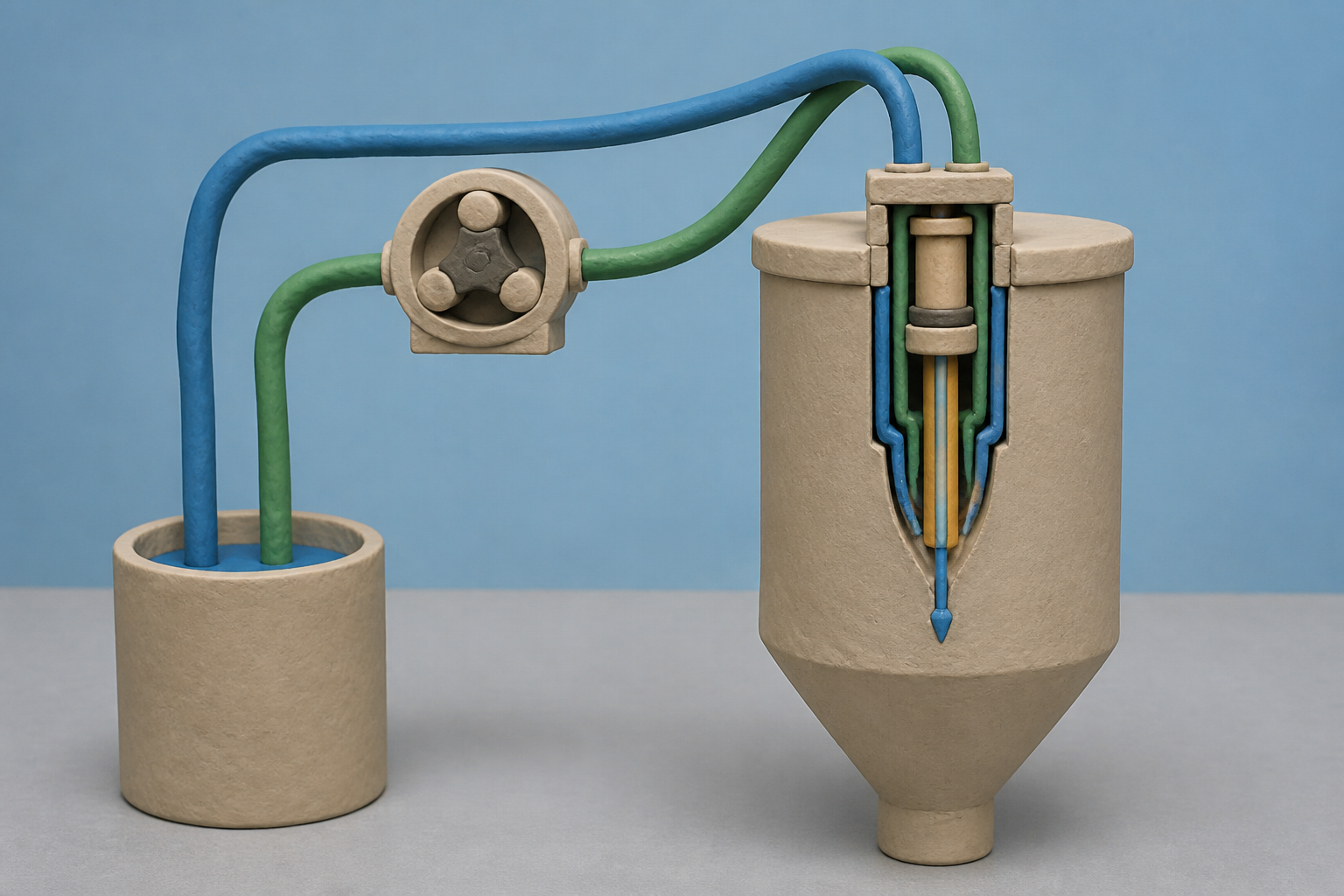
What changes in this design
A reader might picture a spray nozzle as a one-way path: liquid comes in, then leaves as a spray.
Here, liquid has both a delivery tube and a return tube. A piston can allow or block its flow, while an atomizing gas tube and charged internal components are part of the nozzle.
This is more than a spray tip alone. It brings together parts that manage liquid flow within the nozzle, with timing as its stated focus.
Twenty percent on the leaves
In 1977, inventor S. Edward Law described a discouraging agricultural-spraying result: only about 20% of the applied chemical reached target plants. The rest did not simply disappear from the farmer's calculation. It became drift, waste, cost, or somebody else's problem. Law's low-voltage induction-charged nozzle offered a different proposition: give droplets an electrical charge and let a grounded plant pull more of them in. The number makes me understand why this technology kept finding new homes. It frames spraying as a placement problem, not simply a matter of producing more liquid or more pressure. A University of Georgia account says the resulting patents let farmers use 50% less chemical for equal pest control, and eventually earned nearly $1 million in royalties before expiring. That comparison gives the original result a commercial consequence: if equal control requires less chemical, efficiency is not an abstract laboratory gain. It changes the value of every droplet that would otherwise miss.
Forty-micron droplets in orbit
The idea traveled well because a charged droplet does not care whether its target is a leaf, a painted panel, or a surface needing disinfection. Law's work later appeared in spray-tan franchises, food-surface sanitizing, and COVID-era disinfection equipment. NASA's Kennedy Space Center built an electrostatic mister for watering plants on the International Space Station, where ordinary watering is awkward in microgravity. Its version made charged droplets about 40 microns across, with Law serving as a consultant. The move from a farm field to orbit makes the point especially clearly: the setting changes, but the need to control where liquid goes remains. What catches my attention is not the novelty of any one use, but the persistence of the underlying bargain: use charge to place liquid more deliberately, then find a commercial setting where that precision matters enough to pay for the machinery.
A valve inside the nozzle
That history leads to a much less glamorous problem: what happens to fluid before it leaves the nozzle. Spraying Systems Co. received US11,285,498 in 2022 for an electrostatic spray-drying nozzle assembly with piston or valve control, an atomizing-gas passage, and an internally charged flow path. Its patent described multistage charging that could support liquid flows up to 125 kg/hr, compared with under 10 kg/hr for older external-mix nozzles. A continuation, US12,290,829, issued in May 2025. The contrast in stated flow capacity helps explain why internal handling matters. Once a system is meant to move substantially more liquid, control of that liquid inside the assembly becomes part of the claimed engineering problem, rather than a detail that can be left outside the nozzle. I cannot establish from the published material that the new application belongs to that same patent family, and it would be wrong to imply that it does. But the mechanical resemblance is unusually close: internal electrical charging, gas-assisted atomization, valve control, and fluid that is managed within the assembly rather than treated as a one-way stream.
Corners that won't take paint
Electrostatic spraying has never been a universal answer to coverage. The Faraday cage effect gives the limitation a plain physical explanation: charged particles tend toward the nearest grounded surface, leaving inside corners, recesses, and hole bottoms under-coated. That gap matters to me because it changes how to read every improvement around the nozzle. Better plumbing may reduce wasted fluid, ease a color change, or make a system more controllable. It does not repeal the field geometry that makes a recess difficult. In other words, a more carefully managed spray can still encounter the same difficult destination. The safety burden is serious as well. Industry guidance on NFPA 33 notes that powder coatings can have minimum ignition energies of 3 to 20 millijoules and calls for grounding, separation against sparking, and automatic high-voltage shutdown when ventilation or a conveyor stops. A charged internal system is therefore an engineering convenience nested inside an electrical hazard.
What the filing is really betting on
US20260257233A1, titled “Liquid Dispensing System With Internal Recirculation,” describes an electrostatic nozzle assembly with delivery and return tubes, a piston assembly that selectively permits or blocks fluid flow, an atomizing-gas tube, and electrically charged internal flow-directing components. The word “internal” leaves me with the strongest impression: the application is betting that better command of the liquid inside the device can improve what happens outside it. That is a sensible, bounded bet. Recirculation and selective flow control address the expensive practical moments when fluid must be held, redirected, or kept moving, while atomizing gas and charged components preserve the familiar electrostatic approach at the exit. The filing's apparent ambition is therefore operational as much as electrostatic: to make the path to the spray more deliberate before the droplets confront the target. We should resist treating it as a new answer to where droplets can go. It is an attempt to make a very old answer behave better between the reservoir and the spray, while corners and recesses remain stubborn evidence that the larger problem is not solved.
Sources
Reporting for this piece drew on the published filing and the references below.
- US4004733A - Electrostatic spray nozzle system
- From agriculture to COVID disinfection, technology developed at UGA continues to serve
- Spraying for Food Safety
- US11285498B2 - Electrostatic spray drying nozzle assembly
- US12290829B2 - Electrostatic spray drying nozzle assembly
- Faraday Cage Effect
- Improving Spray Booth Fire Safety Using NFPA 33
- US20260257233A1 - Liquid Dispensing System With Internal Recirculation
The record, briefly. US20260257233A1, “Liquid Dispensing System With Internal Recirculation” An electrostatic spray nozzle assembly has fluid delivery and return tubes, a piston assembly that selectively permits or blocks fluid flow, an atomizing gas tube, and electrically charged internal flow-directing components.
More angles on this
- The Fan Blade Learns a Reversible TrickAnother reading from the same B05B classification family, spraying apparatus; atomising apparatus; nozzles.
- CPC B05B: Spraying apparatus; atomising apparatus; nozzlesThe official classification family this record was filed into, published in the USPTO Cooperative Patent Classification scheme.
- CPC F26B: Drying solid materials or objects by removing liquid therefromThe official classification family this record was filed into, published in the USPTO Cooperative Patent Classification scheme.
- A Membrane, Two Outlets, and the Difference Between Setting and PromiseAnother reading from the wider B01D classification family, separation.
- Centrifugal Microfluidic Analysis Chip Marks a Pause Worth NoticingAnother reading in the same Machines category on this site.
Read around this one:Public patent recordUSPTO published figure