Field Notes
Method For Producing Microparticles And Colloidal Solution Makes a Small Case for Better Timing
A new US laser-particle filing exposes an old industrial problem: can purer metal particles escape milligram-per-hour chemistry?

What changes in this design
The record does not identify a standard way of making metal-containing microparticles, so no ordinary process is established for comparison.
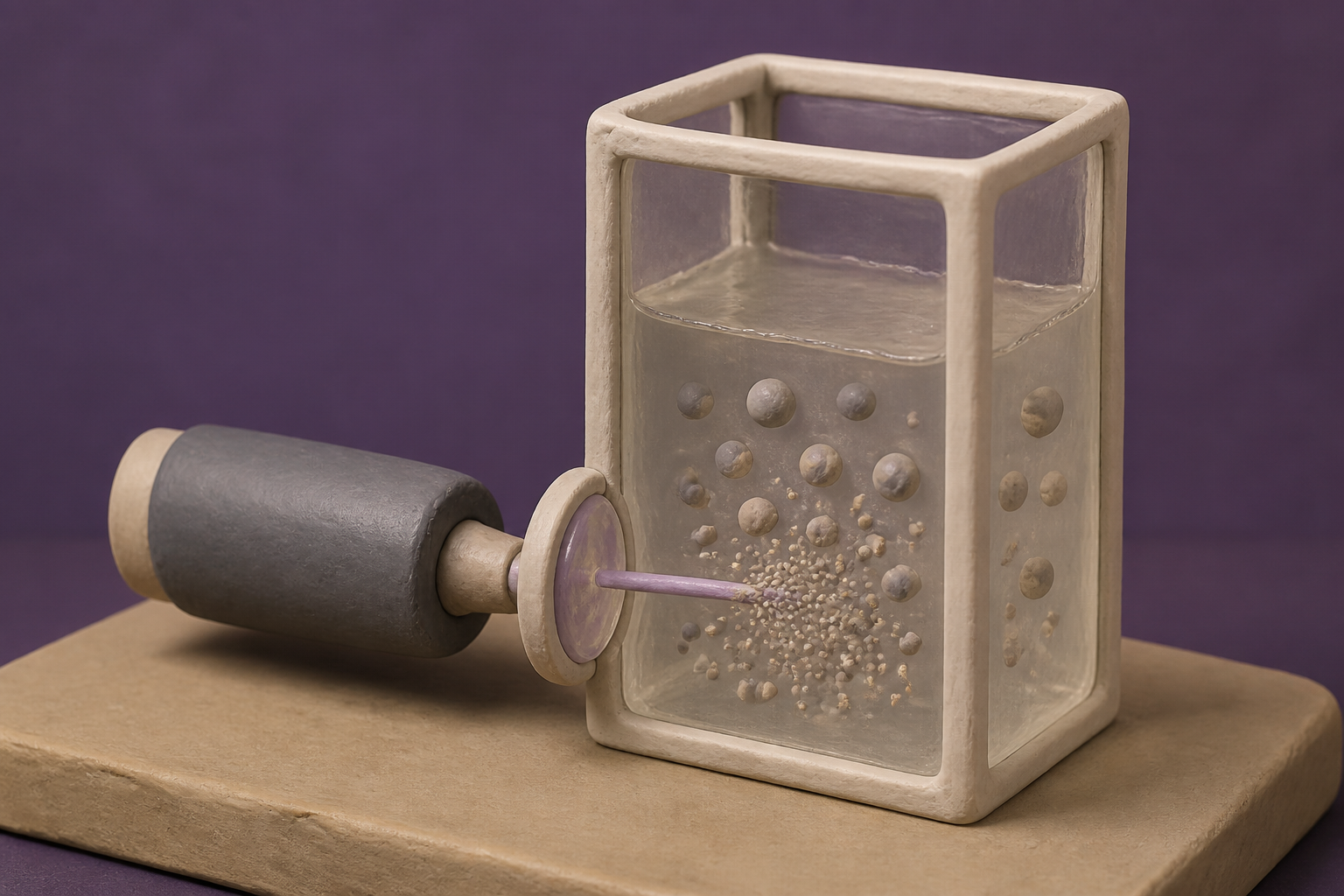
Instead, it calls for placing metal-containing powder in a solvent and irradiating it with femtosecond laser pulses, extraordinarily brief flashes of laser light. This generates metal-containing microparticles. It also says two metal-containing powders may be used to form an alloy microparticle.
This is worth knowing because it gives a clear picture of the stated approach: powder, liquid, and extremely brief laser pulses lead to tiny metal-containing particles. It also notes that using two metal-containing powders may form an alloy microparticle.
A tonne and 160 milligrams
Since January 1, 2020, a company manufacturing or importing one tonne or more of a nanoform into Europe has needed a dedicated registration with characterization and safety data. That threshold is regulatory, not a production target, but it gives scale a hard and useful number.
The number that stays with me is 160 milligrams per hour. In a March 2025 paper, illuminus researchers reported that their laser-induced reduction process for gold began at 1 mg/h, reached 20 mg/h after optical changes, and reached 160 mg/h only after adding radical scavengers and increasing metal-ion concentration. That is a serious laboratory gain, but it is not evidence that the process is nearing tonne-scale production. The paper makes me cautious about clean-manufacturing claims that leave output in the margin.
Powder under a pulse
US20260257275A1, published September 3, 2026, enters that gap with a different starting material. Rather than reduce dissolved metal ions, it irradiates metal-containing powder suspended in a solvent with femtosecond laser pulses, described at roughly 100 femtoseconds and 800 nanometres. The intended result is metal-containing microparticles smaller than the powder they began as.
The application says this powder route is meant to suppress impurities associated with ion-reduction methods. It also describes using two metal-containing powders to form an alloy microparticle. That choice matters, because it separates this work from illuminus's reported ion-reduction throughput figures. It does not, however, establish impurity-free production or industrial-scale alloy output. What I can see is a different materials strategy, not yet a demonstrated factory process.
An older laboratory move
Calling the central move new would overstate it. A 2006 patent from researchers at a Kyoto university already claimed using a femtosecond laser on suspended metal-containing powder to split it into nanowires and then nanoparticles. The wider field reaches back to laser work in liquids reported in 1993, and now includes laser ablation, fragmentation, and melting in liquids. The lineage is long.
That earlier patent does not decide the legal fate of this application. Patent claims can differ in the particulars that matter, and I would not infer validity from a family resemblance. But the history makes it difficult, in my view, to treat this filing as a newly discovered route to laser-made particles.
The US application is also a later member of a family with a May 2, 2022 priority date and a European publication in March 2025. illuminus, a 2023 university spinoff, presents ion reduction and pulsed-laser ablation in liquids as separate technical lanes and says it has a distinct patent-pending alloy approach. That broader work makes the filing one experiment in a continuing program, not the whole program.
Where the laser loses its energy
The obstacle is not only age or throughput. A December 2025 single-particle study of gold microparticle fragmentation found that 83% of absorbed laser energy went into forming a cavitation bubble, while about 1% became surface energy in the newly formed nanoparticles. Fragmenting existing particles was still far more efficient than ablating a solid target, but the loss is stark.
That experiment was not a measurement of this patent's exact setup, and I do not treat it as a verdict on its performance. It does show why the field's scale problem has resisted tidy answers. A 2026 review describes traditional yields as milligrams per hour, with only recent flow-cell and high-repetition systems reaching grams per hour, while identifying productivity and laser-system cost as major barriers.
Commercial interest is not new either. Particular GmbH was reported commercializing laser-ablation-in-liquid nanoparticle production in 2010. The existence of that earlier business proves neither that this route failed nor that it scaled comfortably. It simply removes the easy story that a laser in a liquid is an untouched commercial frontier.
What the filing is really betting on
Mitsubishi Materials invested in illuminus in 2024 to co-develop lower-environmental-impact metal and alloy nanoparticle manufacturing, with the larger materials company supplying source materials. That makes the wager concrete: a powder-fed laser process may offer enough control over purity and composition to justify solving its formidable production economics.
To my eye, the application is best read as a bet that a different feedstock can trade one difficult problem for another. Moving away from dissolved ions may reduce a source of impurities. It does not make the energy losses, laser costs, or throughput limits disappear. Until this approach shows output and particle quality together at a meaningful scale, the most important result is not a smaller particle. It is whether the process can cross the long distance from a careful liquid-filled cell to the volumes the industrial world actually recognizes.
Sources
Reporting for this piece drew on the published filing and the references below.
- US20260257275A1 - Method For Producing Microparticles And Colloidal Solution
- illuminus Inc. technology overview
- Investment in illuminus, a Developer of Advanced Nanoparticle Technology
- Effect of additives on the synthesis efficiency of nanoparticles by laser-induced reduction
- Laser-material interactions in liquids for the synthesis of nanomaterials: current status and perspectives
- Microparticle laser fragmentation in liquids: mechanisms, energetics, and efficiency
- Startup uses lasers to produce pure nanoparticles
- EU REACH Nanomaterial Registration & Notification: Key Insights
The record, briefly. US20260257275A1, “Method For Producing Microparticles And Colloidal Solution” A method irradiates a powder material in a solvent with femtosecond laser pulses to generate metal-containing microparticles. The powder has a larger mid-diameter and contains the metal; two metal-containing powders may form an alloy microparticle.
More angles on this
- CPC B22F: Working metallic powderThe official classification family this record was filed into, published in the USPTO Cooperative Patent Classification scheme.
- What a Steelmaking Sequence Leaves for JudgmentAnother reading from the neighbouring B22D classification family, casting of metals; casting of other substances by the same processes or devices.
- Inside protective film, methodAnother reading from the wider B05D classification family, processes for applying fluent materials to surfaces, in general.
- Corner Paint Roller Questions the Default ArrangementAnother reading in the same Field Notes category on this site.
Read around this one:Public patent recordUSPTO published figure